If you have any questions, you are always welcome to contact us. We'll get back to you as soon as possible, withing 24 hours on weekdays.
Customer service
All questions about your order, return and delivery must be sent to our customer service team by e-mail at yourstore@yourdomain.com
Sale & Press
If you are interested in selling our products, need more information about our brand or wish to make a collaboration, please contact us at press@yourdomain.com
Help
If you have any questions, you are always welcome to contact us. We'll get back to you as soon as possible, withing 24 hours on weekdays.
Customer service
All questions about your order, return and delivery must be sent to our customer service team by e-mail at yourstore@yourdomain.com
Sale & Press
If you are interested in selling our products, need more information about our brand or wish to make a collaboration, please contact us at press@yourdomain.com
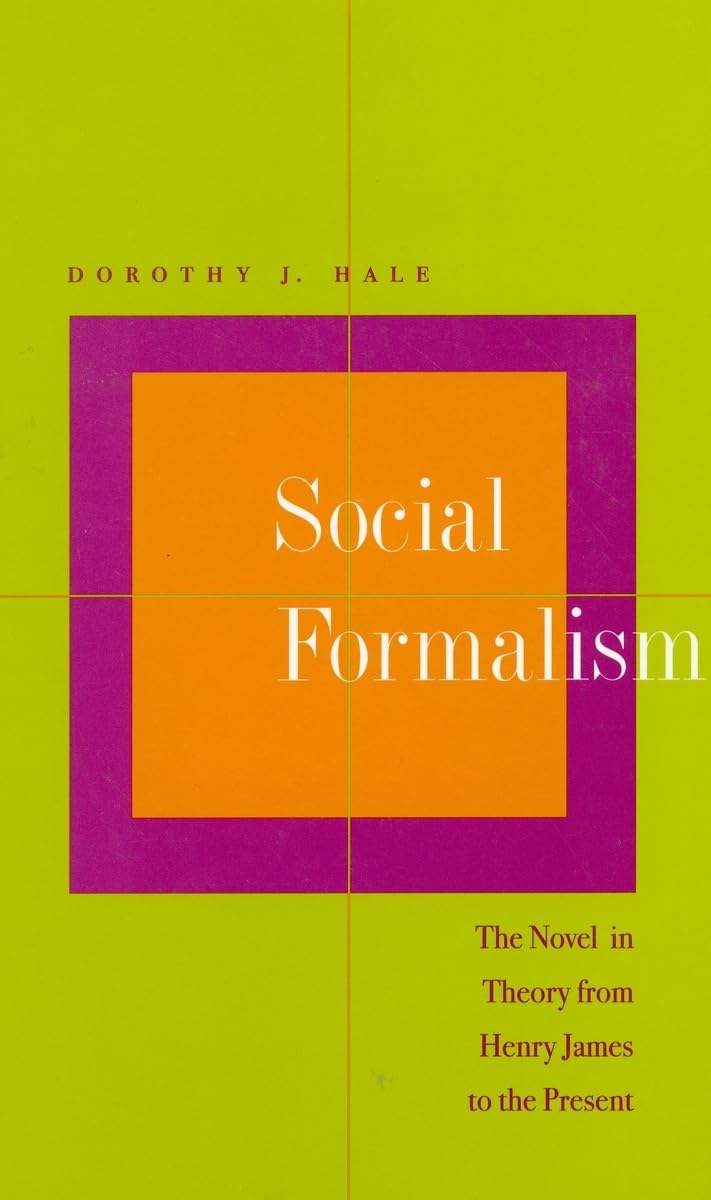
In recent decades, literary critics have praised novel theory for abandoning its formalist roots and defining the novel as a vehicle of social discourse. The old school of novel theory has long been associated with Henry James; the new school allies itself with the Russian theorist Mikhail Bakhtin. In this book, the author argues that actually it was the compatibility of Bakhtin with James that prompted AngloAmerican theorists to embrace Bakhtin with such enthusiasm. Far from rejecting James, in other words, recent novel theorists have only refined James's foundational recharacterization of the novel as the genre that does not simply represent identity through its content but actually instantiates it through its form.Social Formalism demonstrates the persistence of James's theoretical assumptions from his writings and those of his disciple Percy Lubbock through the critique of Jamesian theory by Roland Barthes, Wayne Booth, and Grard Genette to the current AngloAmerican assimilation of Bakhtin. It also traces the expansion of James's influence, as mediated by Bakhtin, into cultural and literary theory. Jamesian social formalism is shown to help determine the widely influential theories of minority identity expounded by such important cultural critics as Barbara Johnson and Henry Louis Gates. Social Formalism thus explains why a tradition that began by defining novelistic value as the formal instantiation of identity ends by defining minority political empowerment as aestheticized selfrepresentation.
⚠️ WARNING (California Proposition 65):
This product may contain chemicals known to the State of California to cause cancer,
birth defects, or other reproductive harm.
For MAP (Minimum Advertised Price) violations and Intellectual Property (IP) or Trademark concerns, please contact:
support@ergodebooks.com
⚠️ California Proposition 65 Warning: Some products sold on this website may expose you to chemicals known to the State of California to cause cancer, birth defects, or other reproductive harm. For more information, visit www.P65Warnings.ca.gov.