
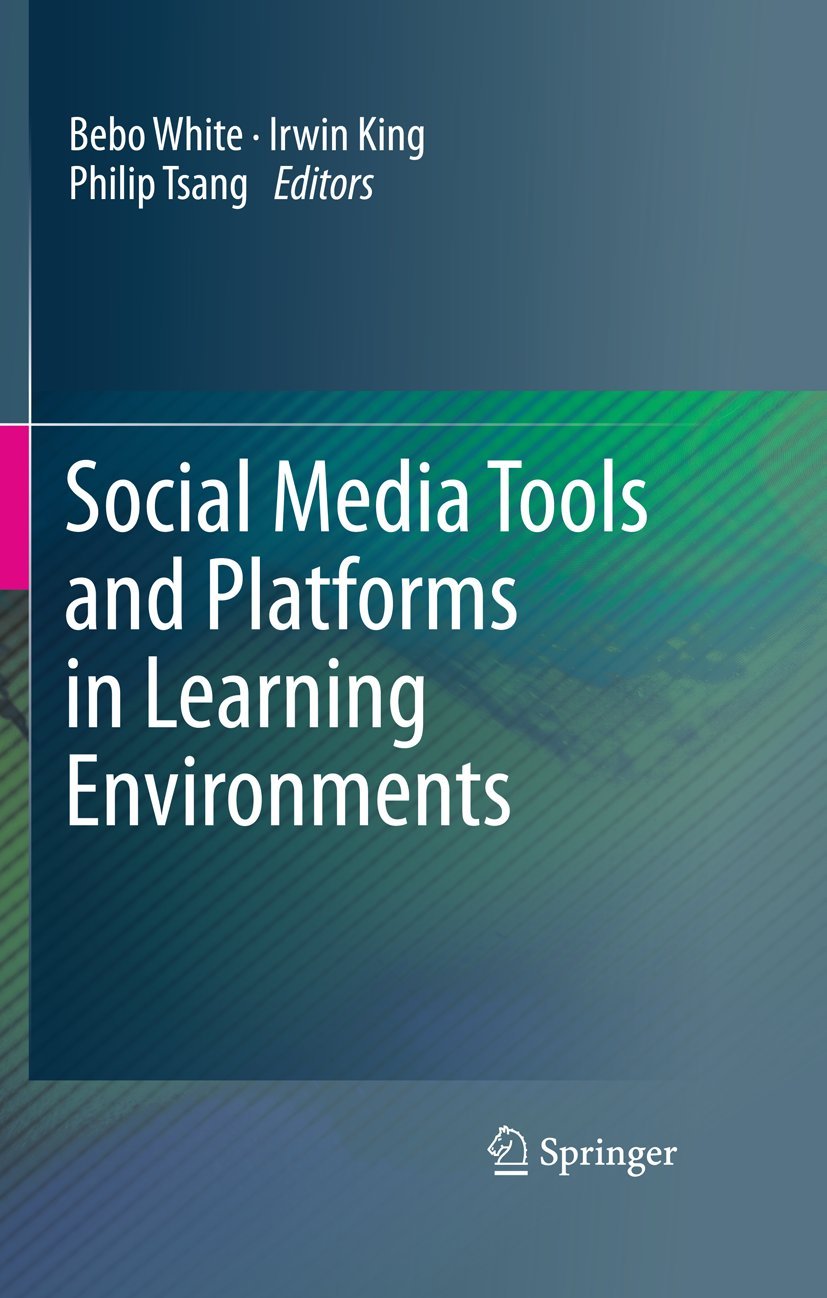
Title
Social Media Tools and Platforms in Learning Environments,Used
Sold by Ergodebooks, an authorized reseller.
Returns accepted within 30 days | support@ergodebooks.com
Shipping Information
- Free Standard Shipping — United States only
- Processing Time: 3–5 business days
- Estimated Delivery: 6–10 business days after dispatch
- Double-boxed, fully insured & discreetly packaged
- Tracking number sent via email once dispatched
Returns & Refund
Returns accepted within 30 days of delivery.
Damaged or Defective Item
Free return shipping + replacement or full refund
Wrong Item Received
Free return shipping + replacement or full refund
Change of Mind
Return shipping at customer's expense · 25% restocking fee applies
Payment Option

Product Description Online social media have transformed the face of human interaction in the 21st century. Wikis, blogs, online groups and forums, podcasts, virtual worlds, and social tagging are but a few of the applications enabling innovative behaviors that support acquisition, access, manipulation, retrieval, and visualization of information. It is, therefore, no surprise that educational practitioners and theorists have begun to explore how social media can be harnessed to describe and implement new paradigms for communication, learning, and education.The editors goal in publishing this book was to identify original research on the application of online social media and related technologies in education as well as emerging applications in Web technologies that could provide and shape future educational platforms. The selected contributions deal with questions such as how social media can truly enrich and enhance learning and teaching experiences in ways not otherwise possible; how learning can be integrated in a distributed and ubiquitous social computing environment; or what theories, paradigms, and models are applicable for the support of social computing in education. Researchers in education or educational software will find interesting and sometimes provocative chapters on paradigms and methodologies, virtual and mobile learning spaces, and assessment and social factors. Practitioners in these fields will benefit from an additional section devoted to case studies and first experience reports. From the Back Cover Online social media have transformed the face of human interaction in the 21st century. Wikis, blogs, online groups and forums, podcasts, virtual worlds, and social tagging are but a few of the applications enabling innovative behaviors that support acquisition, access, manipulation, retrieval, and visualization of information. It is, therefore, no surprise that educational practitioners and theorists have begun to explore how social media can be harnessed to describe and implement new paradigms for communication, learning, and education.The editors goal in publishing this book was to identify original research on the application of online social media and related technologies in education as well as emerging applications in Web technologies that could provide and shape future educational platforms. The selected contributions deal with questions such as how social media can truly enrich and enhance learning and teaching experiences in ways not otherwise possible; how learning can be integrated in a distributed and ubiquitous social computing environment; or what theories, paradigms, and models are applicable for the support of social computing in education. Researchers in education or educational software will find interesting and sometimes provocative chapters on paradigms and methodologies, virtual and mobile learning spaces, and assessment and social factors. Practitioners in these fields will benefit from an additional section devoted to case studies and first experience reports. About the Author Bebo WhiteBebo White is a Departmental Associate (Emeritus) at the SLAC National Accelerator Laboratory, the U.S. national laboratory for highenergy physics and basic energy science at Stanford University. Working as a computational physicist, he first became involved with the emerging Web technology while on sabbatical at CERN in 1989.Upon his return he was part of the team that established the first American Web site at SLAC (the fifth site in the world). Ever since, his academic research interests have evolved in parallel with Web technology.He is often considered to be the "first American Webmaster" and one of the founders of the discipline of Web Engineering.In addition to his work at SLAC, he also holds faculty appointments at several other institutions, is involved with a number of major conferences series, and is a frequent conference speaker. He is the author (or coauthor) o
⚠️ WARNING (California Proposition 65):
This product may contain chemicals known to the State of California to cause cancer, birth defects, or other reproductive harm.
For more information, please visit www.P65Warnings.ca.gov.