
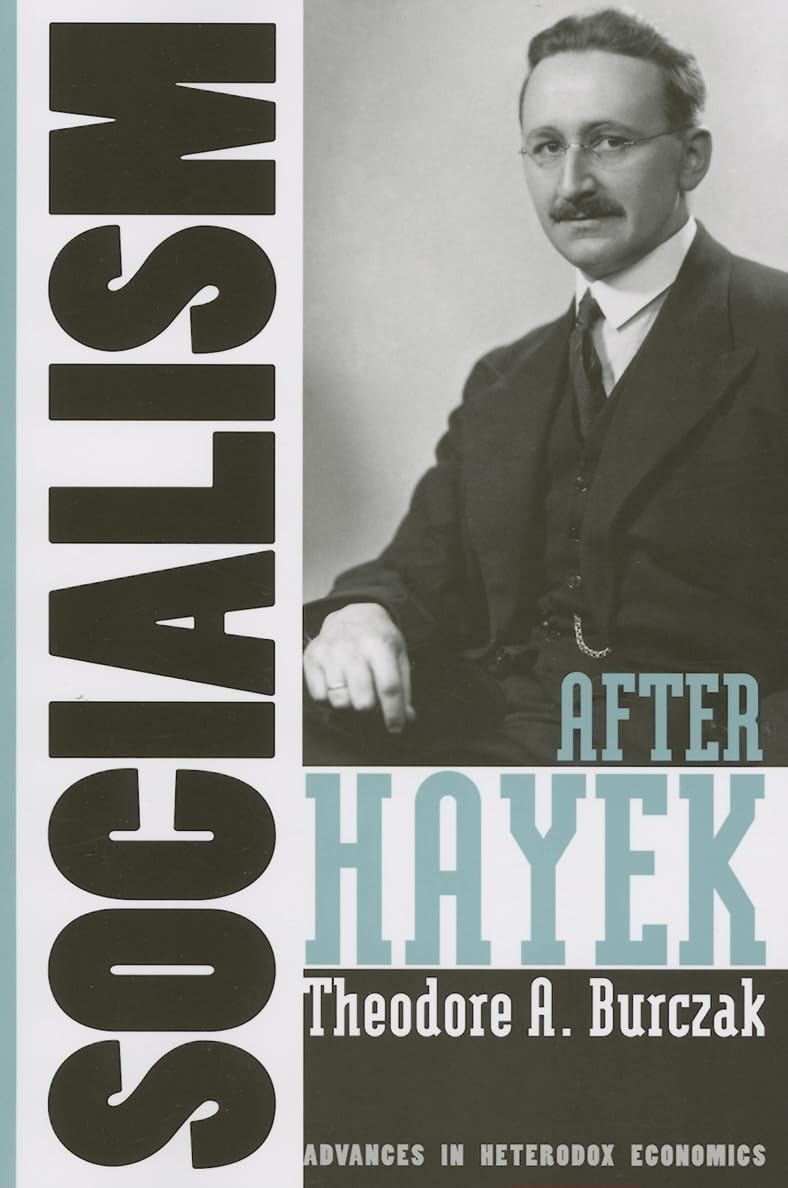
Title
Socialism After Hayek (Advances In Heterodox Economics)
Sold by Ergodebooks, an authorized reseller.
Returns accepted within 30 days | support@ergodebooks.com
Shipping Information
- Free Standard Shipping — United States only
- Processing Time: 3–5 business days
- Estimated Delivery: 6–10 business days after dispatch
- Double-boxed, fully insured & discreetly packaged
- Tracking number sent via email once dispatched
Returns & Refund
Returns accepted within 30 days of delivery.
Damaged or Defective Item
Free return shipping + replacement or full refund
Wrong Item Received
Free return shipping + replacement or full refund
Change of Mind
Return shipping at customer's expense · 25% restocking fee applies
Payment Option

Socialism After Hayek Recasts And Reinvigorates The Socialist Quest For Class Justice By Rendering It Compatible With Hayek'S Social And Economic Theories. Theodore A. Burczak Puts Forth A Conception Of Socialism From A Postmodern Perspective, Drawing From The Apparently Opposing Ideas Of Marx And Hayek (The Latter Of Whom Achieved Worldwide Recognition In The Twentieth Century As A Champion Of The Free Market And Fierce Opponent Of Government Interference In Markets). Burczak Sketches An Institutional Structure That Would Promote A Democratic Socialist Notion Of Distributive Justice And His Own Interpretation Of Marx'S Notion Of Freely Associated Labor, While Avoiding Hayek'S Criticisms Of Centrally Planned Socialism.Burczak'S Version Of Market Socialism Is One In Which Privately Owned Firms Are Run Democratically By Workers, Governments Engage In Ongoing Redistribution Of Wealth To Support Human Development, And Markets Are Otherwise Unregulated. Burczak Poses This Model Of Free Market Socialism Against Other Models Of Socialism, Especially Those Developed By John Roemer, Michael Albert, And Robin Hahnel.Burczakian Socialism = (Hayek + Nussbaum + Sen + Ackerman + Resnick And Wolff) = Ellerman = Legaleconomic Democracy. Brilliant! Burczak Takes Hayek, His Critics, And Other Social Theorists And Produces The Foundations Of A Legaleconomic Order In Which The Concerns Of Most Current Thinkers Are Provided For. It Is A Deep, Sustained, And Brilliant Achievement.Warren J. Samuels, Professor Emeritus, Economics Department, Michigan State University; Former President Of The History Of Economics Society And The Association For Social Economics; Coeditor Of The Journal Of Income Distribution; And Author Of Over 40 BooksTheodore A. Burczak'S Socialism After Hayek Is A Thoroughly Researched And Thoughtful Examination Not Only Of The Ideological Debate That Framed The Twentieth Century, But Of Hayek'S Intellectual Framework. Burczak Hopes For An Economic Framework That Is Both Humanistic In Its Approach And Humanitarian In Its Concern While Being Grounded In Good Reasons. The Book Should Be On The Reading List Of Every Comparative Political Economist And In Particular Anyone Who Wants To Take Hayek Seriously, Including Those Who Would Like To Push Hayek'S Classical Liberal Politics Toward The Left In The Twentyfirst Century. Burczak Has Made An Outstanding Contribution To The Fields Of Political And Economic Thought And To Hayek Studies In Particular.Peter J. Boettke, Professor And Director Of Graduate Studies, Department Of Economics, George Mason University, FairfaxAn Advance Well Beyond The Great 'Socialist Calculation Debate.' Socialism After Hayek Is Both Novel And Challenging To Contemporary Hayekian Scholars. Burczak Is The Only Scholar Working In The Postmarxist Tradition That Thoroughly Understands And Appreciates The Hayekian Critique Of Socialism. He Is On His Way To Answering Many Of Our Longheld Objections.Dave Prychitko, Department Of Economics, Northern Michigan UniversityOne Does Not Have To Agree With All Of Burczak'S Arguments To Accept That He Has Developed A Bold, Creative And Challenging Response To The Powerful Hayekian Critique Of Socialism. Burczak Wisely Rejects The Agoraphobialiterally The Fear Of Marketsof Many Socialists, And Focuses Instead On The Socialist Goal Of The Abolition Of Exploitation. If This Important Book Is Read By Both Socialists And Hayekians, Then There Is A Chance That Debates On The Viability Of Socialism May Avoid Some Past Pitfalls.Geoffrey M. Hodgson, University Of Hertfordshire, UkProvocative And Expansive. An Excellent Book That Deals In Depth With The Relevant Literature, Incorporating It Into A New Analysis Of The Question Of Socialism. . . . The Scholarship Is Superior: Burczak Integrates The Works Of Hayek And Marx To Devel
⚠️ WARNING (California Proposition 65):
This product may contain chemicals known to the State of California to cause cancer, birth defects, or other reproductive harm.
For more information, please visit www.P65Warnings.ca.gov.
- Q: What is the page count of 'Socialism after Hayek'? A: This book has one hundred eighty-four pages. It provides a thorough examination of economic theories and socialist perspectives.
- Q: What type of binding does 'Socialism after Hayek' have? A: It is available in paperback binding. This makes it more accessible and easier to handle for readers.
- Q: What are the dimensions of 'Socialism after Hayek'? A: The book measures six inches in length, zero point five nine inches in width, and nine point zero two inches in height. These dimensions make it convenient for storage and reading.
- Q: Who is the author of 'Socialism after Hayek'? A: The author is Theodore A. Burczak, an Associate Professor of Economics. His expertise informs the book's analysis of socialism and economic theory.
- Q: What academic category does 'Socialism after Hayek' fall under? A: This book is categorized under theory. It explores complex economic theories and socialist ideologies.
- Q: How should I read 'Socialism after Hayek' for best understanding? A: It is recommended to read it analytically, focusing on the arguments presented. Engaging with the text critically will enhance comprehension of its main themes.
- Q: Is 'Socialism after Hayek' suitable for beginners in economics? A: Yes, it can be suitable for beginners. However, some prior knowledge of economic theories may enhance understanding.
- Q: Can I use 'Socialism after Hayek' in academic studies? A: Yes, this book is valuable for academic studies. It provides insights into economic theories and critiques relevant for various courses.
- Q: How can I keep 'Socialism after Hayek' in good condition? A: Store it in a cool, dry place away from direct sunlight. This will help preserve the integrity of the paperback binding and pages.
- Q: Is there a specific way to clean 'Socialism after Hayek'? A: Yes, gently wipe the cover with a soft, dry cloth. Avoid using liquids to prevent damage to the pages and binding.
- Q: What if 'Socialism after Hayek' arrives damaged? A: You should contact the seller for a return or exchange. Most retailers have policies in place for damaged goods.
- Q: Are there any specific audiences that 'Socialism after Hayek' is aimed at? A: It is primarily aimed at students and scholars of economics and political thought. However, anyone interested in socialism may find it useful.
- Q: How does 'Socialism after Hayek' compare to other economic theory books? A: It offers a unique perspective by integrating ideas from both Marx and Hayek, unlike many other books that focus on one ideology.
- Q: Is 'Socialism after Hayek' recommended for political economists? A: Yes, it is highly recommended for political economists. It provides a deep examination of economic frameworks and socialist critiques.
- Q: What are some main themes in 'Socialism after Hayek'? A: Main themes include the compatibility of socialism with market dynamics and the critique of centrally planned economies. The book challenges traditional views on socialism.