
Title
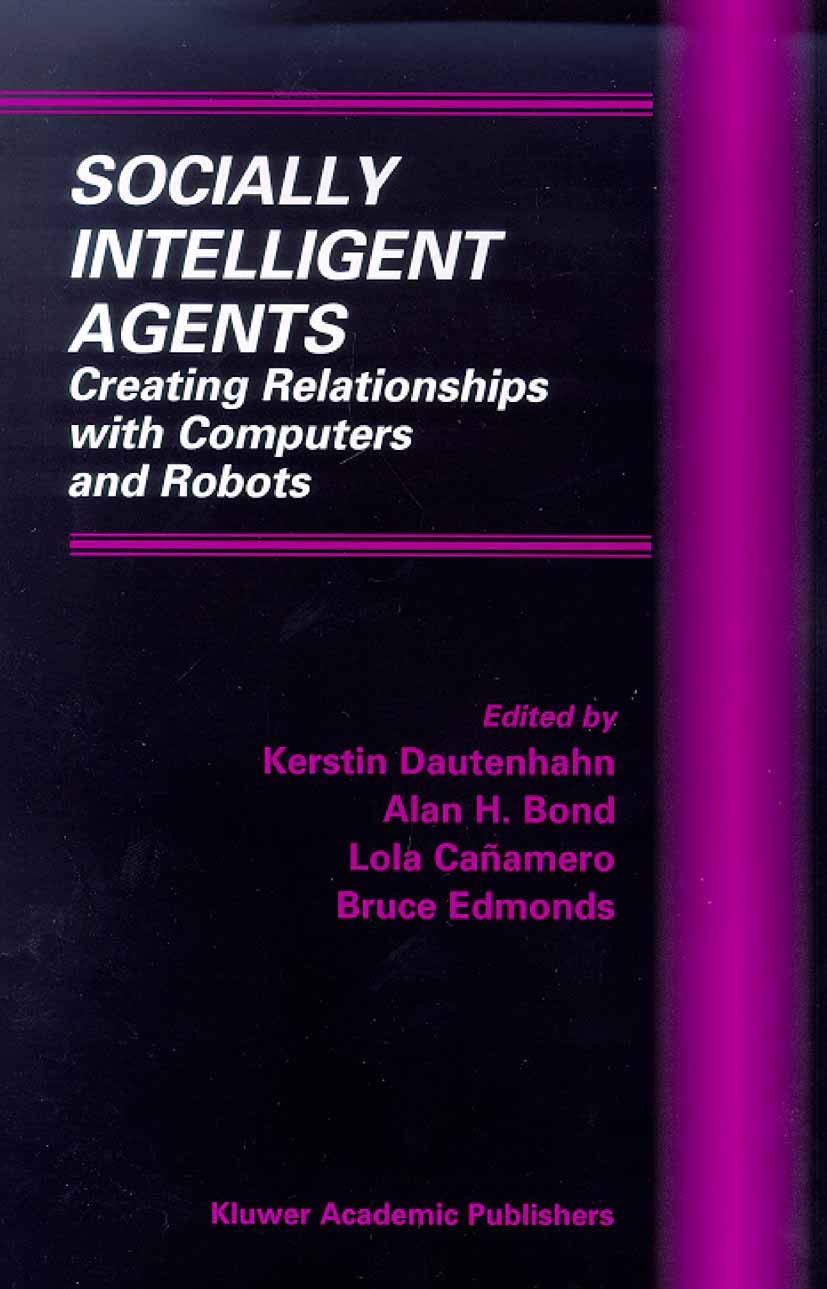
Socially Intelligent Agents: Creating Relationships with Computers and Robots (Multiagent Systems, Artificial Societies, and Sim,Used
Sold by Ergodebooks, an authorized reseller.
Returns accepted within 30 days | support@ergodebooks.com
Shipping Information
- Free Standard Shipping — United States only
- Processing Time: 3–5 business days
- Estimated Delivery: 6–10 business days after dispatch
- Double-boxed, fully insured & discreetly packaged
- Tracking number sent via email once dispatched
Returns & Refund
Returns accepted within 30 days of delivery.
Damaged or Defective Item
Free return shipping + replacement or full refund
Wrong Item Received
Free return shipping + replacement or full refund
Change of Mind
Return shipping at customer's expense · 25% restocking fee applies
Payment Option

Socially situated planning provides one mechanism for improving the social awareness ofagents. Obviously this work isin the preliminary stages and many of the limitation and the relationship to other work could not be addressed in such a short chapter. The chief limitation, of course, is the strong commitment to de?ning social reasoning solely atthe metalevel, which restricts the subtlety of social behavior. Nonetheless, our experience in some realworld military simulation applications suggest that the approach, even in its preliminary state, is adequate to model some social interactions, and certainly extends the sta ofthe art found in traditional training simulation systems. Acknowledgments This research was funded by the Army Research Institute under contract TAPCARIBR References [1] J. Gratch. Emile: Marshalling passions in training and education. In Proceedings of the Fourth International Conference on Autonomous Agents, pages 325332, New York, 2000. ACM Press. [2] J. Gratch and R. Hill. Continous planning and collaboration for command and control in joint synthetic battlespaces. In Proceedings of the 8th Conference on Computer Generated Forces and Behavioral Representation, Orlando, FL, 1999. [3] B. Grosz and S. Kraus. Collaborative plans for complex group action. Arti?cial Intelli gence, 86(2):269357, 1996. [4] A. Ortony, G. L. Clore, and A. Collins. The Cognitive Structure of Emotions. Cambridge University Press, 1988. [5] R.W.PewandA.S.Mavor,editors. Modeling Human and Organizational Behavior. National Academy Press, Washington D.C., 1998.
⚠️ WARNING (California Proposition 65):
This product may contain chemicals known to the State of California to cause cancer, birth defects, or other reproductive harm.
For more information, please visit www.P65Warnings.ca.gov.