If you have any questions, you are always welcome to contact us. We'll get back to you as soon as possible, withing 24 hours on weekdays.
Customer service
All questions about your order, return and delivery must be sent to our customer service team by e-mail at yourstore@yourdomain.com
Sale & Press
If you are interested in selling our products, need more information about our brand or wish to make a collaboration, please contact us at press@yourdomain.com
Help
If you have any questions, you are always welcome to contact us. We'll get back to you as soon as possible, withing 24 hours on weekdays.
Customer service
All questions about your order, return and delivery must be sent to our customer service team by e-mail at yourstore@yourdomain.com
Sale & Press
If you are interested in selling our products, need more information about our brand or wish to make a collaboration, please contact us at press@yourdomain.com
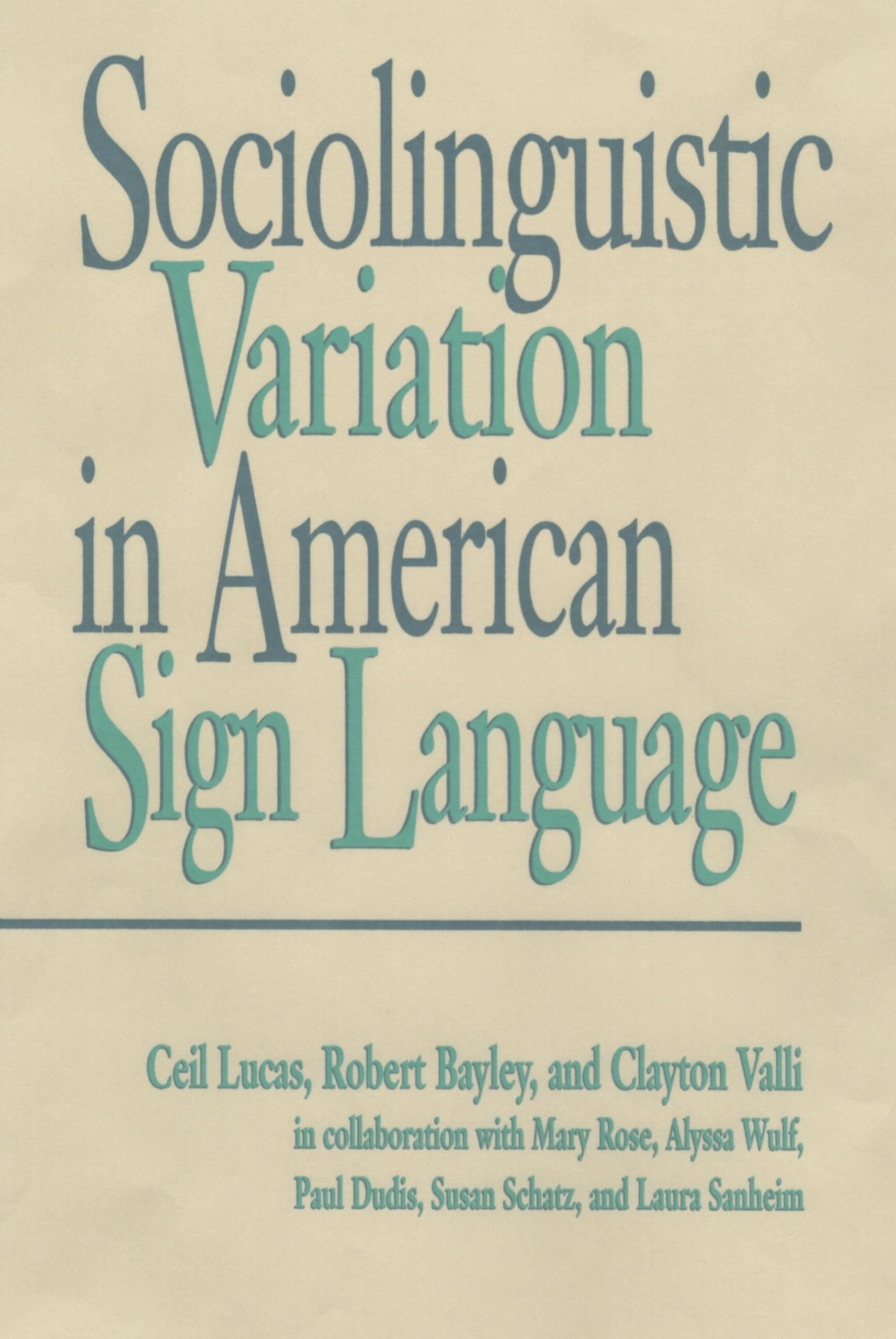
The culmination of a sevenyear project, this volume provides a complete description of American Sign Language (ASL) variation. For four decades, linguists have studied how people from varying regions and backgrounds have different ways of saying the same thing. For example, in English some people say test, while others say tes, dropping the final t. Noted scholars Ceil Lucas, Robert Bayley, and Clayton Valli led a team of exceptional researchers in applying techniques for analyzing spoken language variation to ASL. Their observations at the phonological, lexical, morphological, and syntactic levels demonstrate that ASL variation correlates with many of the same driving social factors of spoken languages, including age, socioeconomic class, gender, ethnic background, region, and sexual orientation. Internal constraints that mandate variant choices for spoken languages have been compared to ASL as well, with intriguing results. Sociolinguistic Variation in American Sign Language stands alone as the new standard for students and scholars committed to this discipline.
⚠️ WARNING (California Proposition 65):
This product may contain chemicals known to the State of California to cause cancer,
birth defects, or other reproductive harm.
For MAP (Minimum Advertised Price) violations and Intellectual Property (IP) or Trademark concerns, please contact:
support@ergodebooks.com
⚠️ California Proposition 65 Warning: Some products sold on this website may expose you to chemicals known to the State of California to cause cancer, birth defects, or other reproductive harm. For more information, visit www.P65Warnings.ca.gov.