
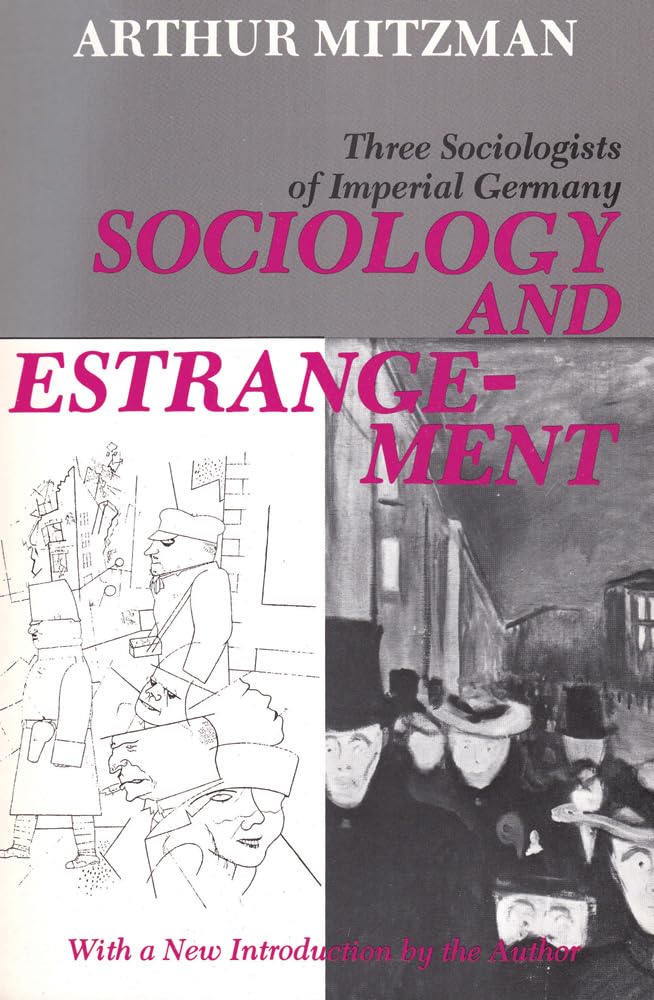
Title
Sociology and Estrangement: Three Sociologists of Imperial Germany,Used
Sold by Ergodebooks, an authorized reseller.
Returns accepted within 30 days | support@ergodebooks.com
Shipping Information
- Free Standard Shipping — United States only
- Processing Time: 3–5 business days
- Estimated Delivery: 6–10 business days after dispatch
- Double-boxed, fully insured & discreetly packaged
- Tracking number sent via email once dispatched
Returns & Refund
Returns accepted within 30 days of delivery.
Damaged or Defective Item
Free return shipping + replacement or full refund
Wrong Item Received
Free return shipping + replacement or full refund
Change of Mind
Return shipping at customer's expense · 25% restocking fee applies
Payment Option

Product DescriptionArthur Mitzman's critical study of three major German sociologiststhe nineteenthcentury pioneers Ferdinand Tonnies, Werner Sombart, and Robert Michelsis rooted in the context of German social and intellectual history. Mitzman shows how Tbnnies's interest in community and Michels's critique of socialist bureaucracy were both intimately connected with their allegiance to an older, more communitarian and decentralized Germany that was being irreparably destroyed by Prussian domination. Sombart's analysis of modern capitalism and his evolution from supporter of revisionist socialism to bitter critic of modernity are similarly related, by the author, to his increasing estrangement from German society.With the brilliance of analysis that distinguished his study of Max WeberThe Iron CageArthur Mitzman's book has revised longheld ideas about the beginnings of sociology: Far from originating as an antiseptic development of scientific objectivity, it grew out of a passionate commitment to humanist values within a social order apparently determined to destroy them.Review'Mitzman is absolutely firstclass, perceptive, disciplined, unobtrusively learned, compelling.'Robert K. Merton, Columbia UniversityAbout the AuthorArthur Mitzman is professor of modern European history at the University of Amsterdam in Holland. He has taught at Brooklyn College, Goddard College, the University of Rochester, and Simon Fraser University, and is the author of The Iron Cage: An Historical Interpretation of Max Weber.
⚠️ WARNING (California Proposition 65):
This product may contain chemicals known to the State of California to cause cancer, birth defects, or other reproductive harm.
For more information, please visit www.P65Warnings.ca.gov.
- Q: What is the main focus of 'Sociology and Estrangement: Three Sociologists of Imperial Germany'? A: The book critically examines the works of three major German sociologists—Ferdinand Tonnies, Werner Sombart, and Robert Michels—within the context of German social and intellectual history.
- Q: Who is the author of this book? A: The author is Arthur Mitzman, a professor of modern European history at the University of Amsterdam.
- Q: What are the key themes explored in the book? A: Key themes include the relationship between sociology and humanist values, the critique of socialist bureaucracy, and the impact of Prussian domination on German society.
- Q: What is the publication date of this book? A: The book was published on January 31, 1987.
- Q: How many pages does the book have? A: The book contains 417 pages.
- Q: What is the binding type of 'Sociology and Estrangement'? A: This edition of the book is a paperback.
- Q: Is this book suitable for beginners in sociology? A: While it offers critical insights into sociology, it may be more suitable for readers with some background knowledge in the subject due to its academic focus.
- Q: What condition is the book in? A: The book is listed as being in 'Very Good' condition.
- Q: Does this book contain a bibliography or references? A: Yes, academic texts like this typically include a bibliography and references to support the author's analysis.
- Q: What is the significance of Arthur Mitzman's analysis in this book? A: Mitzman's analysis challenges long-held beliefs about the origins of sociology, emphasizing its roots in humanist values rather than just scientific objectivity.