
Title
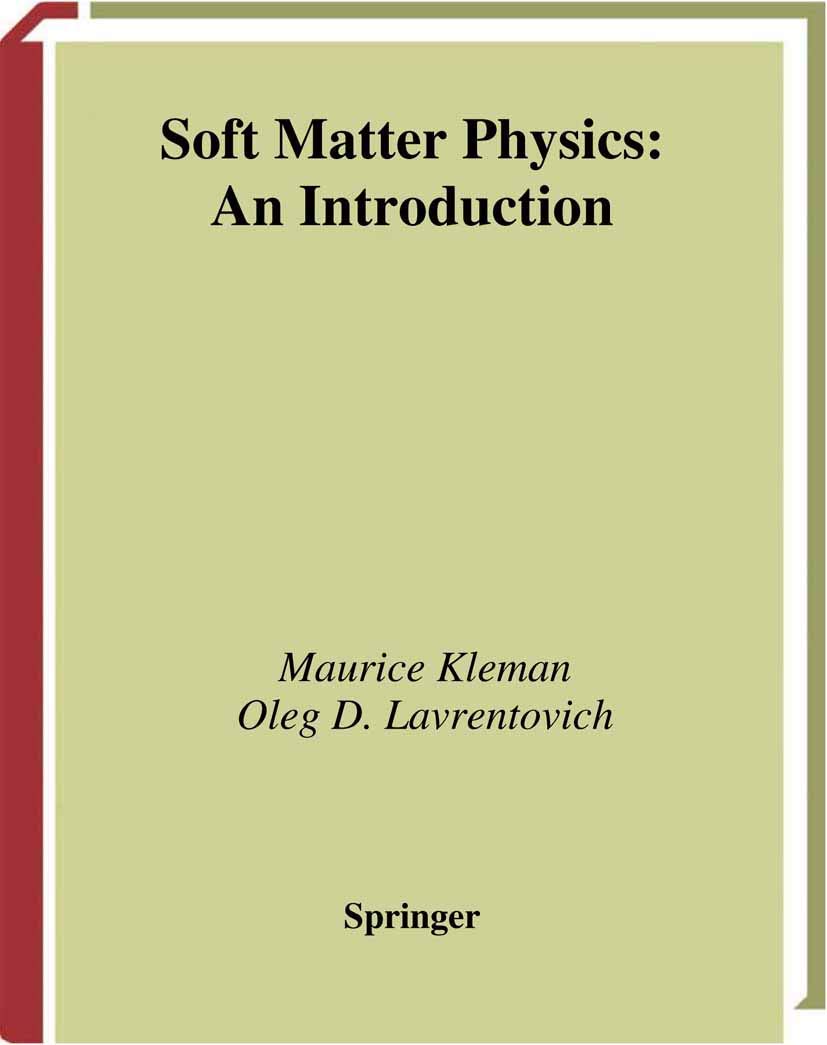
Soft Matter Physics: An Introduction (Partially Ordered Systems),Used
Sold by Ergodebooks, an authorized reseller.
Returns accepted within 30 days | support@ergodebooks.com
Shipping Information
- Free Standard Shipping — United States only
- Processing Time: 3–5 business days
- Estimated Delivery: 6–10 business days after dispatch
- Double-boxed, fully insured & discreetly packaged
- Tracking number sent via email once dispatched
Returns & Refund
Returns accepted within 30 days of delivery.
Damaged or Defective Item
Free return shipping + replacement or full refund
Wrong Item Received
Free return shipping + replacement or full refund
Change of Mind
Return shipping at customer's expense · 25% restocking fee applies
Payment Option

Introductions to solid state physics have, ever since the initial book by F. Seitz in 1940, concentrated on simple crystals, with few atoms per cell, bonded together by strong ionic, covalent, or metallic bonds. References to weaker bonds, such as van der Waals forces in rare gases, or to geometric or chemical disorder (e.g., alloys or glasses) have been limited. The physical understanding of this ?eld started well before Seitzs book and led to a number of Nobel prizes after the last war. Applications cover classical metallurgy, el tronics, geology and building materials, as well as electrical and ionic transport, chemical reactivity, ferroelectricity and magnetism. But in parallel with this general and well publicized trend, and sometimes earlier as far as physical concepts were concerned, an exploration and increasingly systematic study of softer matter has developed through the twentieth century. More often in the hands of physical chemists and crystallographers than those of pure physicists, the ?eld had for a long time a reputation of complexity. If progress in polymers was steady but slow, interest in liquid crystals had lain dormant for forty years, after a bright start lasting through 1925, to be revived in the late 1960s based on their possible use in imaging techniques. The optoelectronic properties of the ?eld in general are even more recent.
⚠️ WARNING (California Proposition 65):
This product may contain chemicals known to the State of California to cause cancer, birth defects, or other reproductive harm.
For more information, please visit www.P65Warnings.ca.gov.