
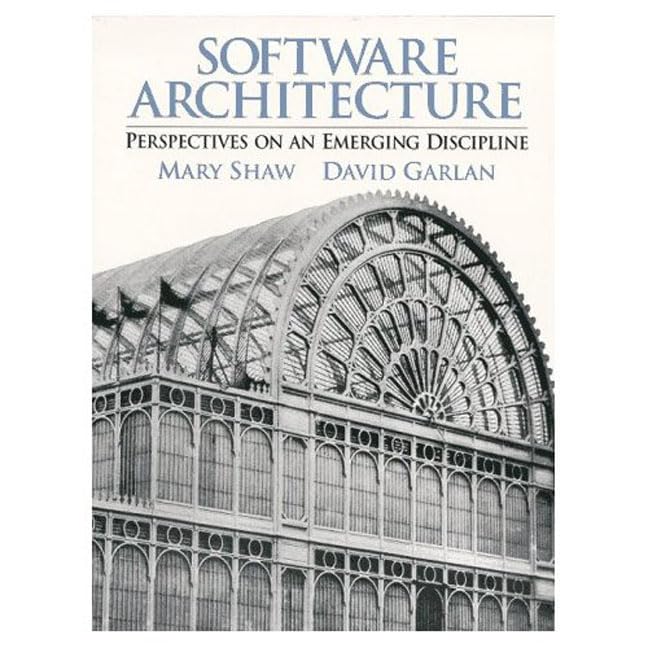
Title
Software Architecture: Perspectives on an Emerging Discipline,Used
Sold by Ergodebooks, an authorized reseller.
Returns accepted within 30 days | support@ergodebooks.com
Shipping Information
- Free Standard Shipping — United States only
- Processing Time: 3–5 business days
- Estimated Delivery: 6–10 business days after dispatch
- Double-boxed, fully insured & discreetly packaged
- Tracking number sent via email once dispatched
Returns & Refund
Returns accepted within 30 days of delivery.
Damaged or Defective Item
Free return shipping + replacement or full refund
Wrong Item Received
Free return shipping + replacement or full refund
Change of Mind
Return shipping at customer's expense · 25% restocking fee applies
Payment Option

Good software developers often adopt one or several architectural patterns as strategies for system organization. But, although they use these patterns purposefully, they often use them informally and nearly unconsciously. This book organizes this substantial emerging 'folklore' of system design with its rich language of system description and closes the gap between the useful abstractions (constructs and patterns) of system design and the current models, notations and tools. It identifies useful patterns clearly, gives examples, compares them, and evaluates their utility in various settings allowing readers to develop a repertoire of useful techniques that goes beyond the singleminded current fads. KEY TOPICS: Examines the ways in which architectural issues can impact software design; shows how to design new systems in principled ways using wellunderstood architectural paradigms; emphasizes informal descriptions, touching lightly on formal notations and specifications, and the tools that support them; explains how to understand and evaluate the design of existing software systems from an architectural perspective; and presents concrete examples of actual system architectures that can serve as models for new designs. MARKET: For professional software developers looking for new ideas about system organization.
⚠️ WARNING (California Proposition 65):
This product may contain chemicals known to the State of California to cause cancer, birth defects, or other reproductive harm.
For more information, please visit www.P65Warnings.ca.gov.
- Q: How many pages does the book contain? A: The book has two hundred sixty-four pages. This length provides a comprehensive exploration of software architecture and its patterns.
- Q: What are the dimensions of this book? A: The book measures seven point zero one inches in length, zero point six three inches in width, and nine point two two inches in height. These dimensions make it convenient for reading and storage.
- Q: What type of binding does this book have? A: The book is paperback bound. This binding style is lightweight and flexible, suitable for both casual and professional reading.
- Q: Who is the author of this book? A: The author of the book is Mary Shaw. She is a recognized expert in software architecture and design.
- Q: What category does this book fall under? A: This book is categorized under Business Technology. It focuses on software architecture and design principles relevant to the industry.
- Q: What are the key topics discussed in this book? A: The book discusses architectural issues impacting software design, architectural paradigms, and evaluating existing software systems. It aims to bridge the gap between theory and practical application.
- Q: How should I use this book? A: You can use this book as a reference for understanding software architecture. It's ideal for professional developers seeking to enhance their system design skills.
- Q: Is this book suitable for beginners? A: Yes, the book is suitable for both beginners and experienced developers. It provides foundational concepts along with advanced architectural strategies.
- Q: What is the reading level for this book? A: The book is intended for professional software developers. It assumes a basic understanding of programming and software development concepts.
- Q: How should I care for this book? A: To keep the book in good condition, store it in a cool, dry place and avoid exposure to direct sunlight. Handling it carefully will preserve its binding and pages.
- Q: Are there any safety concerns with this book? A: No, there are no safety concerns associated with this book. It is suitable for readers interested in software architecture.
- Q: What if my book arrives damaged? A: If your book arrives damaged, you should contact the retailer for assistance. Most retailers offer return or exchange options for damaged items.
- Q: Is there a warranty for this book? A: No, there is typically no warranty for books. However, check with the retailer for their return policy.
- Q: What should I do if I have issues with the content? A: If you encounter issues with the content, consider reaching out to the author or publisher for clarification. They may provide additional resources or insights.
- Q: Can I find examples of system architectures in this book? A: Yes, the book presents concrete examples of actual system architectures. These serve as models for developing new designs.
- Q: Does this book cover modern architectural trends? A: Yes, the book addresses current trends in software architecture. It evaluates various patterns and their applicability in modern software design.