
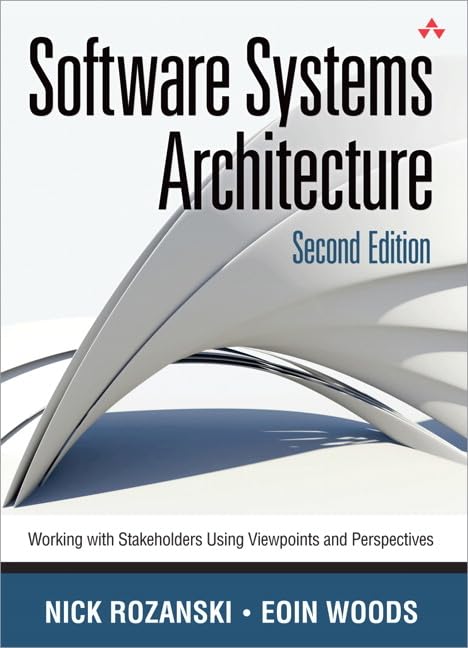
Title
Software Systems Architecture: Working With Stakeholders Using Viewpoints And Perspectives,Used
Sold by Ergodebooks, an authorized reseller.
Returns accepted within 30 days | support@ergodebooks.com
Shipping Information
- Free Standard Shipping — United States only
- Processing Time: 3–5 business days
- Estimated Delivery: 6–10 business days after dispatch
- Double-boxed, fully insured & discreetly packaged
- Tracking number sent via email once dispatched
Returns & Refund
Returns accepted within 30 days of delivery.
Damaged or Defective Item
Free return shipping + replacement or full refund
Wrong Item Received
Free return shipping + replacement or full refund
Change of Mind
Return shipping at customer's expense · 25% restocking fee applies
Payment Option

Software Systems Architecture, Second Editionis A Highly Regarded, Practitioneroriented Guide To Designing And Implementing Effective Architectures For Information Systems. It Is Both A Readily Accessible Introduction To Software Architecture And An Invaluable Handbook Of Wellestablished Best Practices.With This Book You Will Learn How To Design And Communicate An Architecture That Reflects And Balances The Different Needs Of Its Stakeholders Focus On Architecturally Significant Aspects Of Design, Including Frequently Overlooked Areas Such As Performance, Resilience, And Location Use Scenarios And Patterns To Drive The Creation And Validation Of Your Architecture Document Your Architecture As A Set Of Related Viewsreflecting New Standards And Developments In The Field, This New Edition Extends And Updates Much Of The Content, And Adds A System Context Viewpoint That Documents The Systems Interactions With Its Environment Expands The Discussion Of Architectural Principles, Showing How They Can Be Used To Provide Traceability And Rationale For Architectural Decisions Explains How Agile Development And Architecture Can Work Together Positions Requirements And Architecture Activities In The Project Context Presents A New Lightweight Method For Architectural Validationwhether You Are An Aspiring Or Practicing Software Architect, You Will Find Yourself Referring Repeatedly To The Practical Advice In This Book Throughout The Lifecycle Of Your Projects. A Supporting Web Site Containing Further Information Can Be Found At Www.Viewpointsandperspectives.Info.
⚠️ WARNING (California Proposition 65):
This product may contain chemicals known to the State of California to cause cancer, birth defects, or other reproductive harm.
For more information, please visit www.P65Warnings.ca.gov.
- Q: How many pages does this book have? A: This book has seven hundred four pages. It provides a comprehensive guide to software systems architecture.
- Q: What is the binding type of this book? A: This book is a hardcover edition. Hardcover bindings offer durability and a professional appearance.
- Q: What are the dimensions of this book? A: The dimensions of this book are seven point twenty-eight inches in length, one point sixty-nine inches in width, and nine point twenty-nine inches in height. These sizes make it manageable for reading.
- Q: Who is the author of this book? A: The author of this book is Nick Rozanski. He is recognized for his expertise in software architecture.
- Q: What topics are covered in this book? A: This book covers software architecture design, stakeholder communication, and architectural principles. It provides strategies for effective architecture implementation.
- Q: Is this book suitable for beginners? A: Yes, this book is suitable for both beginners and experienced architects. It serves as an accessible introduction to software architecture.
- Q: How can I apply the concepts in this book? A: You can apply the concepts by designing architecture that balances stakeholder needs and documenting it through related views. The book provides practical methods for implementation.
- Q: Does this book include real-world examples? A: Yes, this book includes scenarios and patterns that illustrate architectural concepts. These examples help in understanding and validating your architecture.
- Q: Are there any online resources related to this book? A: Yes, there is a supporting website at www.viewpoints-and-perspectives.info. This site offers additional information and resources.
- Q: What is the main focus of this book? A: The main focus of this book is on designing software architectures that meet stakeholder requirements. It emphasizes a balanced approach to architecture.
- Q: Is there a focus on agile development in this book? A: Yes, the book discusses how agile development and architecture can coexist. It provides insights on integrating these methodologies.
- Q: How does this book address architectural validation? A: The book presents a new lightweight method for architectural validation. This approach helps ensure that the architecture is sound and meets requirements.
- Q: What are the key principles discussed in this book? A: Key principles include traceability and rationale for architectural decisions. These principles guide effective architecture design.
- Q: Can I use this book for project management purposes? A: Yes, this book positions architecture activities within the project context. It offers valuable insights for project managers.
- Q: Is there a glossary or index in the book? A: Yes, the book includes an index, which allows for easy navigation of topics. This feature enhances usability for readers.
- Q: What makes this edition different from the first edition? A: This edition updates much of the content and includes a new 'system context viewpoint.' It reflects new standards in software architecture.