
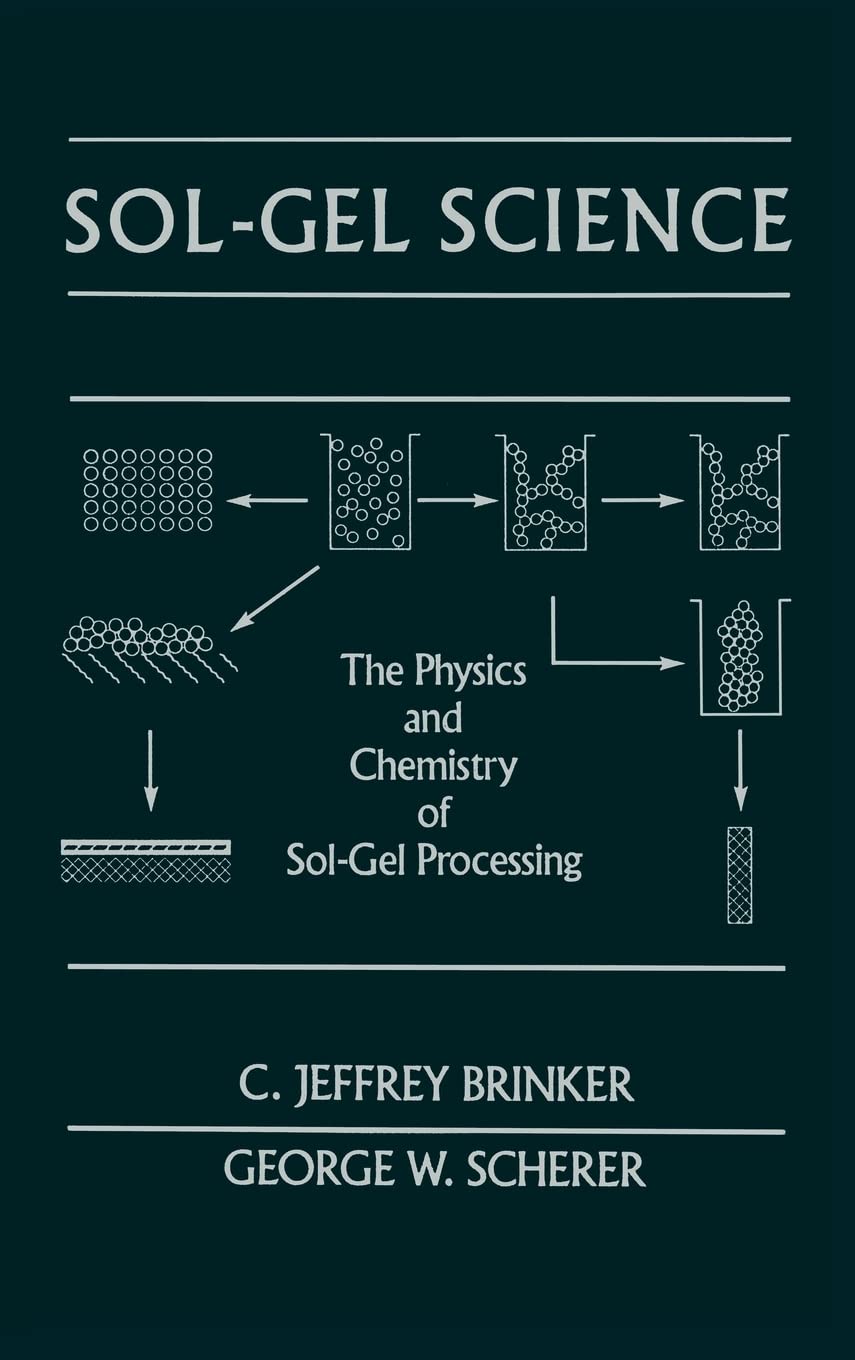
Title
Solgel Science: The Physics And Chemistry Of Solgel Processing
Sold by Ergodebooks, an authorized reseller.
Returns accepted within 30 days | support@ergodebooks.com
Shipping Information
- Free Standard Shipping — United States only
- Processing Time: 3–5 business days
- Estimated Delivery: 6–10 business days after dispatch
- Double-boxed, fully insured & discreetly packaged
- Tracking number sent via email once dispatched
Returns & Refund
Returns accepted within 30 days of delivery.
Damaged or Defective Item
Free return shipping + replacement or full refund
Wrong Item Received
Free return shipping + replacement or full refund
Change of Mind
Return shipping at customer's expense · 25% restocking fee applies
Payment Option

Solgel Science: The Physics And Chemistry Of Solgel Processing Presents The Physical And Chemical Principles Of The Solgel Process. The Book Emphasizes The Science Behind Solgel Processing With A Chapter Devoted To Applications. The First Chapter Introduces Basic Terminology, Provides A Brief Historical Sketch, And Identifies Some Excellent Texts For Background Reading. Chapters 2 And 3 Discuss The Mechanisms Of Hydrolysis And Condensation For Nonsilicate And Silicate Systems. Chapter 4 Deals With Stabilization And Gelation Of Sols. Chapter 5 Reviews Theories Of Gelation And Examines The Predicted And Observed Changes In The Properties Of A Sol In The Vicinity Of The Gel Point. Chapter 6 Describes The Changes In Structure And Properties That Occur During Aging Of A Gel In Its Pore Liquor (Or Some Other Liquid). The Discussion Of Drying Is Divided Into Two Parts, With The Theory Concentrated In Chapter 7 And The Phenomenology In Chapter 8. The Structure Of Dried Gels Is Explored In Chapter 9. Chapter 10 Shows The Possibility Of Using The Gel As A Substrate For Chemical Reactions Or Of Modifying The Bulk Composition Of The Resulting Ceramic By Performing A Surface Reaction (Such As Nitridation) On The Gel. Chapter 11 Reviews The Theory And Practice Of Sintering, Describing The Mechanisms That Govern Densification Of Amorphous And Crystalline Materials, And Showing The Advantages Of Avoiding Crystallization Before Sintering Is Complete. The Properties Of Gelderived And Conventional Ceramics Are Discussed In Chapter 12. The Preparation Of Films Is Such An Important Aspect Of Solgel Technology That The Fundamentals Of Film Formation Are Treated At Length In Chapter 13. Films And Other Applications Are Briefly Reviewed In Chapter 14. Materials Scientists And Researchers In The Field Of Solgel Processing Will Find The Book Invaluable.
⚠️ WARNING (California Proposition 65):
This product may contain chemicals known to the State of California to cause cancer, birth defects, or other reproductive harm.
For more information, please visit www.P65Warnings.ca.gov.
- Q: What is the binding type of this book? A: This book has a hardcover binding. Hardcover books are known for their durability and ability to withstand frequent handling.
- Q: How many pages does this book have? A: This book contains nine hundred twenty-four pages. It offers an extensive exploration of sol-gel processing principles and applications.
- Q: What are the dimensions of this book? A: The book measures six point thirty-eight inches in length, one point ninety-seven inches in width, and nine point twenty-one inches in height. These dimensions make it a substantial reference volume.
- Q: Is this book suitable for beginners? A: Yes, this book is suitable for both beginners and experienced researchers. It starts with basic terminology and progresses to advanced concepts in sol-gel processing.
- Q: What topics does this book cover? A: The book covers a wide range of topics, including hydrolysis, gelation, and sintering processes in sol-gel technology. It also discusses applications of sol-gel derived materials.
- Q: Can I use this book as a textbook for a course? A: Yes, this book can be used as a textbook for courses on materials science and chemistry. Its comprehensive approach makes it ideal for academic settings.
- Q: How should I store this book to keep it in good condition? A: Store this book upright on a shelf, away from direct sunlight and moisture. This will help maintain its physical integrity and prevent damage.
- Q: Can I clean the cover of this book? A: Yes, you can clean the cover by wiping it gently with a soft, dry cloth. Avoid using water or cleaning solutions to prevent damage.
- Q: What do I do if the book arrives damaged? A: If the book arrives damaged, contact the seller for return or exchange options. Most retailers have policies in place to handle such issues.
- Q: Is this book well-reviewed by experts in the field? A: Yes, the book is highly regarded by experts in materials science and sol-gel processing. It is often recommended for its thorough coverage and clarity.
- Q: Are there any illustrations or diagrams in the book? A: Yes, the book includes various illustrations and diagrams. These visual aids help clarify complex concepts related to sol-gel processes.
- Q: Does this book include references for further reading? A: Yes, the book includes references for further reading. These references can help readers explore additional resources on sol-gel technology.
- Q: Is the author of this book an expert in sol-gel processing? A: Yes, the author, C. Jeffrey Brinker, is a recognized expert in the field of sol-gel processing. His expertise adds significant value to the content.
- Q: What is the target audience for this book? A: The target audience includes materials scientists, researchers, and students interested in sol-gel technology. It caters to a range of expertise levels.
- Q: Can this book be used for self-study? A: Yes, this book is suitable for self-study. It provides clear explanations and structured content that facilitate independent learning.