
Title
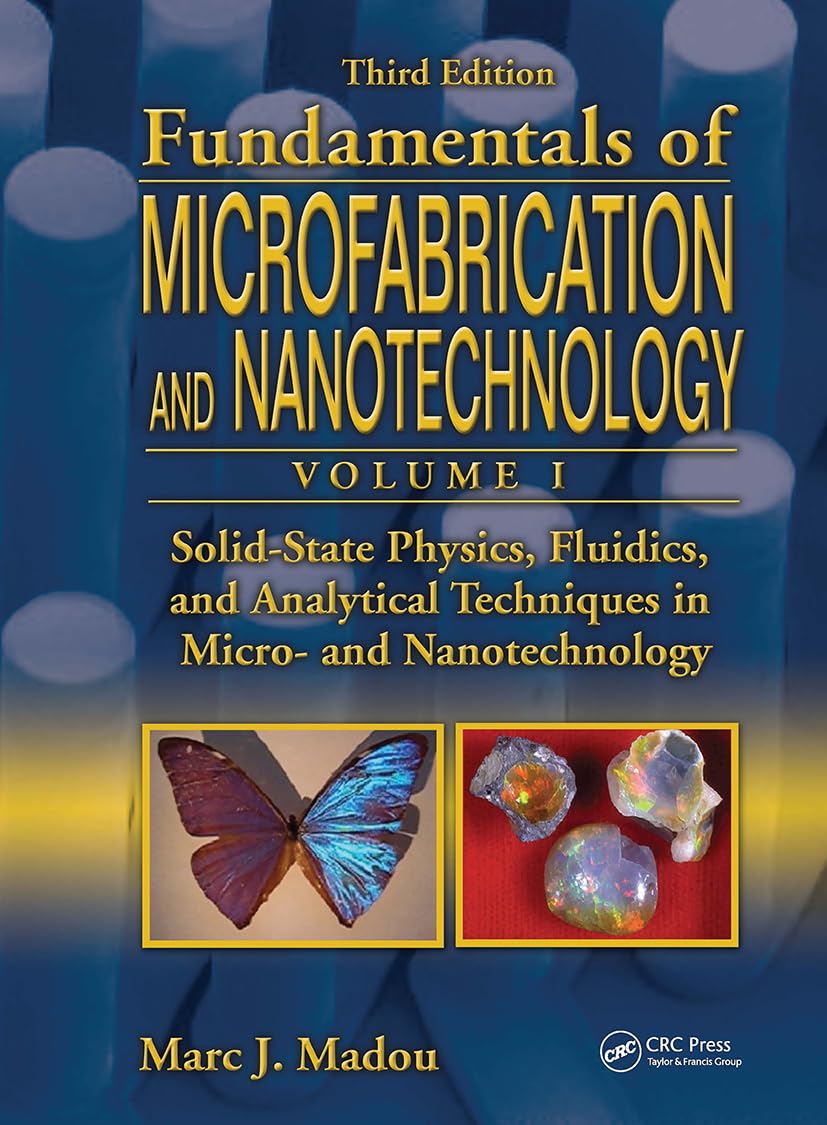
SolidState Physics, Fluidics, and Analytical Techniques in Micro and Nanotechnology,Used
Sold by Ergodebooks, an authorized reseller.
Returns accepted within 30 days | support@ergodebooks.com
Shipping Information
- Free Standard Shipping — United States only
- Processing Time: 3–5 business days
- Estimated Delivery: 6–10 business days after dispatch
- Double-boxed, fully insured & discreetly packaged
- Tracking number sent via email once dispatched
Returns & Refund
Returns accepted within 30 days of delivery.
Damaged or Defective Item
Free return shipping + replacement or full refund
Wrong Item Received
Free return shipping + replacement or full refund
Change of Mind
Return shipping at customer's expense · 25% restocking fee applies
Payment Option

Providing a clear theoretical understanding of MEMS and NEMS, SolidState Physics, Fluidics, and Analytical Techniques in Micro and Nanotechnology focuses on nanotechnology and the science behind it, including solidstate physics. It provides a clear understanding of the electronic, mechanical, and optical properties of solids relied on in integrated circuits (ICs), MEMS, and NEMS. After exploring the rise of Si, MEMS, and NEMS in a historical context, the text discusses crystallography, quantum mechanics, the band theory of solids, and the silicon single crystal. It concludes with coverage of photonics, the quantum hall effect, and superconductivity. Fully illustrated in color, the text offers endofchapter problems, worked examples, extensive references, and a comprehensive glossary of terms.Topics include:Crystallography and the crystalline materials used in many semiconductor devices Quantum mechanics, the band theory of solids, and the relevance of quantum mechanics in the context of ICs and NEMS Single crystal Si properties that conspire to make Si so important Optical properties of bulk 3D metals, insulators, and semiconductors Effects of electron and photon confinement in lower dimensional structures How evanescent fields on metal surfaces enable the guiding of light below the diffraction limit in plasmonics Metamaterials and how they could make for perfect lenses, changing the photonic field forever Fluidic propulsion mechanisms and the influence of miniaturization on fluid behavior Electromechanical and optical analytical processes in miniaturized components and systemsThe first volume in Fundamentals of Microfabrication and Nanotechnology, Third Edition, ThreeVolume Set, the book presents the electronic, mechanical, and optical properties of solids that are used in integrated circuits, MEMS, and NEMS and covers quantum mechanics, electrochemistry, fluidics, and photonics. It lays the foundation for a qualitative and quantitative theoretical understanding of MEMS and NEMS.
⚠️ WARNING (California Proposition 65):
This product may contain chemicals known to the State of California to cause cancer, birth defects, or other reproductive harm.
For more information, please visit www.P65Warnings.ca.gov.
- Q: What is the main focus of the book 'Solid-State Physics, Fluidics, and Analytical Techniques in Micro- and Nanotechnology'? A: The book primarily focuses on providing a theoretical understanding of MEMS and NEMS, emphasizing the science behind nanotechnology, solid-state physics, and the electronic, mechanical, and optical properties of solids used in integrated circuits.
- Q: What topics are covered in this book? A: Key topics include crystallography, quantum mechanics, the band theory of solids, properties of single crystal silicon, optical properties of materials, plasmonics, metamaterials, fluid propulsion mechanisms, and electromechanical analytical processes.
- Q: Who is the author of this book? A: The book is authored by Marc J. Madou.
- Q: What is the condition of the book? A: The book is listed as a used book in good condition.
- Q: How many pages does 'Solid-State Physics, Fluidics, and Analytical Techniques in Micro- and Nanotechnology' have? A: The book contains 656 pages.
- Q: What is the binding type of the book? A: The book is available in hardcover binding.
- Q: When was the book published? A: The book was published on June 13, 2011.
- Q: Is this book suitable for beginners in nanotechnology? A: Yes, the book aims to provide a qualitative and quantitative theoretical understanding, making it suitable for both beginners and advanced readers in the field of nanotechnology.
- Q: Does the book include practical examples or problems? A: Yes, it includes end-of-chapter problems, worked examples, and extensive references to enhance understanding.
- Q: What is the edition of this book? A: This is the first edition of the book.