If you have any questions, you are always welcome to contact us. We'll get back to you as soon as possible, withing 24 hours on weekdays.
Customer service
All questions about your order, return and delivery must be sent to our customer service team by e-mail at yourstore@yourdomain.com
Sale & Press
If you are interested in selling our products, need more information about our brand or wish to make a collaboration, please contact us at press@yourdomain.com
Help
If you have any questions, you are always welcome to contact us. We'll get back to you as soon as possible, withing 24 hours on weekdays.
Customer service
All questions about your order, return and delivery must be sent to our customer service team by e-mail at yourstore@yourdomain.com
Sale & Press
If you are interested in selling our products, need more information about our brand or wish to make a collaboration, please contact us at press@yourdomain.com
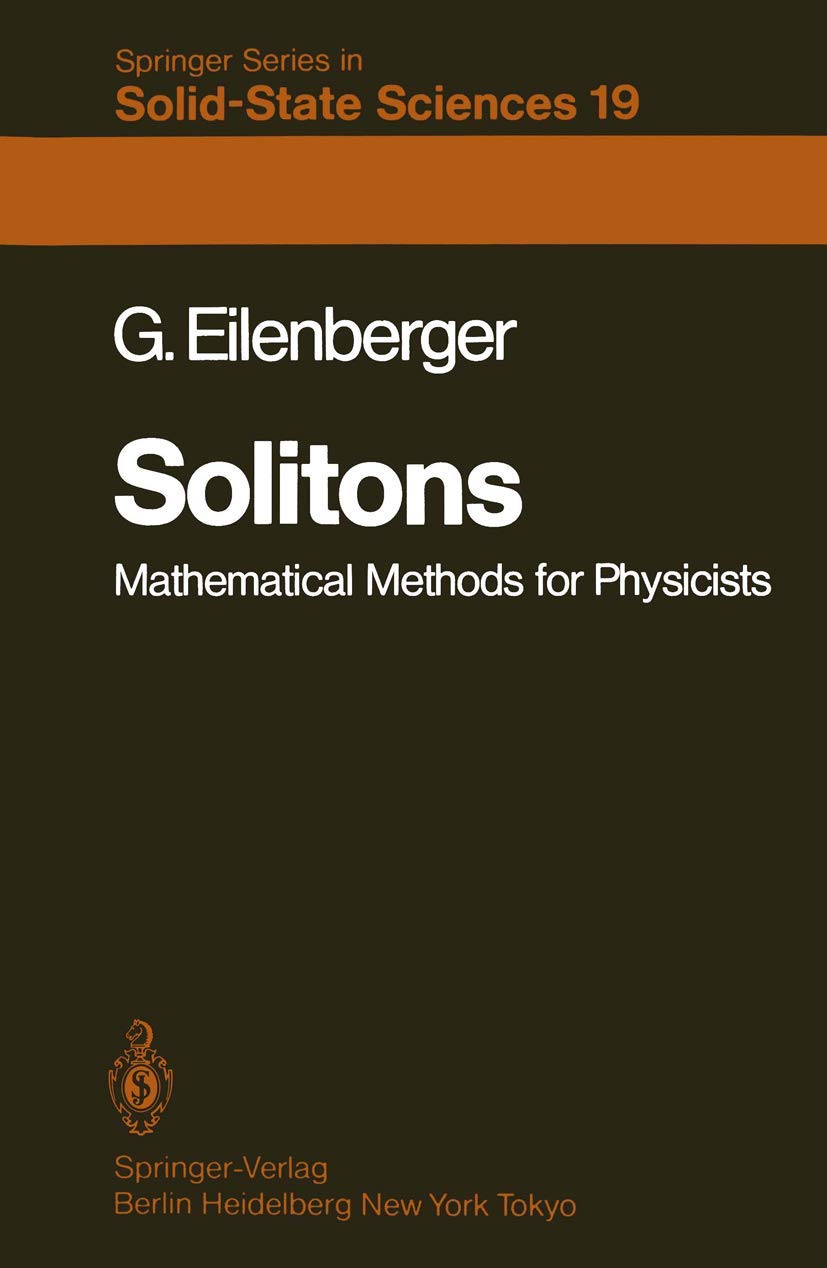
1.1 Why Study Solitons? The last century of physics, which was initiated by Maxwell's completion of the theory of electromagnetism, can, with some justification, be called the era of linear physi cs. Jith few excepti ons, the methods of theoreti ca 1 phys ics have been dominated by linear equations (Maxwell, Schrodinger), linear mathematical objects (vector spaces, in particular Hilbert spaces), and linear methods (Fourier transforms, perturbation theory, linear response theory) . Naturally the importance of nonlinearity, beginning with the NavierStokes equations and continuing to gravitation theory and the interactions of par ticles in solids, nuclei, and quantized fields, was recognized. However, it was hardly possible to treat the effects of nonlinearity, except as a per turbation to the basis solutions of the linearized theory. During the last decade, it has become more widely recognized in many areas of 'field physics' that nonlinearity can result in qualitatively new phenom ena which cannot be constructed via perturbation theory starting from linear ized equations. By 'field physics' we mean all those areas of theoretical physics for which the description of physical phenomena leads one to consider field equations, or partial differential equations of the form (1.1.1) t or tt = F(, x ... ) for one or manycomponent 'fields' Ht, x, y, ... ) (or their quantum analogs).
⚠️ WARNING (California Proposition 65):
This product may contain chemicals known to the State of California to cause cancer,
birth defects, or other reproductive harm.
For MAP (Minimum Advertised Price) violations and Intellectual Property (IP) or Trademark concerns, please contact:
support@ergodebooks.com
⚠️ California Proposition 65 Warning: Some products sold on this website may expose you to chemicals known to the State of California to cause cancer, birth defects, or other reproductive harm. For more information, visit www.P65Warnings.ca.gov.