If you have any questions, you are always welcome to contact us. We'll get back to you as soon as possible, withing 24 hours on weekdays.
Customer service
All questions about your order, return and delivery must be sent to our customer service team by e-mail at yourstore@yourdomain.com
Sale & Press
If you are interested in selling our products, need more information about our brand or wish to make a collaboration, please contact us at press@yourdomain.com
Help
If you have any questions, you are always welcome to contact us. We'll get back to you as soon as possible, withing 24 hours on weekdays.
Customer service
All questions about your order, return and delivery must be sent to our customer service team by e-mail at yourstore@yourdomain.com
Sale & Press
If you are interested in selling our products, need more information about our brand or wish to make a collaboration, please contact us at press@yourdomain.com
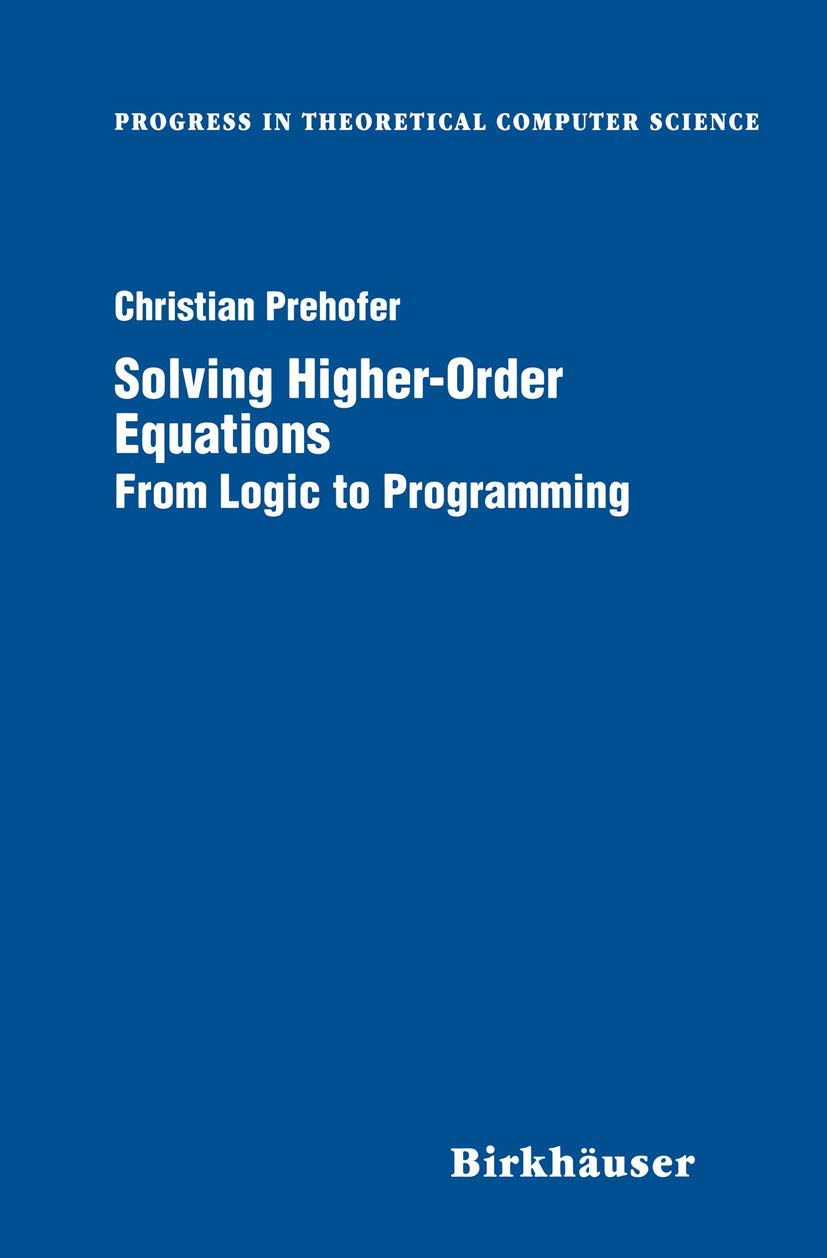
This monograph develops techniques for equational reasoning in higherorder logic. Due to its expressiveness, higherorder logic is used for specification and verification of hardware, software, and mathematics. In these applica tions, higherorder logic provides the necessary level of abstraction for con cise and natural formulations. The main assets of higherorder logic are quan tification over functions or predicates and its abstraction mechanism. These allow one to represent quantification in formulas and other variablebinding constructs. In this book, we focus on equational logic as a fundamental and natural concept in computer science and mathematics. We present calculi for equa tional reasoning modulo higherorder equations presented as rewrite rules. This is followed by a systematic development from general equational rea soning towards effective calculi for declarative programming in higherorder logic and Acalculus. This aims at integrating and generalizing declarative programming models such as functional and logic programming. In these two prominent declarative computation models we can view a program as a logical theory and a computation as a deduction.
⚠️ WARNING (California Proposition 65):
This product may contain chemicals known to the State of California to cause cancer,
birth defects, or other reproductive harm.
For MAP (Minimum Advertised Price) violations and Intellectual Property (IP) or Trademark concerns, please contact:
support@ergodebooks.com
⚠️ California Proposition 65 Warning: Some products sold on this website may expose you to chemicals known to the State of California to cause cancer, birth defects, or other reproductive harm. For more information, visit www.P65Warnings.ca.gov.