

Title
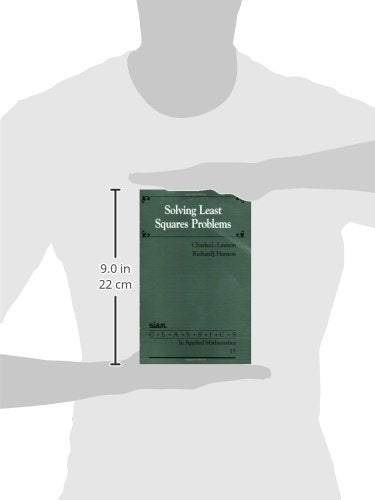
Solving Least Squares Problems (Classics in Applied Mathematics, Series Number 15),Used
Processing time: 1-3 days
US Orders Ships in: 3-5 days
International Orders Ships in: 8-12 days
Return Policy: 15-days return on defective items
Payment Option

An accessible text for the study of numerical methods for solving least squares problems remains an essential part of a scientific software foundation. This book has served this purpose well. Numerical analysts, statisticians, and engineers have developed techniques and nomenclature for the least squares problems of their own discipline. This wellorganized presentation of the basic material needed for the solution of least squares problems can unify this divergence of methods. Mathematicians, practising engineers, and scientists will welcome its return to print. The material covered includes Householder and Givens orthogonal transformations, the QR and SVD decompositions, equality constraints, solutions in nonnegative variables, banded problems, and updating methods for sequential estimation. Both the theory and practical algorithms are included. The easily understood explanations and the appendix providing a review of basic linear algebra make the book accessible for the nonspecialist.
⚠️ WARNING (California Proposition 65):
This product may contain chemicals known to the State of California to cause cancer, birth defects, or other reproductive harm.
For more information, please visit www.P65Warnings.ca.gov.
- Q: What is the page count of this book? A: This book contains three hundred fifty pages. It provides comprehensive coverage of numerical methods for solving least squares problems.
- Q: What are the dimensions of the book? A: The book measures six point twenty-six inches in length, zero point seventy-five inches in width, and nine point twenty-five inches in height. These dimensions make it a manageable size for reading and referencing.
- Q: What kind of binding does this book have? A: This book is published in paperback binding. This makes it lightweight and easy to handle during study sessions.
- Q: Who is the author of this book? A: The author of this book is Charles L. Lawson. He is known for his expertise in numerical analysis and applied mathematics.
- Q: What is the main focus of this book? A: The book focuses on numerical methods for solving least squares problems. It serves as an essential resource for students and professionals in the field.
- Q: How is this book suitable for non-specialists? A: Yes, the book includes easily understood explanations and an appendix reviewing basic linear algebra. This makes it accessible for those without a strong background in mathematics.
- Q: Can this book be used for self-study? A: Yes, this book is well-organized for self-study. It covers both theory and practical algorithms, making it ideal for independent learners.
- Q: Is this book appropriate for beginners in mathematics? A: Yes, it is suitable for beginners. The accessible explanations and review materials help newcomers grasp the necessary concepts.
- Q: What type of readers would benefit from this book? A: Mathematicians, practicing engineers, and scientists would benefit from this book. It unifies various methods and techniques used across disciplines.
- Q: How should I care for this book? A: To keep this book in good condition, store it in a dry place away from direct sunlight. Avoid heavy stacking to prevent warping.
- Q: What if my book arrives damaged? A: If your book arrives damaged, contact customer service for a replacement. Most retailers have a return policy for damaged goods.
- Q: Is there a warranty for this book? A: No, books typically do not come with a warranty. However, check the retailer's return policy for any guarantees.
- Q: What are common issues readers face with this book? A: Common issues might include difficulty understanding certain concepts. If this occurs, supplemental materials or study groups may help.
- Q: How does this book compare to others in its field? A: This book is comprehensive and well-organized, making it a strong choice compared to others. It effectively bridges the gap between theory and practice.
- Q: Is this book recommended for advanced studies? A: Yes, while it is accessible for beginners, it also provides valuable insights for advanced studies in numerical methods.
- Q: What are the key features of this book? A: Key features include its organization, comprehensive coverage, and accessibility for non-specialists. It is also noted for practical algorithms and theory.