
Title

Soviet Heavy Interceptors Red Star Vol. 19,Used
Sold by Ergodebooks, an authorized reseller.
Returns accepted within 30 days | support@ergodebooks.com
Shipping Information
- Free Standard Shipping — United States only
- Processing Time: 3–5 business days
- Estimated Delivery: 6–10 business days after dispatch
- Double-boxed, fully insured & discreetly packaged
- Tracking number sent via email once dispatched
Returns & Refund
Returns accepted within 30 days of delivery.
Damaged or Defective Item
Free return shipping + replacement or full refund
Wrong Item Received
Free return shipping + replacement or full refund
Change of Mind
Return shipping at customer's expense · 25% restocking fee applies
Payment Option

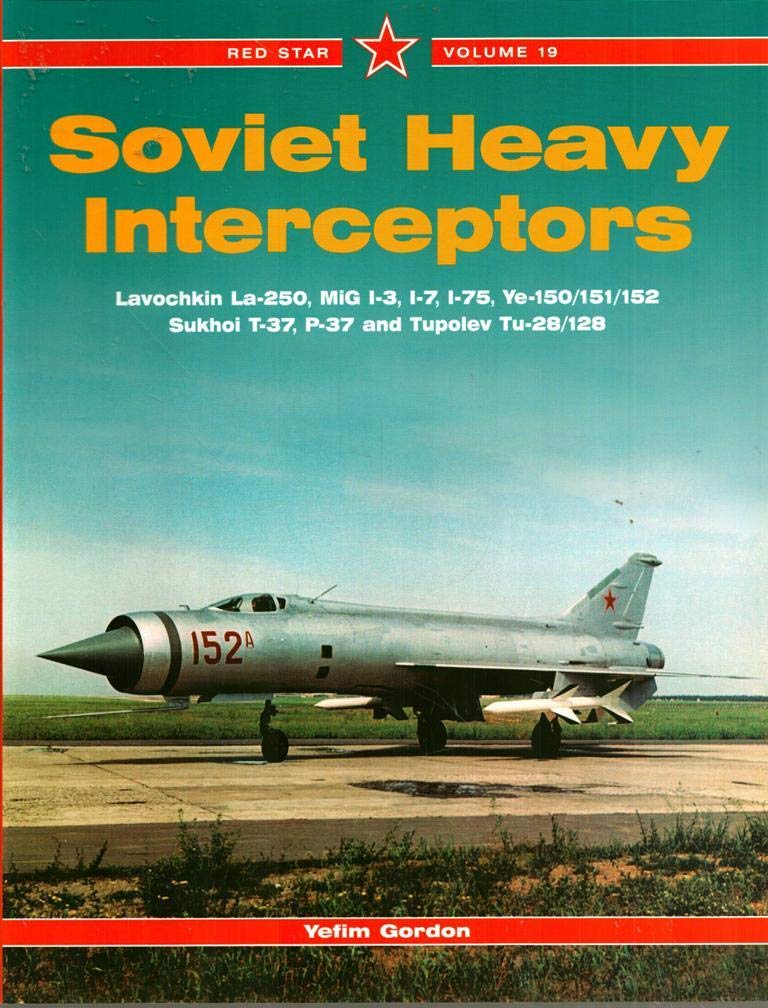
In the nervous 1950s, the Soviet Union faced the task of defending its borders against intrusions by Western spyplanes and deterring an attack by Western bomber armadas. The mission was to intercept incoming adversaries at long range, which required plenty of engine power, ample fuel and heavy armament. Several Soviet design bureaus took on this priority task. The first heavy interceptor from the Mikoyan stable was the sweptwing I3 of 1956 which, though never flown, was the precursor of the cannonarmed I7U and the missilearmed I75. These were followed by the deltawinged Ye150 series of the late 1950s and early 1960s the singleengined Ye150 and Ye152 and the twinengined Ye152A. Known to the outside world as the Ye166, the huge Ye152M set an impressive speed record of 2,681 km/h on 7th July 1962. These aircraft paved the way for the MiG25 interceptor. Other contenders included the Sukhoi T37, terminated by government order before it had a chance to fly. Even the Tupolev OKB, traditionally specializing in heavy bombers and airliners, developed the twinengined Tu128 the world's largest interceptor which was so huge that it was initially mistaken for a medium bomber.
⚠️ WARNING (California Proposition 65):
This product may contain chemicals known to the State of California to cause cancer, birth defects, or other reproductive harm.
For more information, please visit www.P65Warnings.ca.gov.