
Title
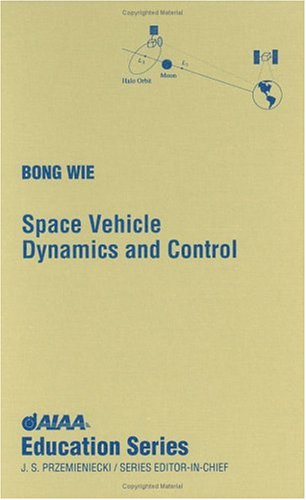
Space Vehicle Dynamics and Control (AIAA Education Series),Used
Sold by Ergodebooks, an authorized reseller.
Returns accepted within 30 days | support@ergodebooks.com
Shipping Information
- Free Standard Shipping — United States only
- Processing Time: 3–5 business days
- Estimated Delivery: 6–10 business days after dispatch
- Double-boxed, fully insured & discreetly packaged
- Tracking number sent via email once dispatched
Returns & Refund
Returns accepted within 30 days of delivery.
Damaged or Defective Item
Free return shipping + replacement or full refund
Wrong Item Received
Free return shipping + replacement or full refund
Change of Mind
Return shipping at customer's expense · 25% restocking fee applies
Payment Option

Space Vehicle Dynamics and Control provides a solid foundation in dynamic modeling, analysis, and control of space vehicles. More than 200 figures, photographs, and tables are featured in detailed sections covering the fundamentals of controlling orbital, attitude, and structural motions of space vehicles.The textbook highlights a range of orbital maneuvering and control problems: orbital transfer, rendezvous, and halo orbit determination and control. Rotational maneuvering and attitude control problems of space vehicles under the influence of reaction jet firings, internal energy dissipation, or momentum transfer via reaction wheels and control moment gyros are treated in detail. The textbook also highlights the analysis and design of attitude control systems in the presence of structural flexibility and/or propellant sloshing. At the end of each chapter, Dr. Wie includes a helpful list of references for graduate students and working professionals studying spacecraft dynamics and control. A bibliography of more than 350 additional references in the field of spacecraft guidance, control, and dynamics is also provided at the end of the book.Space Vehicle Dynamics and Control requires a thorough knowledge of vector and matrix algebra, calculus, ordinary differential equations, engineering mechanics, and linear system dynamics and control. The first two chapters provide a summary of such necessary background material. Since some problems may require the use of software for the analysis, control design, and numerical simulation, readers should have access to computational software (i.e., MATLAB) on a personal computer.
⚠️ WARNING (California Proposition 65):
This product may contain chemicals known to the State of California to cause cancer, birth defects, or other reproductive harm.
For more information, please visit www.P65Warnings.ca.gov.
- Q: What topics are covered in 'Space Vehicle Dynamics and Control'? A: The book covers dynamic modeling, analysis, and control of space vehicles, including orbital transfer, rendezvous, and attitude control problems.
- Q: Is the textbook suitable for beginners? A: While it provides foundational material, a thorough knowledge of vector and matrix algebra, calculus, and engineering mechanics is recommended for readers.
- Q: Who is the author of the book? A: The author of 'Space Vehicle Dynamics and Control' is Bong Wie.
- Q: What type of binding does this book have? A: The book is bound in hardcover, which provides durability for frequent use.
- Q: How many pages does this textbook have? A: The textbook contains a total of 661 pages.
- Q: What is the condition of the used book? A: This is a used book in good condition, specifically rated as 'Very Good'.
- Q: Does the book include references for further reading? A: Yes, each chapter includes a helpful list of references, along with a bibliography of over 350 additional resources in the field.
- Q: What software is recommended for users of this textbook? A: Readers are advised to have access to computational software, such as MATLAB, for analysis and simulation tasks.
- Q: When was 'Space Vehicle Dynamics and Control' published? A: The book was published on January 1, 1709.
- Q: What edition of the book is available? A: This is the first edition of 'Space Vehicle Dynamics and Control'.