If you have any questions, you are always welcome to contact us. We'll get back to you as soon as possible, withing 24 hours on weekdays.
Customer service
All questions about your order, return and delivery must be sent to our customer service team by e-mail at yourstore@yourdomain.com
Sale & Press
If you are interested in selling our products, need more information about our brand or wish to make a collaboration, please contact us at press@yourdomain.com
Help
If you have any questions, you are always welcome to contact us. We'll get back to you as soon as possible, withing 24 hours on weekdays.
Customer service
All questions about your order, return and delivery must be sent to our customer service team by e-mail at yourstore@yourdomain.com
Sale & Press
If you are interested in selling our products, need more information about our brand or wish to make a collaboration, please contact us at press@yourdomain.com
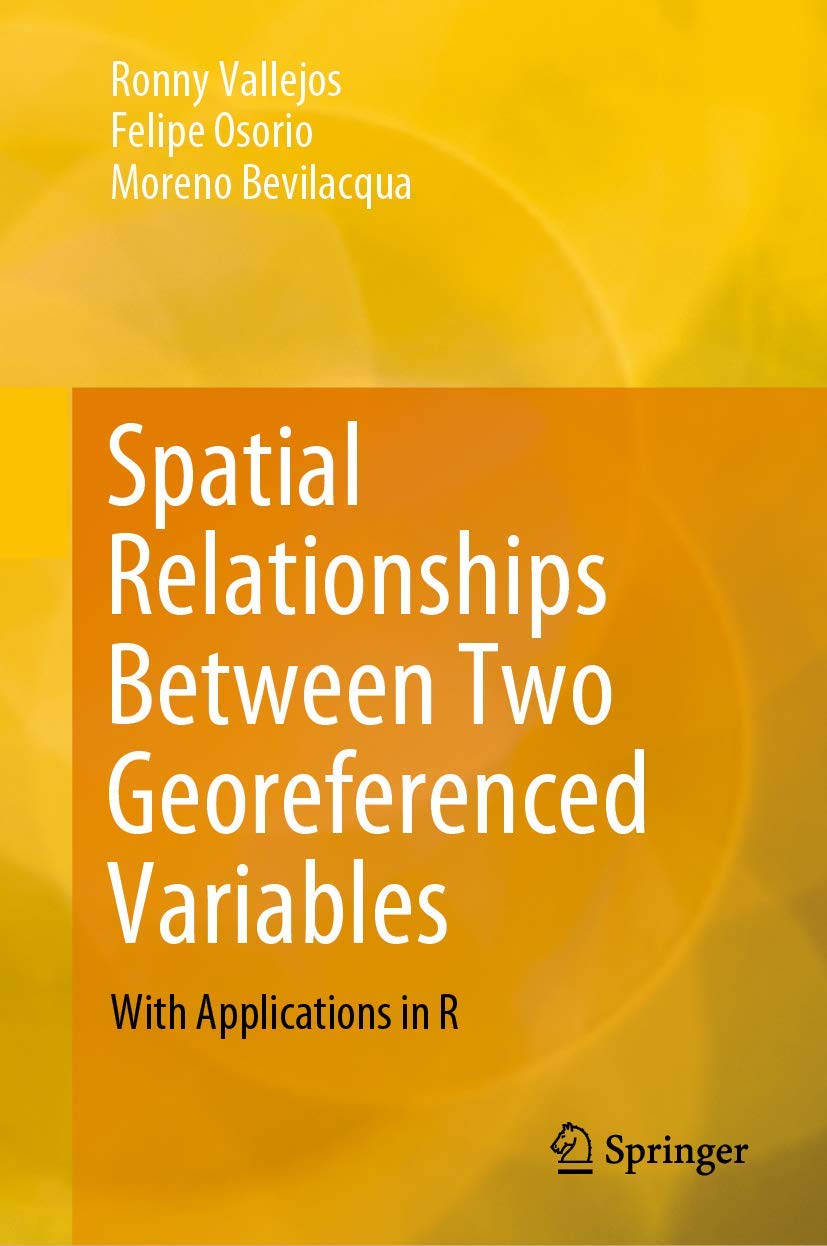
This book offers essential, systematic information on the assessment of the spatial association between two processes from a statistical standpoint. Divided into eight chapters, the book begins with preliminary concepts, mainly concerning spatial statistics. The following seven chapters focus on the methodologies needed to assess the correlation between two or more processes; from theory introduced 35 years ago, to techniques that have only recently been published. Furthermore, each chapter contains a section on R computations to explore how the methodology works with real data. References and a list of exercises are included at the end of each chapter.The assessment of the correlation between two spatial processes has been tackled from several different perspectives in a variety of applications fields. In particular, the problem of testing for the existence of spatial association between two georeferenced variables is relevant for posterior modeling and inference. One evident application in this context is the quantification of the spatial correlation between two images (processes defined on a rectangular grid in a twodimensional space). From a statistical perspective, this problem can be handled via hypothesis testing, or by using extensions of the correlation coefficient. In an imageprocessing framework, these extensions can also be used to define similarity indices between images.
⚠️ WARNING (California Proposition 65):
This product may contain chemicals known to the State of California to cause cancer,
birth defects, or other reproductive harm.
For MAP (Minimum Advertised Price) violations and Intellectual Property (IP) or Trademark concerns, please contact:
support@ergodebooks.com
⚠️ California Proposition 65 Warning: Some products sold on this website may expose you to chemicals known to the State of California to cause cancer, birth defects, or other reproductive harm. For more information, visit www.P65Warnings.ca.gov.