If you have any questions, you are always welcome to contact us. We'll get back to you as soon as possible, withing 24 hours on weekdays.
Customer service
All questions about your order, return and delivery must be sent to our customer service team by e-mail at yourstore@yourdomain.com
Sale & Press
If you are interested in selling our products, need more information about our brand or wish to make a collaboration, please contact us at press@yourdomain.com
Help
If you have any questions, you are always welcome to contact us. We'll get back to you as soon as possible, withing 24 hours on weekdays.
Customer service
All questions about your order, return and delivery must be sent to our customer service team by e-mail at yourstore@yourdomain.com
Sale & Press
If you are interested in selling our products, need more information about our brand or wish to make a collaboration, please contact us at press@yourdomain.com
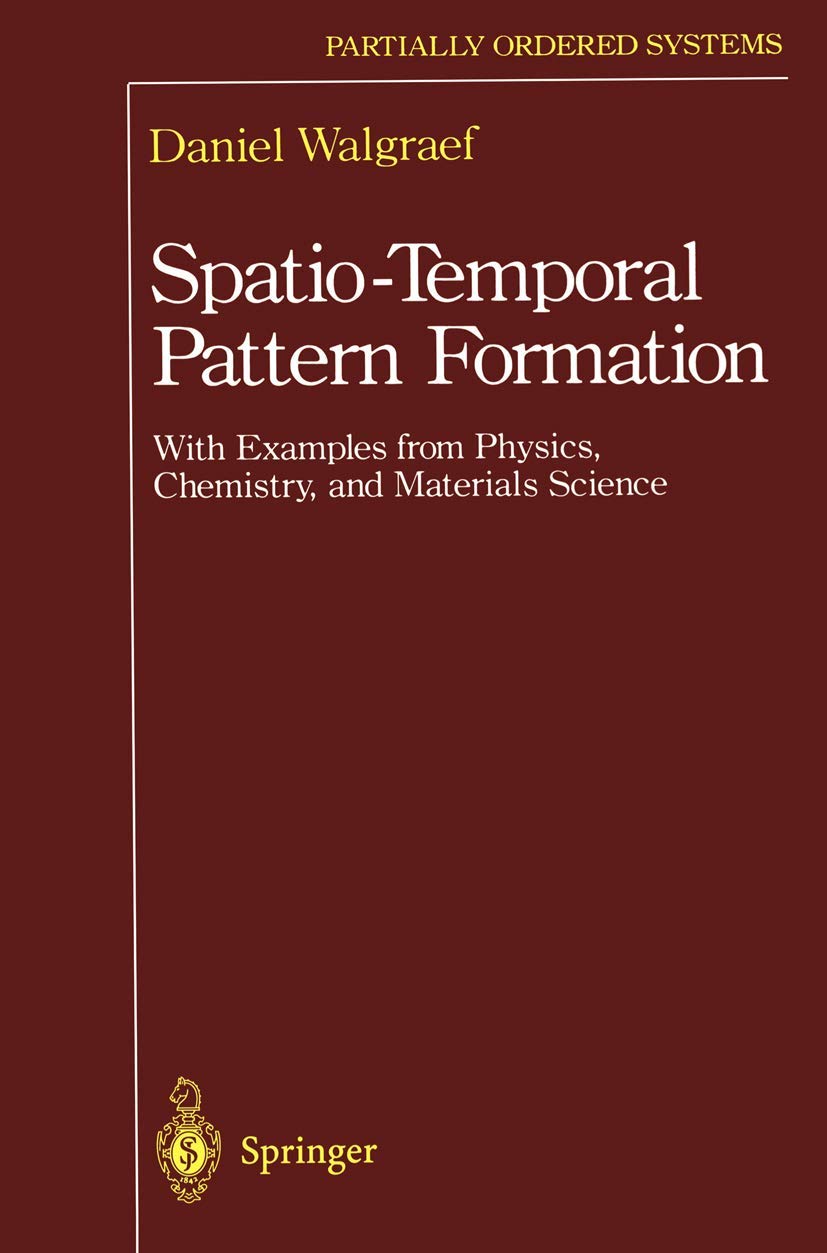
Spatiotemporal patterns appear almost everywhere in nature, and their description and understanding still raise important and basic questions. However, if one looks back 20 or 30 years, definite progress has been made in the modeling of insta bilities, analysis of the dynamics in their vicinity, pattern formation and stability, quantitative experimental and numerical analysis of patterns, and so on. Universal behaviors of complex systems close to instabilities have been determined, leading to the wide interdisciplinarity of a field that is now referred to as nonlinear science or science of complexity, and in which initial concepts of dissipative structures or synergetics are deeply rooted. In pioneering domains related to hydrodynamics or chemical instabilities, the interactions between experimentalists and theoreticians, sometimes on a daily basis, have been a key to progress. Everyone in the field praises the role played by the interactions and permanent feedbacks between ex perimental, numerical, and analytical studies in the achievements obtained during these years. Many aspects of convective patterns in normal fluids, binary mixtures or liquid crystals are now understood and described in this framework. The generic pres ence of defects in extended systems is now well established and has induced new developments in the physics of laser with large Fresnel numbers. Last but not least, almost 40 years after his celebrated paper, Turing structures have finally been ob tained in reallife chemical reactors, triggering anew intense activity in the field of reactiondiffusion systems.
⚠️ WARNING (California Proposition 65):
This product may contain chemicals known to the State of California to cause cancer,
birth defects, or other reproductive harm.
For MAP (Minimum Advertised Price) violations and Intellectual Property (IP) or Trademark concerns, please contact:
support@ergodebooks.com
⚠️ California Proposition 65 Warning: Some products sold on this website may expose you to chemicals known to the State of California to cause cancer, birth defects, or other reproductive harm. For more information, visit www.P65Warnings.ca.gov.