
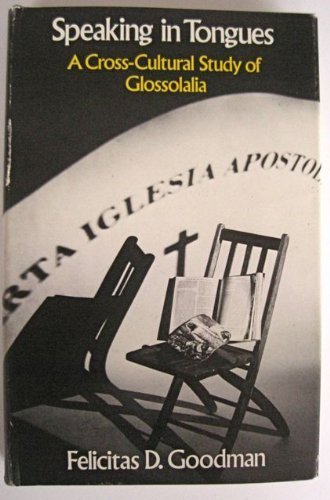
Title
Speaking in tongues;: A crosscultural study of glossolalia,Used
Sold by Ergodebooks, an authorized reseller.
Returns accepted within 30 days | support@ergodebooks.com
Shipping Information
- Free Standard Shipping — United States only
- Processing Time: 3–5 business days
- Estimated Delivery: 6–10 business days after dispatch
- Double-boxed, fully insured & discreetly packaged
- Tracking number sent via email once dispatched
Returns & Refund
Returns accepted within 30 days of delivery.
Damaged or Defective Item
Free return shipping + replacement or full refund
Wrong Item Received
Free return shipping + replacement or full refund
Change of Mind
Return shipping at customer's expense · 25% restocking fee applies
Payment Option

Speaking in tongues, or glossolalia, is practiced in many different religions around the world. Dismissed as meaningless gibberish by some observers, it has been the subject of only a few fragmentary studies. The work of Felicitas D. Goodman represents the first crosscultural analysis of this enigmatic behavior, and she brings to her research an extensive background in linguistics and anthropology. Dr. Goodman's fieldwork included living with apostolic congregations in Mexico City, in the Yucatan with Maya Indians, and visits with a congregation in Hammond, Indiana. Her observations were preserved on a remarkable collection of sound recordings and films. For this book she presents a selection of conversion stories that highlights the personality structure and experiences of the speakers. A detailed analysis of the phonological and suprasegmental features of the recorded utterances show a surprising crosscultural agreement. This led Goodman to believe that glossolalists speak the way they do because their speech behavior is modified in a particular mental state, often termed trance, into which they place themselves. In this light the glossolalia utterance is seen as an artifact of a hyperaroused mental state, or, in Chomskyan terms, as the surface structure of a nonlinguistic deep structure, that of the altered state of consciousness. Goodman describes the hyperaroused mental state as a neurophysiological phenomenon, as well as the associated patterns of movement, and the problems of waking from it. Goodman's diachronic approach yielded equally surprising data about the changes and the waning of the behavior over time. But, as she observes, ''we have barely touched the edge of a very large area of inquiry.'' Her fascinating study opens a number of new avenues of research for anthropologists, such as the study of physiological states accompanying linguistic and ritual behavior. Felicitas D. Goodman (19142005), an internationally accredited translator and interpreter, was Associate Professor Emeritus of Anthropology at Denison University in Granville, Ohio. She also authored a number of papers on glossolalia. A religious anthropoligist, she wrote numerous books including How About Demons?; Where the Spirits Ride the Wind; and Ecstasy, Ritual, and Alternate Reality.
⚠️ WARNING (California Proposition 65):
This product may contain chemicals known to the State of California to cause cancer, birth defects, or other reproductive harm.
For more information, please visit www.P65Warnings.ca.gov.