If you have any questions, you are always welcome to contact us. We'll get back to you as soon as possible, withing 24 hours on weekdays.
Customer service
All questions about your order, return and delivery must be sent to our customer service team by e-mail at yourstore@yourdomain.com
Sale & Press
If you are interested in selling our products, need more information about our brand or wish to make a collaboration, please contact us at press@yourdomain.com
Help
If you have any questions, you are always welcome to contact us. We'll get back to you as soon as possible, withing 24 hours on weekdays.
Customer service
All questions about your order, return and delivery must be sent to our customer service team by e-mail at yourstore@yourdomain.com
Sale & Press
If you are interested in selling our products, need more information about our brand or wish to make a collaboration, please contact us at press@yourdomain.com
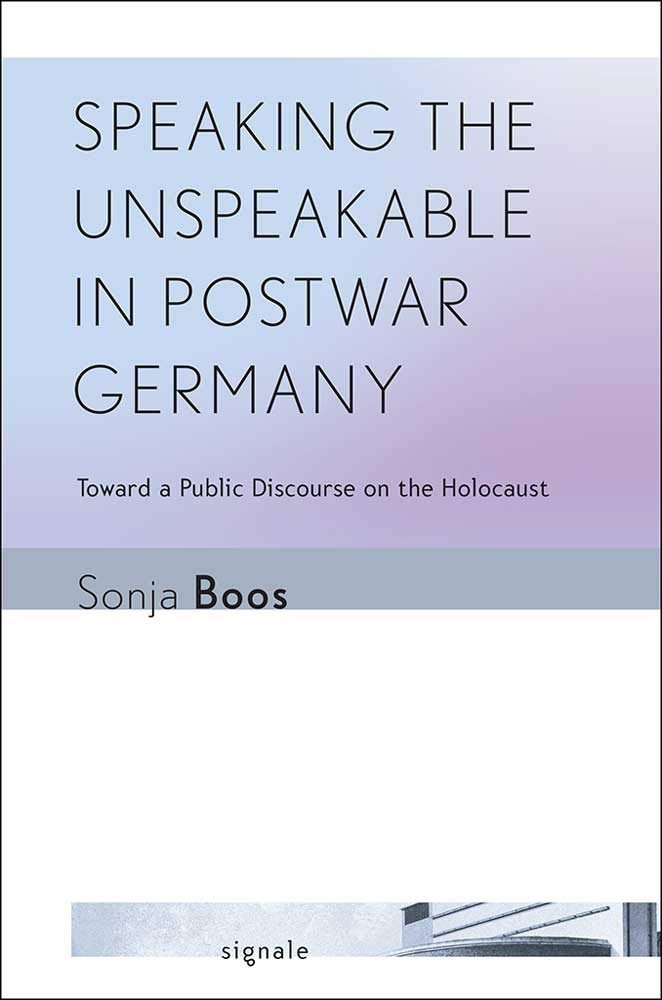
Speaking the Unspeakable in Postwar Germany is an interdisciplinary study of a diverse set of public speeches given by major literary and cultural figures in the 1950s and 1960s. Through close readings of canonical speeches by Hannah Arendt, Theodor W. Adorno, Ingeborg Bachmann, Martin Buber, Paul Celan, Uwe Johnson, Peter Szondi, and Peter Weiss, Sonja Boos demonstrates that these speakers both facilitated and subverted the construction of a public discourse about the Holocaust in postwar West Germany. The authors analysis of original audio recordings of the speech events (several of which will be available on a companion website) improves our understanding of the spoken, performative dimension of public speeches.Speaking the Unspeakable in Postwar Germany emphasizes the social constructedness of discourse, experience, and identity, but does not neglect the pragmatic conditions of aesthetic and intellectual productionmost notably, the felt need to respond to the breach in tradition caused by the Holocaust. The book thereby illuminates the process by which a set of writers and intellectuals, instead of trying to mend what they perceived as a radical break in historical continuity or corroborating the myth of a "new beginning," searched for ways to make this historical rupture rhetorically and semantically discernible and literally audible.
⚠️ WARNING (California Proposition 65):
This product may contain chemicals known to the State of California to cause cancer,
birth defects, or other reproductive harm.
For MAP (Minimum Advertised Price) violations and Intellectual Property (IP) or Trademark concerns, please contact:
support@ergodebooks.com
⚠️ California Proposition 65 Warning: Some products sold on this website may expose you to chemicals known to the State of California to cause cancer, birth defects, or other reproductive harm. For more information, visit www.P65Warnings.ca.gov.