If you have any questions, you are always welcome to contact us. We'll get back to you as soon as possible, withing 24 hours on weekdays.
Customer service
All questions about your order, return and delivery must be sent to our customer service team by e-mail at yourstore@yourdomain.com
Sale & Press
If you are interested in selling our products, need more information about our brand or wish to make a collaboration, please contact us at press@yourdomain.com
Help
If you have any questions, you are always welcome to contact us. We'll get back to you as soon as possible, withing 24 hours on weekdays.
Customer service
All questions about your order, return and delivery must be sent to our customer service team by e-mail at yourstore@yourdomain.com
Sale & Press
If you are interested in selling our products, need more information about our brand or wish to make a collaboration, please contact us at press@yourdomain.com
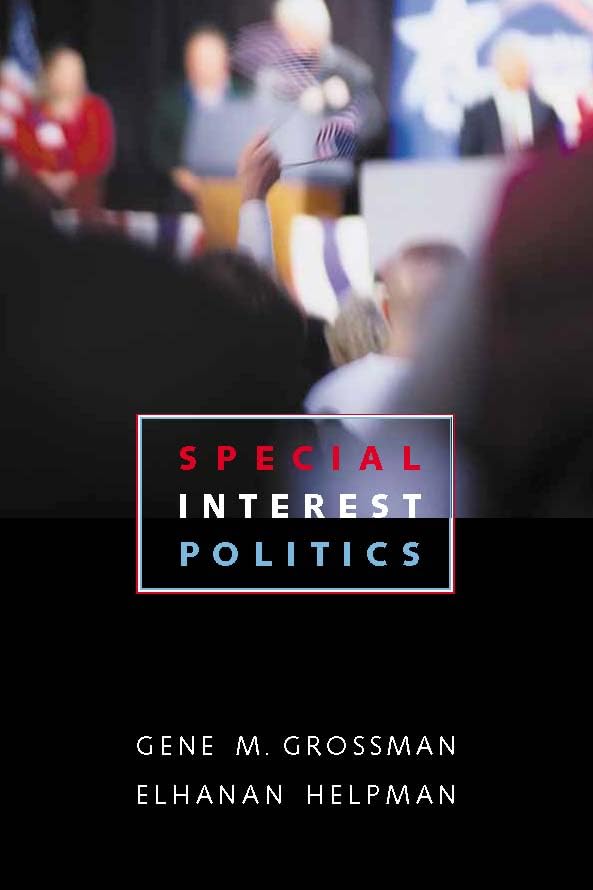
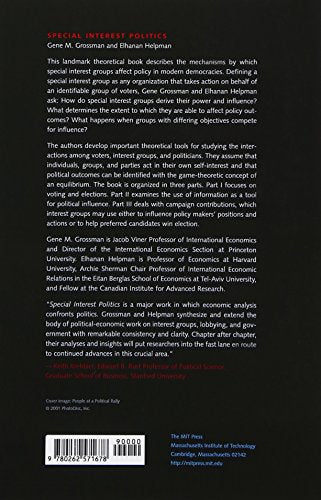
This landmark theoretical book is about the mechanisms by which special interest groups affect policy in modern democracies. Defining a special interest group as any organization that takes action on behalf of an identifiable group of voters, Gene Grossman and Elhanan Helpman ask: How do special interest groups derive their power and influence? What determines the extent to which they are able to affect policy outcomes? What happens when groups with differing objectives compete for influence?The authors develop important theoretical tools for studying the interactions among voters, interest groups, and politicians. They assume that individuals, groups, and parties act in their own selfinterest and that political outcomes can be identified with the gametheoretic concept of an equilibrium. Throughout, they progress from the simple to the more complex. When analyzing campaign giving, for example, they begin with a model of a single interest group and a single, incumbent policy maker. They proceed to add additional interest groups, a legislature with several independent politicians, and electoral competition between rival political parties. The book is organized in three parts. Part I focuses on voting and elections. Part II examines the use of information as a tool for political influence. Part III deals with campaign contributions, which interest groups may use either to influence policy makers' positions and actions or to help preferred candidates to win election.
⚠️ WARNING (California Proposition 65):
This product may contain chemicals known to the State of California to cause cancer,
birth defects, or other reproductive harm.
For MAP (Minimum Advertised Price) violations and Intellectual Property (IP) or Trademark concerns, please contact:
support@ergodebooks.com
⚠️ California Proposition 65 Warning: Some products sold on this website may expose you to chemicals known to the State of California to cause cancer, birth defects, or other reproductive harm. For more information, visit www.P65Warnings.ca.gov.