
Title
Sr Programming Language: Concurrency Pract,Used
Sold by Ergodebooks, an authorized reseller.
Returns accepted within 30 days | support@ergodebooks.com
Shipping Information
- Free Standard Shipping — United States only
- Processing Time: 3–5 business days
- Estimated Delivery: 6–10 business days after dispatch
- Double-boxed, fully insured & discreetly packaged
- Tracking number sent via email once dispatched
Returns & Refund
Returns accepted within 30 days of delivery.
Damaged or Defective Item
Free return shipping + replacement or full refund
Wrong Item Received
Free return shipping + replacement or full refund
Change of Mind
Return shipping at customer's expense · 25% restocking fee applies
Payment Option

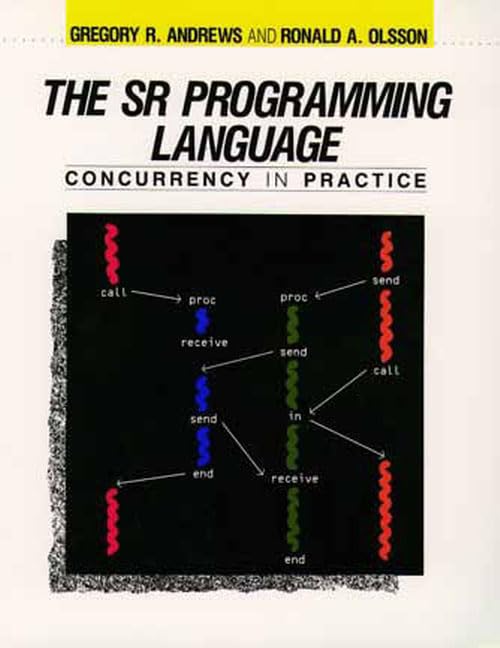
Sr (Synchronizing Resources) Is A Powerful And Flexible Language For Concurrent Programming. With Its Explicit Mechanisms And Concurrency, Communication, And Synchronization, Programmers Can Easily Learn To Write Programs For Both Shared And Distributedmemory Applications And Machines.This Book, Written By The Language Designers, Provides A Complete Introduction To Sr And Gives The Reader The Tools For Learning About And Experimenting With Concurrency. Features *Provides An Accessible, Clear Introduction To Sr By The Language Designers. *Teaches Practical Techniques Through Numerous Realistic Examples Of Parallel And Distributed Programming Problems. *Examines 'Classic' Concurrent Programming Problems As Well As Many Important Parallel And Distributed Programming Problems. *Illustrates Tradeoffs Between Language Mechanisms To Help The Reader Understand And Make Optimum Design Decisions *Reinforces Key Points With Numerous Endofchapter Exercises *Includes Six Appendices That Summarize The Language For Quick Reference, Show How To Develop And Execute Programs, And Describe The Implementation.The Sr Language Implementation Is Available, Free, From The Sr Project, University Of Arizona, At Arizona.Edu/Sr/. 0805300880B04062001
⚠️ WARNING (California Proposition 65):
This product may contain chemicals known to the State of California to cause cancer, birth defects, or other reproductive harm.
For more information, please visit www.P65Warnings.ca.gov.
- Q: What is the page count of this book? A: This book has three hundred forty-four pages. This length provides a comprehensive exploration of concurrent programming.
- Q: What are the dimensions of this book? A: The book measures seven point one inches in length, nine point one inches in height, and zero point nine one inches in thickness. These dimensions make it easy to handle and read.
- Q: What type of binding does this book have? A: This book is bound in paperback. Paperback binding is flexible and lightweight, ideal for portability.
- Q: Who is the author of this book? A: The author of this book is Andrews. He brings expertise in concurrent programming to this educational text.
- Q: What is the main focus of this book? A: The book focuses on the SR programming language and its applications in concurrent programming. It teaches readers about concurrency, communication, and synchronization.
- Q: Does this book include exercises? A: Yes, this book includes numerous end-of-chapter exercises. These exercises reinforce key concepts and help solidify understanding.
- Q: How do I use this book for learning? A: You can use this book by following the structured chapters and completing the exercises. It is designed for readers to learn and experiment with concurrency.
- Q: Is this book suitable for beginners? A: Yes, this book is suitable for beginners. It provides a clear introduction to the SR language and its concepts.
- Q: Can I use this book for reference while programming? A: Yes, this book includes appendices that summarize the language for quick reference. It is a great resource while programming.
- Q: What is the recommended audience for this book? A: This book is recommended for students and professionals interested in parallel and distributed programming. It caters to a wide audience.
- Q: Is there a specific programming background needed to understand this book? A: No specific programming background is required to understand this book. It is accessible to those new to concurrent programming.
- Q: How can I access the SR language implementation? A: The SR language implementation is available for free from the SR Project at the University of Arizona. You can access it via ftp://cs.arizona.edu/sr/.
- Q: What topics are covered in the exercises? A: The exercises cover classic concurrent programming problems as well as important parallel and distributed programming issues. They help apply learned concepts.
- Q: Is there any information about optimizing design decisions? A: Yes, the book illustrates trade-offs between language mechanisms. This helps readers understand and make optimum design decisions.
- Q: Does this book provide real-world programming examples? A: Yes, it teaches practical techniques through numerous realistic examples. These examples enhance understanding of parallel programming.