
Title


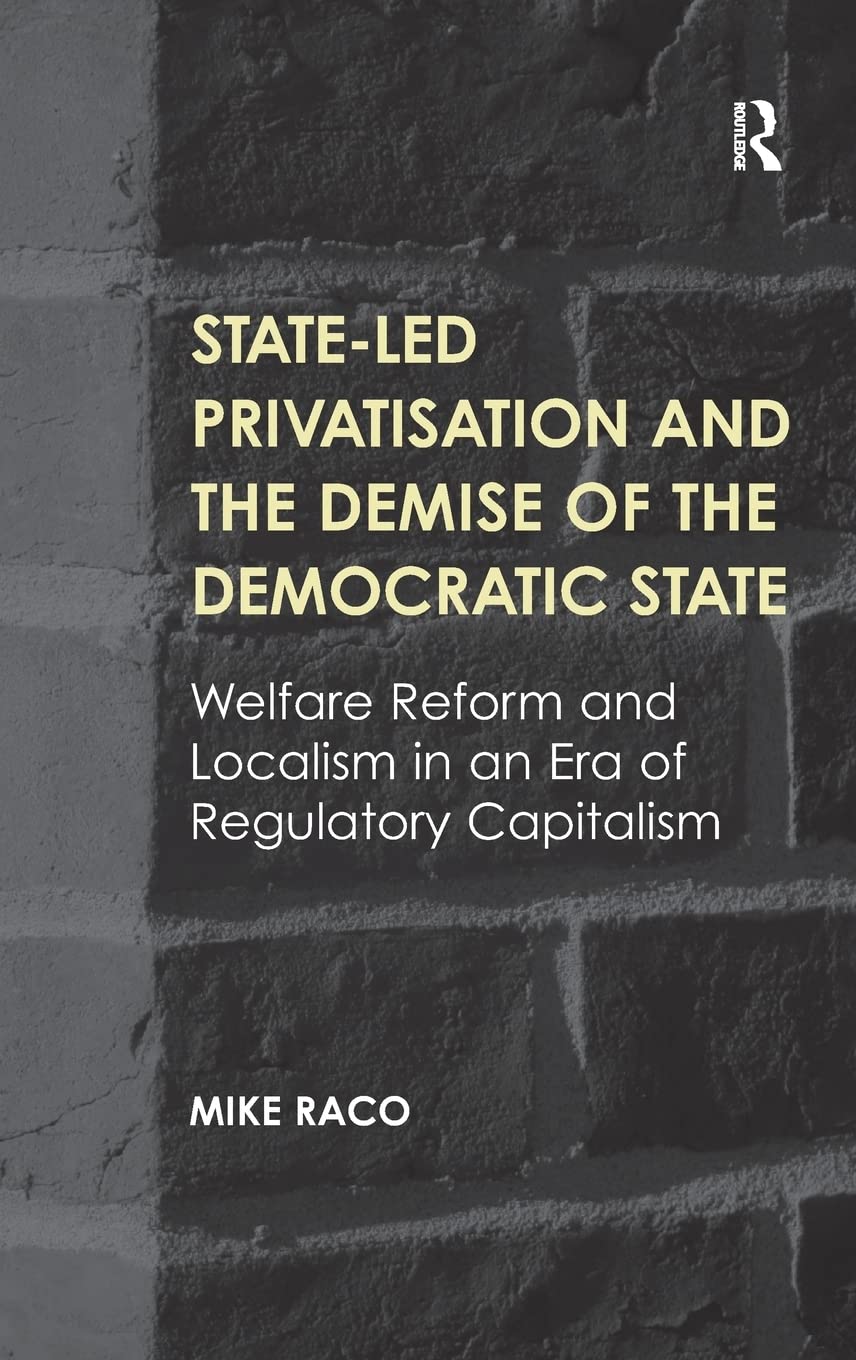
Stateled Privatisation and the Demise of the Democratic State: Welfare Reform and Localism in an Era of Regulatory Capitalism,Used
Sold by Ergodebooks, an authorized reseller.
Returns accepted within 30 days | support@ergodebooks.com
Shipping Information
- Free Standard Shipping — United States only
- Processing Time: 3–5 business days
- Estimated Delivery: 6–10 business days after dispatch
- Double-boxed, fully insured & discreetly packaged
- Tracking number sent via email once dispatched
Returns & Refund
Returns accepted within 30 days of delivery.
Damaged or Defective Item
Free return shipping + replacement or full refund
Wrong Item Received
Free return shipping + replacement or full refund
Change of Mind
Return shipping at customer's expense · 25% restocking fee applies
Payment Option

For decades now we have been told that we are living through a governance revolution. Gone are the days when government agencies and bureaucrats told us what to do and how to do it. We are no longer clients of the state but empowered citizens who are able to take greater control over our own lives and the activities of those who govern in our name. Across the world the prevailing narrative has become one of Good Governance, devolution, liberation, and freedom of expression. In policy fields as diverse as development planning, healthcare, and public transport a neopluralist rhetoric has emerged based on the principles of coproduction and partnership working. And yet at the same time a curious paradox is emerging. Whilst the prevailing zeitgeist is one of openness and citizen empowerment, this book will show that in reality new modes of governance are emerging in which state controls have actually been expanded into many spheres of life that were previously left unregulated. For some a new political economy of regulatory capitalism has emerged and this, in turn, has ushered in unprecedented forms of stateled privatisation under which democraticallyelected politicians have voluntarily handed over their powers, responsibilities, and resources to new corporate elites who promise to deliver services in more efficient and equitable ways. As the discussion will show, in reality the rhetoric of Good Governance has, therefore, been used to legitimate the wholesale transfer of welfare assets and services beyond the democratic control of state actors and the citizens that they represent. Privatisation has become a new utopianism that involves a revolution in ways of thinking about democracy, governance, and urban management, the implications of which will be felt by current and future generations.
⚠️ WARNING (California Proposition 65):
This product may contain chemicals known to the State of California to cause cancer, birth defects, or other reproductive harm.
For more information, please visit www.P65Warnings.ca.gov.