If you have any questions, you are always welcome to contact us. We'll get back to you as soon as possible, withing 24 hours on weekdays.
Customer service
All questions about your order, return and delivery must be sent to our customer service team by e-mail at yourstore@yourdomain.com
Sale & Press
If you are interested in selling our products, need more information about our brand or wish to make a collaboration, please contact us at press@yourdomain.com
Help
If you have any questions, you are always welcome to contact us. We'll get back to you as soon as possible, withing 24 hours on weekdays.
Customer service
All questions about your order, return and delivery must be sent to our customer service team by e-mail at yourstore@yourdomain.com
Sale & Press
If you are interested in selling our products, need more information about our brand or wish to make a collaboration, please contact us at press@yourdomain.com
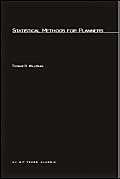
This is a text for introductory courses on statistics for planners. It is unique in its orientation and concern for the realities of planning practice.The book covers such standard topics as probability, random variables, conditional probability and Bayes' rule, descriptive statistics, commonly used distributions, crosstabulations, Bayesian estimation, significance tests, measures of strength of association, bivariate and multivariate regression, experimental design, and nonparametric statistics. Its original contri bution is its focus on planning applications, with emphasis on Bayesian methods, multivariate regression, the mathematical model of experimental results, and graphical methods of testing assumptions.Examples and homework problems have been chosen to relate statistical methods to issues of substantive interest to planners, in most cases using realworld data.While the book has been designed as a text for Masters in City Planning courses, portions of it have been used successfully at MIT in both doctoral and undergraduate planning courses. The applications and the range of statistical methods considered will also make this book a valuable resource for methodological classes in public policy analysis, economics, and social welfare. Students should be familiar with algebra, including logs, exponentials, and the graph ing of functions. Calculus is not used. No prior knowledge of probability and statistics is assumed, although familiarity with histograms would be helpful.
⚠️ WARNING (California Proposition 65):
This product may contain chemicals known to the State of California to cause cancer,
birth defects, or other reproductive harm.
For MAP (Minimum Advertised Price) violations and Intellectual Property (IP) or Trademark concerns, please contact:
support@ergodebooks.com
⚠️ California Proposition 65 Warning: Some products sold on this website may expose you to chemicals known to the State of California to cause cancer, birth defects, or other reproductive harm. For more information, visit www.P65Warnings.ca.gov.