If you have any questions, you are always welcome to contact us. We'll get back to you as soon as possible, withing 24 hours on weekdays.
Customer service
All questions about your order, return and delivery must be sent to our customer service team by e-mail at yourstore@yourdomain.com
Sale & Press
If you are interested in selling our products, need more information about our brand or wish to make a collaboration, please contact us at press@yourdomain.com
Help
If you have any questions, you are always welcome to contact us. We'll get back to you as soon as possible, withing 24 hours on weekdays.
Customer service
All questions about your order, return and delivery must be sent to our customer service team by e-mail at yourstore@yourdomain.com
Sale & Press
If you are interested in selling our products, need more information about our brand or wish to make a collaboration, please contact us at press@yourdomain.com
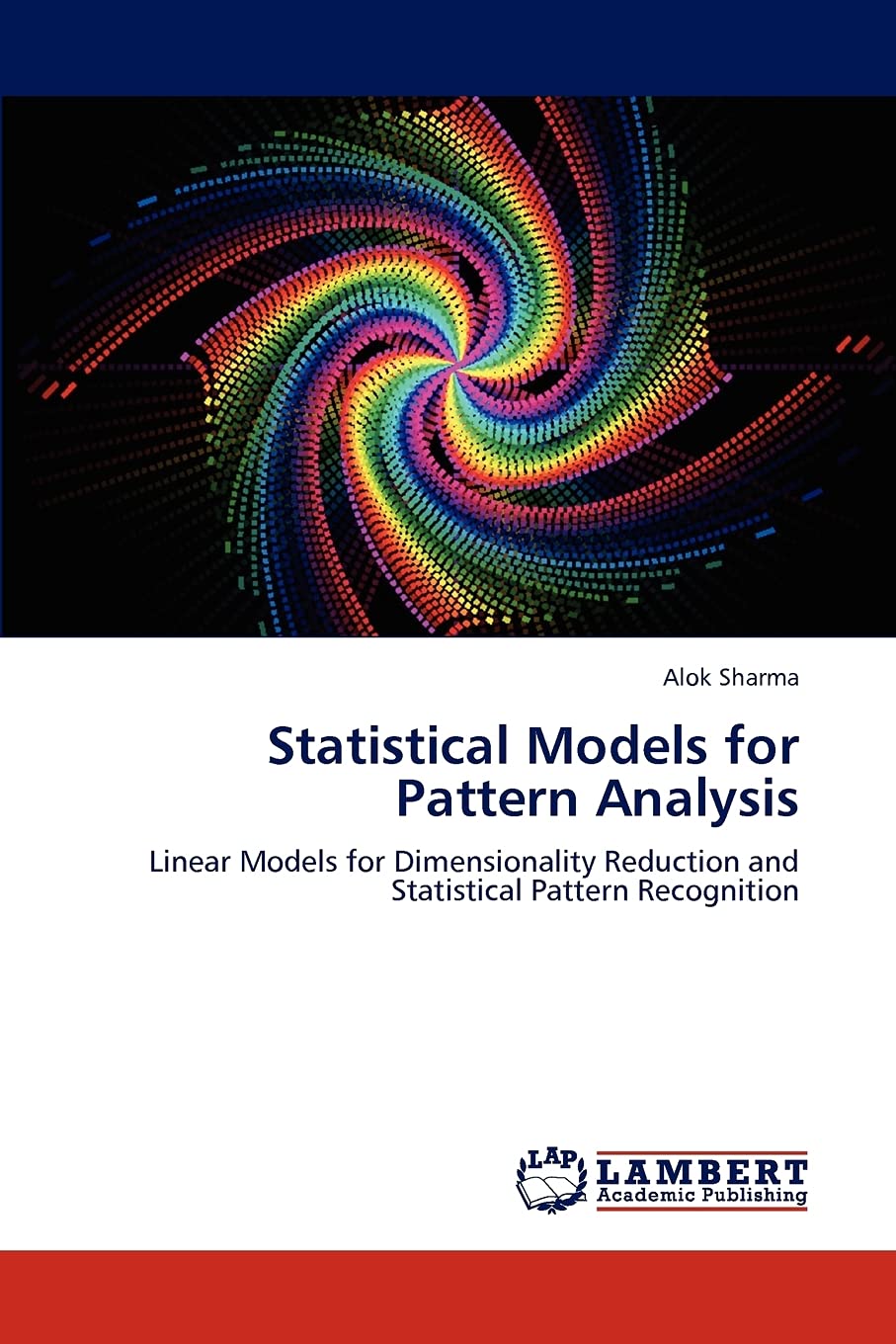
In this book a number of novel algorithms for dimension reduction and statistical pattern recognition for both supervised and unsupervised learning tasks have been presented. Several existing pattern classifiers and dimension reduction algorithms are studied. Their limitations and/or weaknesses are considered and accordingly improved techniques are given which overcome several of their shortcomings. Highlights are: i) Survey of basic dimensional reduction tools viz. principal component analysis and linear discriminant analysis are conducted. ii) Development of Fast PCA technique which finds the desired number of leading eigenvectors with much less computational cost. iii) Development of gradient LDA technique for SSS problem. iv) The rotational LDA technique is developed to reduce the overlapping of samples between the classes. v) A combined classifier using MDC, classdependent PCA and LDA is presented. vi) The splitting technique initialization is introduced in the local PCA technique. vii) A new perspective of subspace ICA (generalized ICA, where all the components need not be independent) is introduced by developing vector kurtosis (an extension of kurtosis) function.
⚠️ WARNING (California Proposition 65):
This product may contain chemicals known to the State of California to cause cancer,
birth defects, or other reproductive harm.
For MAP (Minimum Advertised Price) violations and Intellectual Property (IP) or Trademark concerns, please contact:
support@ergodebooks.com
⚠️ California Proposition 65 Warning: Some products sold on this website may expose you to chemicals known to the State of California to cause cancer, birth defects, or other reproductive harm. For more information, visit www.P65Warnings.ca.gov.