
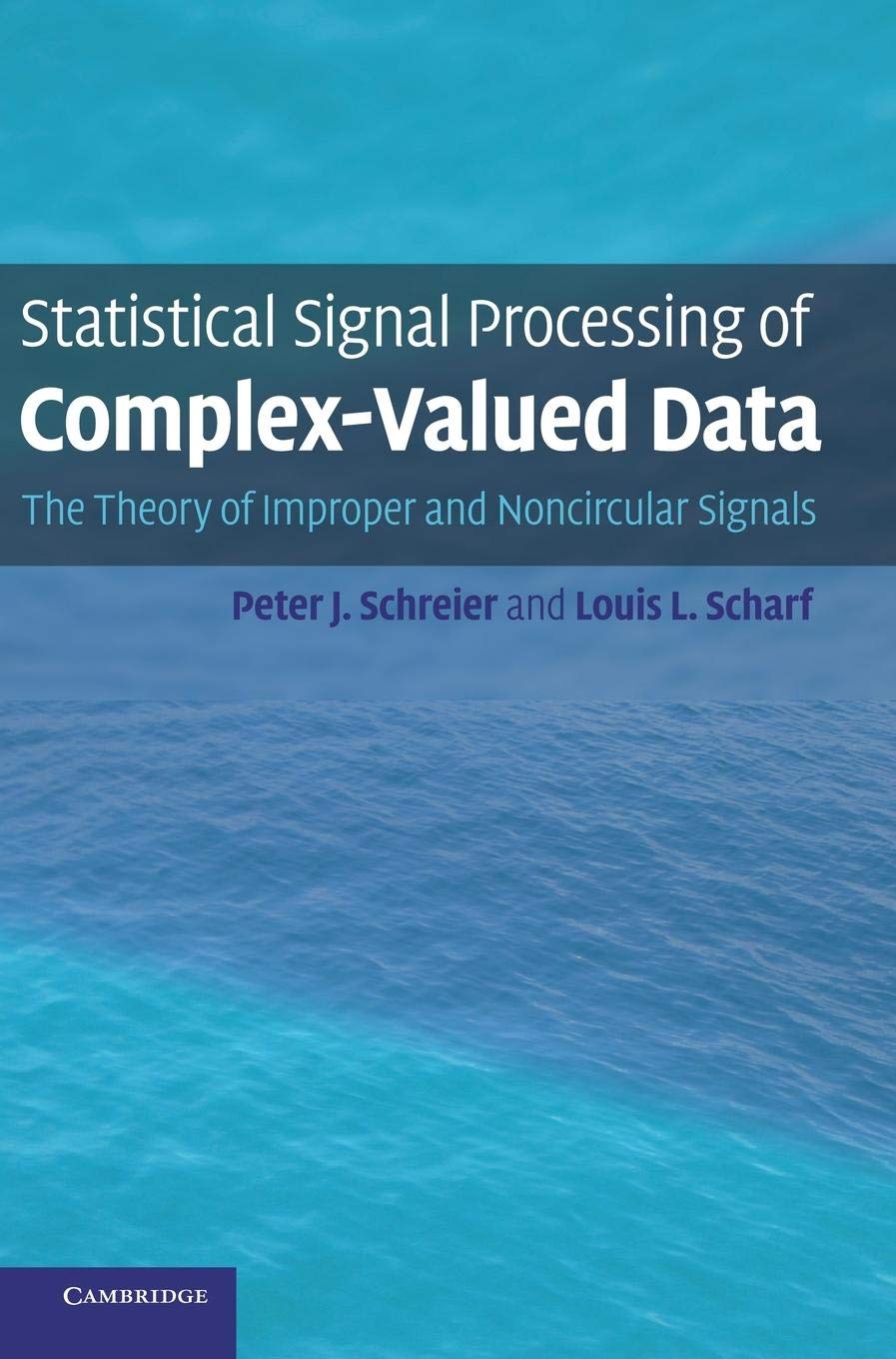
Title
Statistical Signal Processing Of Complexvalued Data: The Theory Of Improper And Noncircular Signals,New
Sold by Ergodebooks, an authorized reseller.
Returns accepted within 30 days | support@ergodebooks.com
Shipping Information
- Free Standard Shipping — United States only
- Processing Time: 3–5 business days
- Estimated Delivery: 6–10 business days after dispatch
- Double-boxed, fully insured & discreetly packaged
- Tracking number sent via email once dispatched
Returns & Refund
Returns accepted within 30 days of delivery.
Damaged or Defective Item
Free return shipping + replacement or full refund
Wrong Item Received
Free return shipping + replacement or full refund
Change of Mind
Return shipping at customer's expense · 25% restocking fee applies
Payment Option

Complexvalued Random Signals Are Embedded In The Very Fabric Of Science And Engineering, Yet The Usual Assumptions Made About Their Statistical Behavior Are Often A Poor Representation Of The Underlying Physics. This Book Deals With Improper And Noncircular Complex Signals, Which Do Not Conform To Classical Assumptions, And It Demonstrates How Correct Treatment Of These Signals Can Have Significant Payoffs. The Book Begins With Detailed Coverage Of The Fundamental Theory And Presents A Variety Of Tools And Algorithms For Dealing With Improper And Noncircular Signals. It Provides A Comprehensive Account Of The Main Applications, Covering Detection, Estimation, And Signal Analysis Of Stationary, Nonstationary, And Cyclostationary Processes. Providing A Systematic Development From The Origin Of Complex Signals To Their Probabilistic Description Makes The Theory Accessible To Newcomers. This Book Is Ideal For Graduate Students And Researchers Working With Complex Data In A Range Of Research Areas From Communications To Oceanography.
⚠️ WARNING (California Proposition 65):
This product may contain chemicals known to the State of California to cause cancer, birth defects, or other reproductive harm.
For more information, please visit www.P65Warnings.ca.gov.
- Q: What is the length of the book? A: The book is seven point zero one inches long. It has been designed to fit comfortably on most bookshelves.
- Q: How many pages does the book have? A: The book contains three hundred thirty pages. This length offers a thorough exploration of the subject matter.
- Q: What type of binding does this book have? A: The book has a hardcover binding. This makes it durable and suitable for frequent use.
- Q: Who is the author of the book? A: The author is Peter J. Schreier. He has substantial expertise in statistical signal processing.
- Q: What is the category of the book? A: The book falls under the Electronics category. It specifically addresses signal processing techniques.
- Q: What are the key topics covered in the book? A: The book covers improper and noncircular complex signals. It includes detection, estimation, and signal analysis techniques.
- Q: How is this book useful for students? A: This book is ideal for graduate students. It provides a systematic development of theory accessible to newcomers.
- Q: What research areas can benefit from this book? A: Research areas such as communications and oceanography can benefit. The book applies complex data analysis to various fields.
- Q: Is this book suitable for beginners? A: Yes, the book is suitable for beginners. It offers detailed coverage of fundamental theory in signal processing.
- Q: How can I use the tools and algorithms discussed in the book? A: You can apply the tools and algorithms through practical experiments. The book provides examples to illustrate their usage.
- Q: How should I care for this hardcover book? A: To care for the book, keep it in a dry place away from direct sunlight. This will help preserve its condition over time.
- Q: Is it safe to store this book with other books? A: Yes, it is safe to store this book with other books. Just ensure that it is not stacked too heavily to avoid damage.
- Q: What if the book arrives damaged? A: If the book arrives damaged, you should contact customer support for a return or exchange. They will guide you through the process.
- Q: What is the warranty period for this book? A: Books typically do not come with a warranty. However, check the return policy for any possible options.
- Q: Can I return the book if I don't like it? A: Yes, you can return the book if it is in good condition. Be sure to check the specific return policy for details.
- Q: What types of readers would benefit from this book? A: Researchers and graduate students would benefit the most. The book is tailored for those with an interest in complex-valued data.