
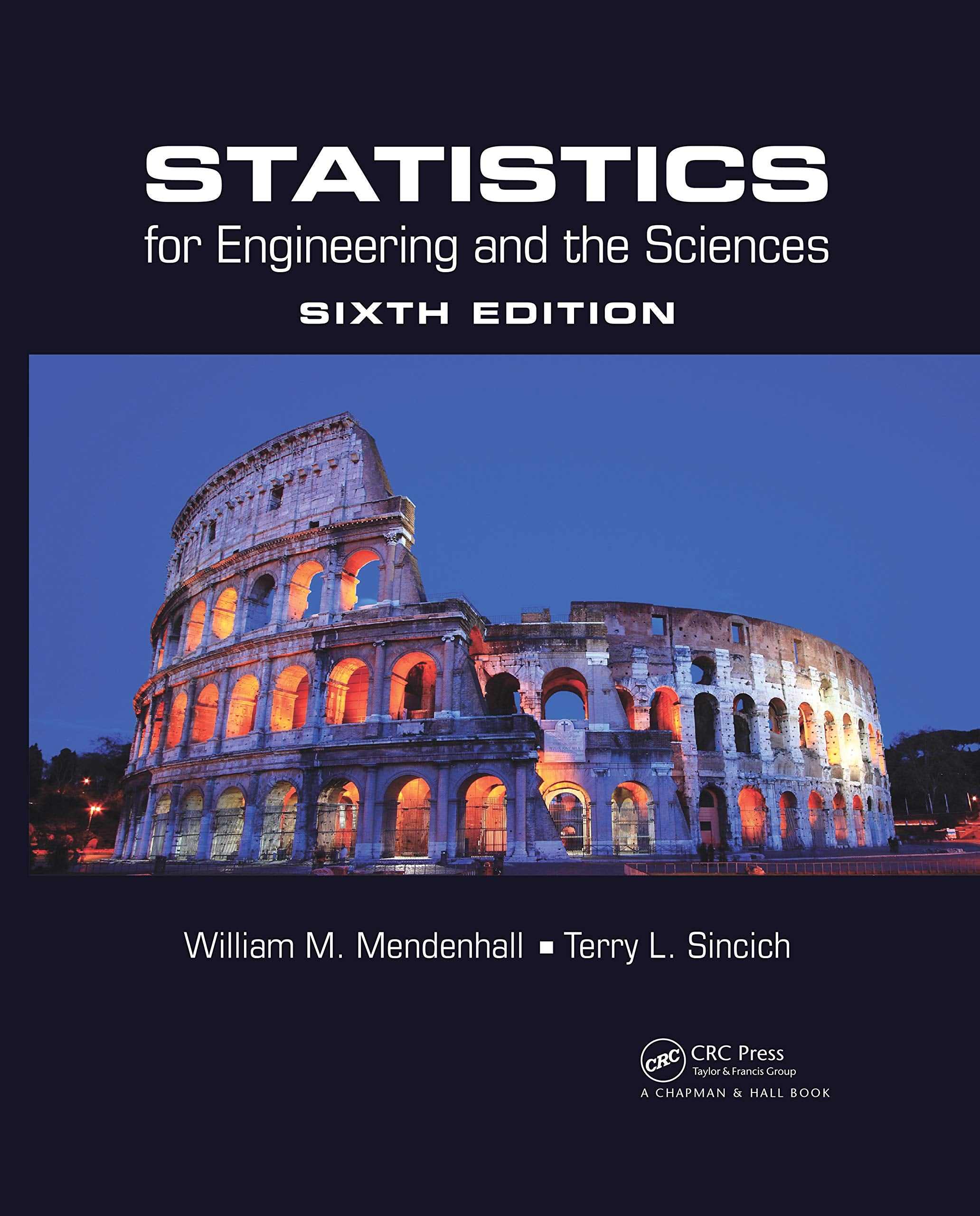
Title
Statistics for Engineering and the Sciences,Used
Sold by Ergodebooks, an authorized reseller.
Returns accepted within 30 days | support@ergodebooks.com
Shipping Information
- Free Standard Shipping — United States only
- Processing Time: 3–5 business days
- Estimated Delivery: 6–10 business days after dispatch
- Double-boxed, fully insured & discreetly packaged
- Tracking number sent via email once dispatched
Returns & Refund
Returns accepted within 30 days of delivery.
Damaged or Defective Item
Free return shipping + replacement or full refund
Wrong Item Received
Free return shipping + replacement or full refund
Change of Mind
Return shipping at customer's expense · 25% restocking fee applies
Payment Option

Prepare Your Students for Statistical Work in the Real WorldStatistics for Engineering and the Sciences, Sixth Edition is designed for a twosemester introductory course on statistics for students majoring in engineering or any of the physical sciences. This popular text continues to teach students the basic concepts of data description and statistical inference as well as the statistical methods necessary for realworld applications. Students will understand how to collect and analyze data and think critically about the results.New to the Sixth Edition Many new and updated exercises based on contemporary engineering and scientificrelated studies and real data More statistical software printouts and corresponding instructions for use that reflect the latest versions of the SAS, SPSS, and MINITAB software Introduction of the case studies at the beginning of each chapter Streamlined material on all basic sampling concepts, such as random sampling and sample survey designs, which gives students an earlier introduction to key sampling issues New examples on comparing matched pairs versus independent samples, selecting the sample size for a designed experiment, and analyzing a twofactor experiment with quantitative factors New section on using regression residuals to check the assumptions required in a simple linear regression analysisThe first several chapters of the book identify the objectives of statistics, explain how to describe data, and present the basic concepts of probability. The text then introduces the two methods for making inferences about population parameters: estimation with confidence intervals and hypothesis testing. The remaining chapters extend these concepts to cover other topics useful in analyzing engineering and scientific data, including the analysis of categorical data, regression analysis, model building, analysis of variance for designed experiments, nonparametric statistics, statistical quality control, and product and system reliability.
⚠️ WARNING (California Proposition 65):
This product may contain chemicals known to the State of California to cause cancer, birth defects, or other reproductive harm.
For more information, please visit www.P65Warnings.ca.gov.
- Q: What is the main focus of 'Statistics for Engineering and the Sciences'? A: The book is designed for a two-semester introductory course on statistics, specifically for students majoring in engineering or physical sciences. It emphasizes real-world applications of statistical concepts and methods.
- Q: What are some key features of the Sixth Edition? A: This edition includes updated exercises, new statistical software printouts for SAS, SPSS, and MINITAB, case studies at the beginning of each chapter, and streamlined content on sampling concepts and regression analysis.
- Q: Who is the author of this textbook? A: 'Statistics for Engineering and the Sciences' is authored by William M. Mendenhall.
- Q: How many pages does this textbook have? A: The textbook contains a total of 1166 pages.
- Q: Is this book suitable for self-study? A: Yes, the clear explanations and practical exercises make it suitable for self-study, especially for students looking to understand statistical concepts in engineering and scientific contexts.
- Q: What topics are covered in this textbook? A: The book covers data description, statistical inference, hypothesis testing, regression analysis, analysis of variance, nonparametric statistics, and statistical quality control, among other topics.
- Q: What is the binding type of the book? A: The book is available in hardcover binding, providing durability for long-term use.
- Q: When was the Sixth Edition published? A: The Sixth Edition of 'Statistics for Engineering and the Sciences' was published on December 16, 2015.
- Q: Are there any new examples or case studies in this edition? A: Yes, the Sixth Edition introduces new examples, including case studies at the start of each chapter, to enhance understanding and application of statistical concepts.
- Q: What condition is the book in when purchased? A: The book is offered in new condition, ensuring that buyers receive a fresh and undamaged copy.