If you have any questions, you are always welcome to contact us. We'll get back to you as soon as possible, withing 24 hours on weekdays.
Customer service
All questions about your order, return and delivery must be sent to our customer service team by e-mail at yourstore@yourdomain.com
Sale & Press
If you are interested in selling our products, need more information about our brand or wish to make a collaboration, please contact us at press@yourdomain.com
Help
If you have any questions, you are always welcome to contact us. We'll get back to you as soon as possible, withing 24 hours on weekdays.
Customer service
All questions about your order, return and delivery must be sent to our customer service team by e-mail at yourstore@yourdomain.com
Sale & Press
If you are interested in selling our products, need more information about our brand or wish to make a collaboration, please contact us at press@yourdomain.com
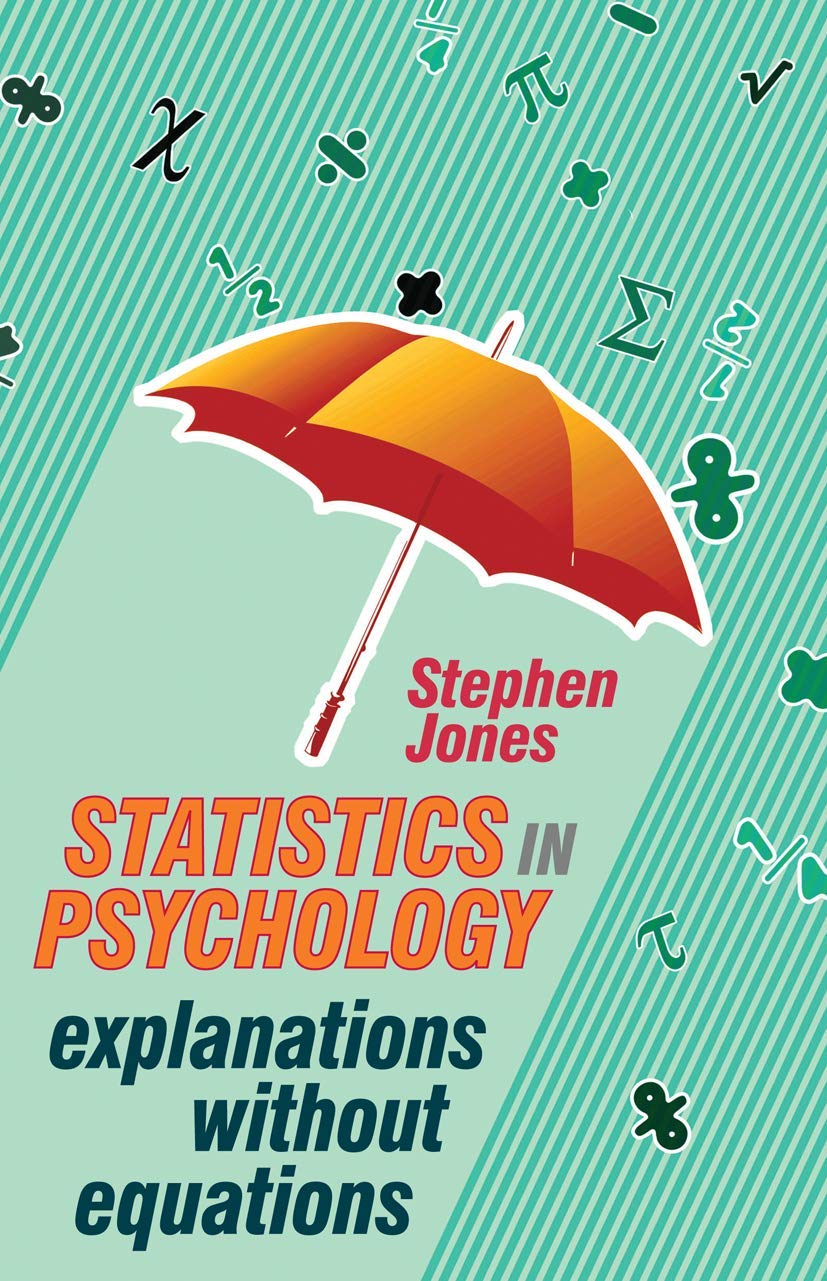
How do you choose the appropriate statistical method for any given research task? What are the features that discern one statistical method from another, and for which research projects are they appropriate to use? Written specifically with the undergraduate psychology student in mind and for those who desire an explanation for the use of statistics in psychological research without the mathematics, this refreshing and muchneeded introduction is invaluable for any psychology students who 'don't get numbers'. Breaking away from the traditional, numerical approaches, Jones delivers an engaging and insightful read into the rationale behind the use of statistics, drawing upon nonnumerical examples and scenarios from both psychological literature and everyday life to explain key statistical concepts. Learn about the methods for testing populations and samples, standard errors, inferential and descriptive statistics as well as variables and participants.This is an ideal companion to core textbooks and will serve a clearer understanding of statistical methods in psychology. By reading this book students can hope to gain a better sense of what makes empirically valid research and learn to critically evaluate facts and figure in any presented research. The foundations of psychology's claims are the empiricism of wellconducted and reliable data.
⚠️ WARNING (California Proposition 65):
This product may contain chemicals known to the State of California to cause cancer,
birth defects, or other reproductive harm.
For MAP (Minimum Advertised Price) violations and Intellectual Property (IP) or Trademark concerns, please contact:
support@ergodebooks.com
⚠️ California Proposition 65 Warning: Some products sold on this website may expose you to chemicals known to the State of California to cause cancer, birth defects, or other reproductive harm. For more information, visit www.P65Warnings.ca.gov.