If you have any questions, you are always welcome to contact us. We'll get back to you as soon as possible, withing 24 hours on weekdays.
Customer service
All questions about your order, return and delivery must be sent to our customer service team by e-mail at yourstore@yourdomain.com
Sale & Press
If you are interested in selling our products, need more information about our brand or wish to make a collaboration, please contact us at press@yourdomain.com
Help
If you have any questions, you are always welcome to contact us. We'll get back to you as soon as possible, withing 24 hours on weekdays.
Customer service
All questions about your order, return and delivery must be sent to our customer service team by e-mail at yourstore@yourdomain.com
Sale & Press
If you are interested in selling our products, need more information about our brand or wish to make a collaboration, please contact us at press@yourdomain.com
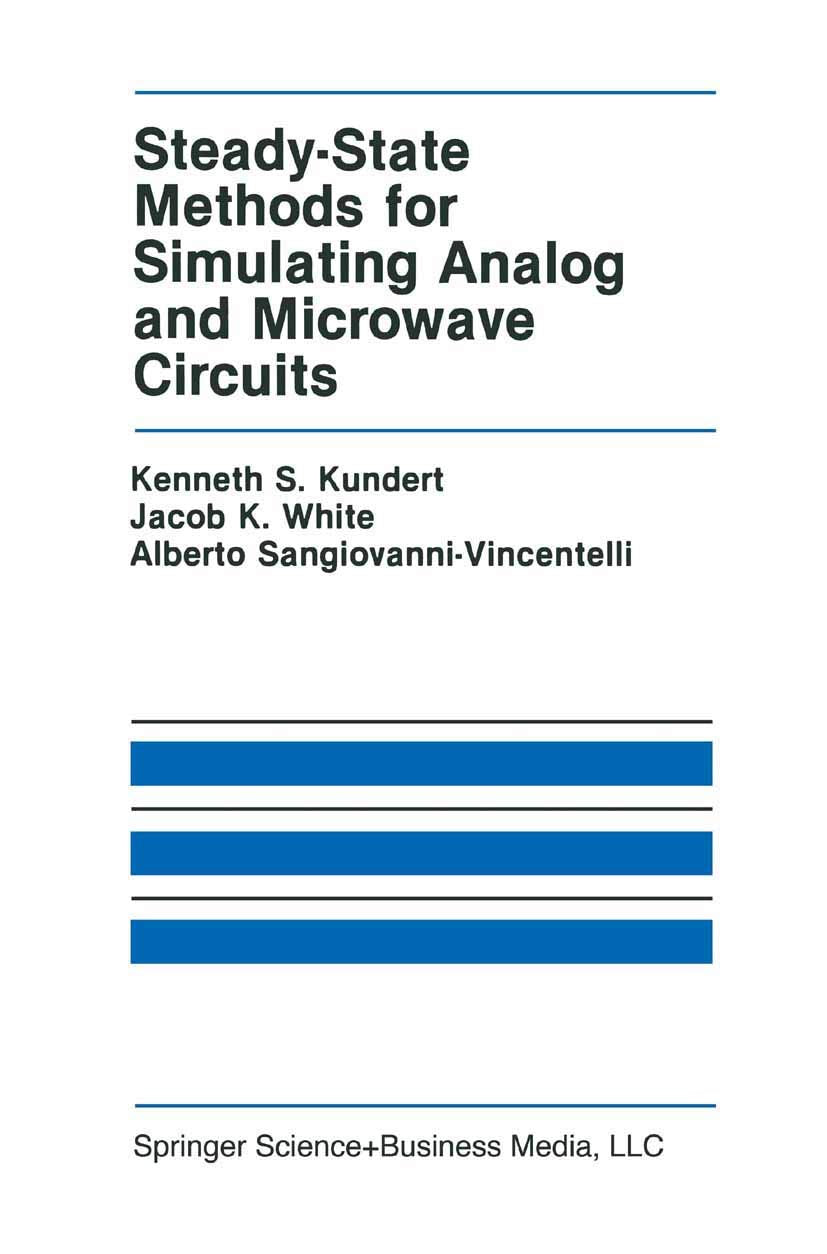
The motivation for starting the work described in this book was the interest that HewlettPackard's microwave circuit designers had in simulation techniques that could tackle the problem of finding steady state solutions for nonlinear circuits, particularly circuits containing distributed elements such as transmission lines. Examining the problem of computing steadystate solutions in this context has led to a collection of novel numerical algorithms which we have gathered, along with some background material, into this book. Although we wished to appeal to as broad an audience as possible, to treat the subject in depth required maintaining a narrow focus. Our compromise was to assume that the reader is familiar with basic numerical methods, such as might be found in [dahlquist74] or [vlach83], but not assume any specialized knowledge of methods for steadystate problems. Although we focus on algorithms for computing steadystate solutions of analog and microwave circuits, the methods herein are general in nature and may find use in other disciplines. A number of new algorithms are presented, the contributions primarily centering around new approaches to harmonic balance and mixed frequencytime methods. These methods are described, along with appropriate background material, in what we hope is a reasonably satisfying blend of theory, practice, and results. The theory is given so that the algorithms can be fully understood and their correctness established.
⚠️ WARNING (California Proposition 65):
This product may contain chemicals known to the State of California to cause cancer,
birth defects, or other reproductive harm.
For MAP (Minimum Advertised Price) violations and Intellectual Property (IP) or Trademark concerns, please contact:
support@ergodebooks.com
⚠️ California Proposition 65 Warning: Some products sold on this website may expose you to chemicals known to the State of California to cause cancer, birth defects, or other reproductive harm. For more information, visit www.P65Warnings.ca.gov.