
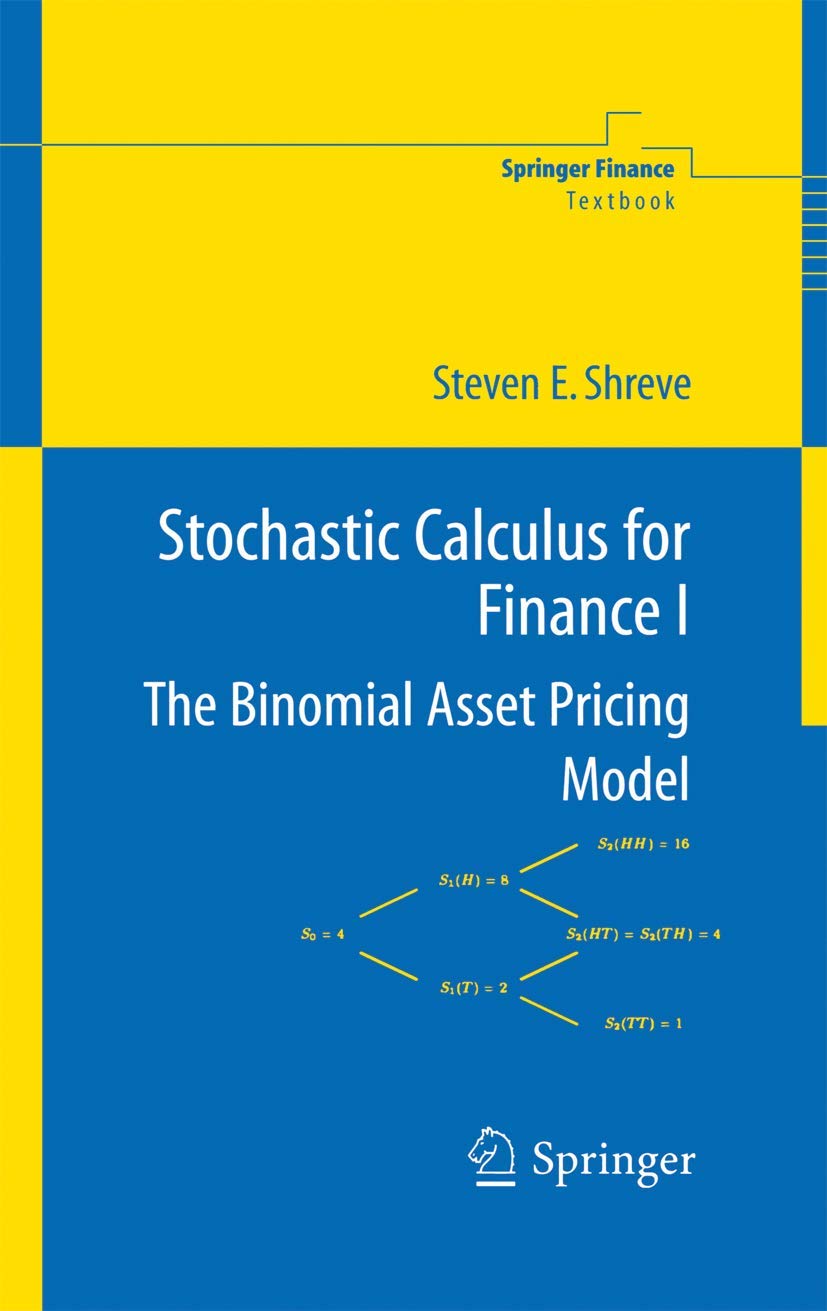
Title
Stochastic Calculus for Finance I: The Binomial Asset Pricing Model (Springer Finance),New
Sold by Ergodebooks, an authorized reseller.
Returns accepted within 30 days | support@ergodebooks.com
Shipping Information
- Free Standard Shipping — United States only
- Processing Time: 3–5 business days
- Estimated Delivery: 6–10 business days after dispatch
- Double-boxed, fully insured & discreetly packaged
- Tracking number sent via email once dispatched
Returns & Refund
Returns accepted within 30 days of delivery.
Damaged or Defective Item
Free return shipping + replacement or full refund
Wrong Item Received
Free return shipping + replacement or full refund
Change of Mind
Return shipping at customer's expense · 25% restocking fee applies
Payment Option

Stochastic Calculus for Finance evolved from the first ten years of the Carnegie Mellon Professional Master's program in Computational Finance. The content of this book has been used successfully with students whose mathematics background consists of calculus and calculusbased probability. The text gives both precise statements of results, plausibility arguments, and even some proofs, but more importantly intuitive explanations developed and refine through classroom experience with this material are provided. The book includes a selfcontained treatment of the probability theory needed for stochastic calculus, including Brownian motion and its properties. Advanced topics include foreign exchange models, forward measures, and jumpdiffusion processes.This book is being published in two volumes. The first volume presents the binomial assetpricing model primarily as a vehicle for introducing in the simple setting the concepts needed for the continuoustime theory in the second volume.Chapter summaries and detailed illustrations are included. Classroom tested exercises conclude every chapter. Some of these extend the theory and others are drawn from practical problems in quantitative finance.Advanced undergraduates and Masters level students in mathematical finance and financial engineering will find this book useful.Steven E. Shreve is CoFounder of the Carnegie Mellon MS Program in Computational Finance and winner of the Carnegie Mellon Doherty Prize for sustained contributions to education.
⚠️ WARNING (California Proposition 65):
This product may contain chemicals known to the State of California to cause cancer, birth defects, or other reproductive harm.
For more information, please visit www.P65Warnings.ca.gov.
- Q: What is the page count of this book? A: The book contains two hundred two pages. It provides a comprehensive overview of stochastic calculus specifically for finance.
- Q: What are the dimensions of this book? A: The book measures six point one inches in length, zero point four seven inches in width, and nine point two five inches in height. This size makes it portable for students.
- Q: What type of binding does this book have? A: This book is paperback bound. This binding is commonly used for academic texts to provide flexibility and durability.
- Q: Who is the author of this book? A: The author is Steven E. Shreve. He is a co-founder of the Carnegie Mellon MS Program in Computational Finance.
- Q: What topics does this book cover? A: The book covers stochastic calculus, binomial asset pricing, and advanced topics like foreign exchange models. It is designed for students with a background in calculus.
- Q: Is this book suitable for beginners in finance? A: Yes, this book is suitable for advanced undergraduates and master's level students. It serves as an introduction to concepts necessary for more advanced studies.
- Q: How is the content structured in this book? A: The content includes chapter summaries, illustrative examples, and exercises. Each chapter concludes with exercises to reinforce learning.
- Q: Can this book help with practical finance problems? A: Yes, it includes problems drawn from practical scenarios in quantitative finance. This makes the theoretical concepts applicable.
- Q: Is there a second volume to this book? A: Yes, this book is published in two volumes. The first volume focuses on the binomial asset-pricing model.
- Q: Are there exercises included in each chapter? A: Yes, each chapter ends with classroom-tested exercises. These exercises help solidify the theoretical concepts discussed.
- Q: What is the main focus of this book? A: The main focus is on the binomial asset pricing model. It introduces essential concepts in a simple context.
- Q: Does this book provide proofs for its concepts? A: Yes, the book includes proofs alongside intuitive explanations. This balance aids in understanding complex ideas.
- Q: Is this book recommended for financial engineering students? A: Yes, it is particularly useful for students in financial engineering. The content aligns with their curriculum and practical applications.
- Q: What kind of illustrations are included? A: The book includes detailed illustrations to clarify complex topics. These visuals enhance conceptual understanding.
- Q: Is the probability theory covered in this book standalone? A: Yes, the book provides a self-contained treatment of the necessary probability theory. This makes it accessible to those with a basic math background.
- Q: What level of math is required to understand this book? A: A background in calculus and calculus-based probability is required. This foundation is essential for grasping the material.