If you have any questions, you are always welcome to contact us. We'll get back to you as soon as possible, withing 24 hours on weekdays.
Customer service
All questions about your order, return and delivery must be sent to our customer service team by e-mail at yourstore@yourdomain.com
Sale & Press
If you are interested in selling our products, need more information about our brand or wish to make a collaboration, please contact us at press@yourdomain.com
Help
If you have any questions, you are always welcome to contact us. We'll get back to you as soon as possible, withing 24 hours on weekdays.
Customer service
All questions about your order, return and delivery must be sent to our customer service team by e-mail at yourstore@yourdomain.com
Sale & Press
If you are interested in selling our products, need more information about our brand or wish to make a collaboration, please contact us at press@yourdomain.com
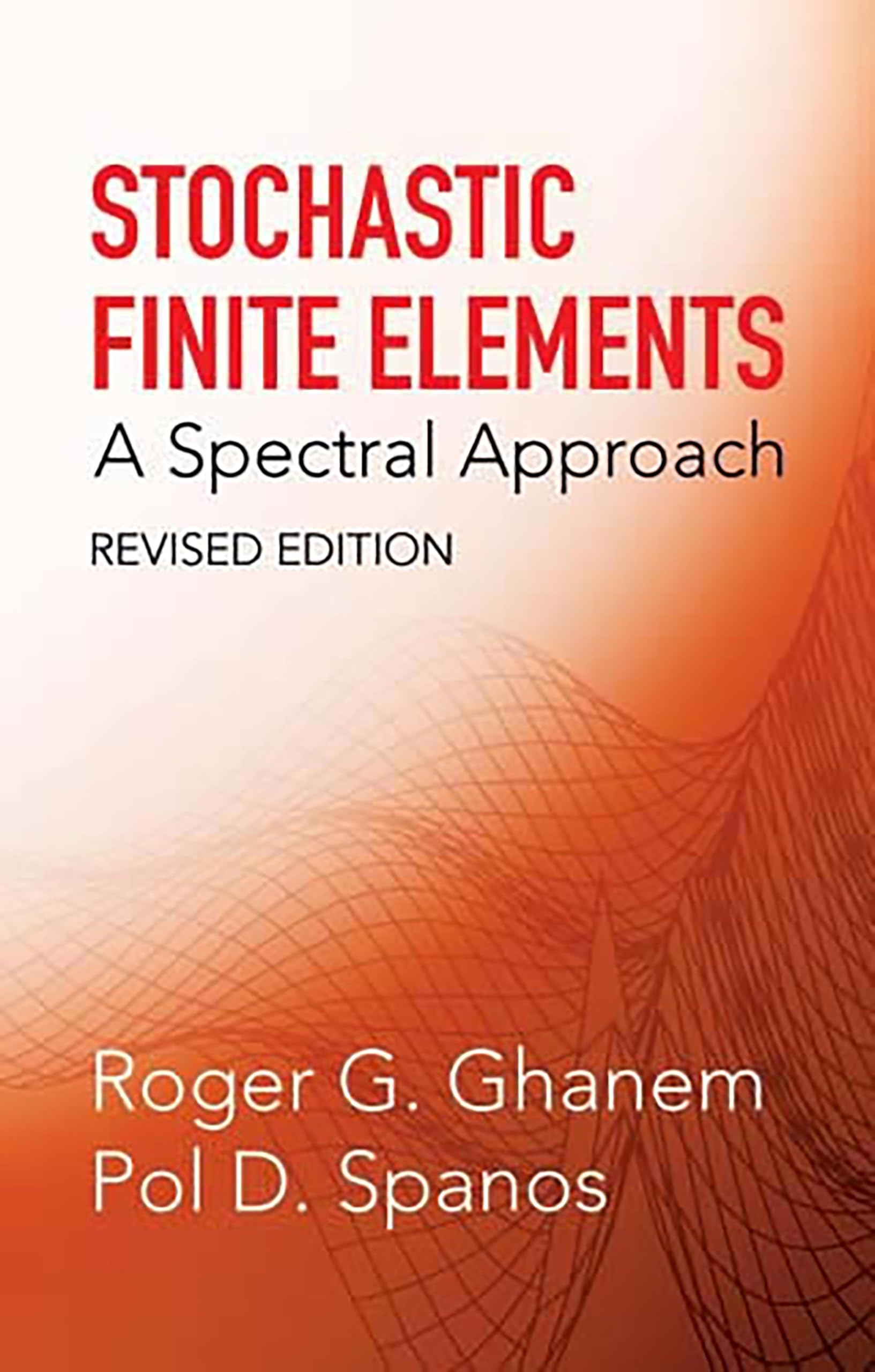
Discrepancies frequently occur between a physical system's responses and predictions obtained from mathematical models. The Spectral Stochastic Finite Element Method (SSFEM) has proven successful at forecasting a variety of uncertainties in calculating system responses. This text analyzes a class of discrete mathematical models of engineering systems, identifying key issues and reviewing relevant theoretical concepts, with particular attention to a spectral approach.Random system parameters are modeled as secondorder stochastic processes, defined by their mean and covariance functions. Relying on the spectral properties of the covariance function, the KarhunenLoeve expansion is employed to represent these processes in terms of a countable set of uncorrected random variables, casting the problem in a finite dimensional setting. Various spectral approximations for the stochastic response of the system are obtained. Implementing the concept of generalized inverse leads to an explicit expression for the response process as a multivariate polynomial functional of a set of uncorrelated random variables. Alternatively, the solution process is treated as an element in the Hilbert space of random functions, in which a spectral representation is identified in terms of polynomial chaos. In this context, the solution process is approximated by its projection onto a finite subspace spanned by these polynomials.
⚠️ WARNING (California Proposition 65):
This product may contain chemicals known to the State of California to cause cancer,
birth defects, or other reproductive harm.
For MAP (Minimum Advertised Price) violations and Intellectual Property (IP) or Trademark concerns, please contact:
support@ergodebooks.com
⚠️ California Proposition 65 Warning: Some products sold on this website may expose you to chemicals known to the State of California to cause cancer, birth defects, or other reproductive harm. For more information, visit www.P65Warnings.ca.gov.