
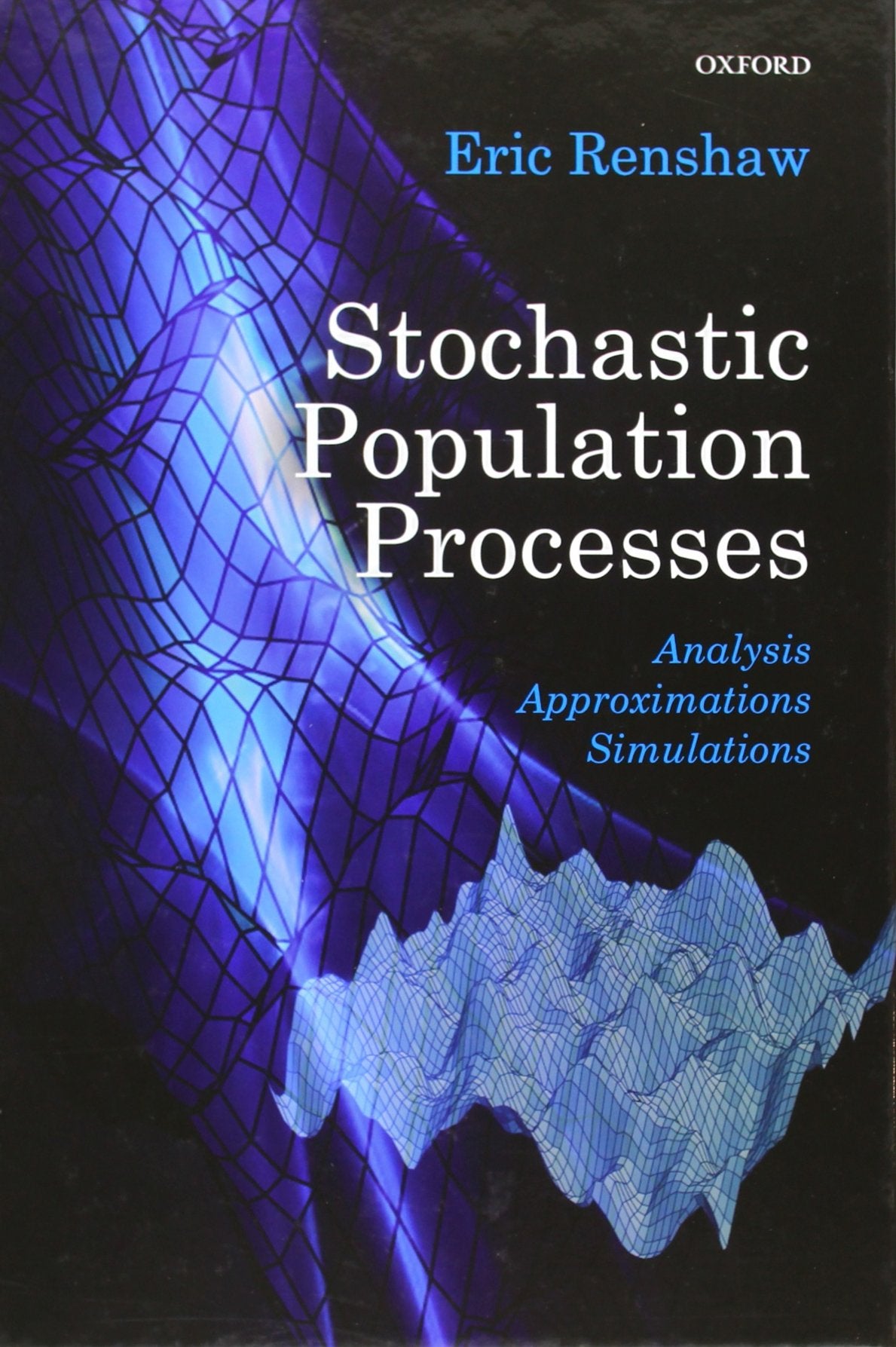
Title
Stochastic Population Processes: Analysis, Approximations, Simulations
Sold by Ergodebooks, an authorized reseller.
Returns accepted within 30 days | support@ergodebooks.com
Shipping Information
- Free Standard Shipping — United States only
- Processing Time: 3–5 business days
- Estimated Delivery: 6–10 business days after dispatch
- Double-boxed, fully insured & discreetly packaged
- Tracking number sent via email once dispatched
Returns & Refund
Returns accepted within 30 days of delivery.
Damaged or Defective Item
Free return shipping + replacement or full refund
Wrong Item Received
Free return shipping + replacement or full refund
Change of Mind
Return shipping at customer's expense · 25% restocking fee applies
Payment Option

The vast majority of random processes in the real world have no memory the next step in their development depends purely on their current state. Stochastic realizations are therefore defined purely in terms of successive eventtime pairs, and such systems are easy to simulate irrespective of their degree of complexity. However, whilst the associated probability equations are straightforward to write down, their solution usually requires the use of approximation and perturbation procedures. Traditional books, heavy in mathematical theory, often ignore such methods and attempt to force problems into a rigid framework of closedform solutions.This text, strongly oriented towards problem solving, has three aims. First, basic analytic tools are introduced through a suite of stochastic processes which do possess relatively simple closedform solutions. Second, techniques are presented that enable the extraction of considerable behavioral information even when exact probability structures are intractable to direct solution. Third, a range of simulation procedures is proposed which provide insight into the way that particular systems develop these often expose hitherto unforeseen features and thereby suggest further lines of exploration.Although the examples are slanted towards ecological and physical applications, only a little imagination is required in order to apply the techniques to problems generic to engineering, chemistry and finance. Indeed, the book provides a rich source of ideas for anyone working with random processes who is prepared to take a flexible approach.Many aspects of population dynamics are covered, including: general birthdeath and powerlaw processes; random and correlated walks; Markov chains; perturbation and saddlepoint techniques; Wiener, FokkerPlanck and OrnsteinUhlenbeck diffusion processes; general bivariate processes, including predatorprey, competition, epidemic, cumulative size and counting systems; MCMC and simulation techniques; and velocities, dynamic structure, Turing ring systems and cellular automata for spatialtemporal systems. Extensions include fractal structure from powerlaw contact distributions, and marked point processes.Since little of the material is covered at a deep mathematical level, the book will be readily accessible to a wide range of researchers and practitioners, and provides an excellent basis for constructing novel undergraduate and postgraduate courses in applied probability. The unified approach exposes the high degree of linkage that exists between apparently unconnected processes. The book can also be treated as a toolbox to be dipped into in order to select specific analytic and computational techniques.
⚠️ WARNING (California Proposition 65):
This product may contain chemicals known to the State of California to cause cancer, birth defects, or other reproductive harm.
For more information, please visit www.P65Warnings.ca.gov.