
Title
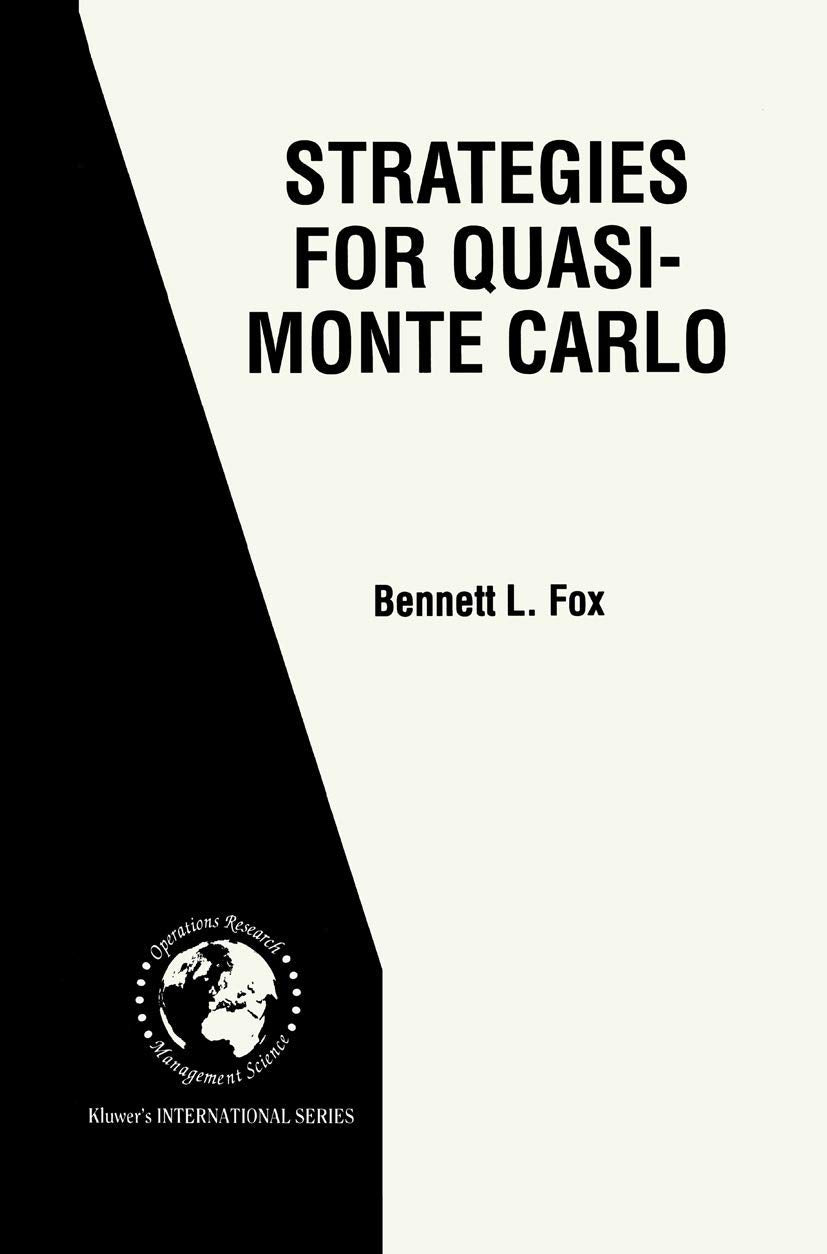
Strategies for QuasiMonte Carlo (International Series in Operations Research & Management Science, 22),Used
Sold by Ergodebooks, an authorized reseller.
Returns accepted within 30 days | support@ergodebooks.com
Shipping Information
- Free Standard Shipping — United States only
- Processing Time: 3–5 business days
- Estimated Delivery: 6–10 business days after dispatch
- Double-boxed, fully insured & discreetly packaged
- Tracking number sent via email once dispatched
Returns & Refund
Returns accepted within 30 days of delivery.
Damaged or Defective Item
Free return shipping + replacement or full refund
Wrong Item Received
Free return shipping + replacement or full refund
Change of Mind
Return shipping at customer's expense · 25% restocking fee applies
Payment Option

Strategies for QuasiMonte Carlo builds a framework to design and analyze strategies for randomized quasiMonte Carlo (RQMC). One key to efficient simulation using RQMC is to structure problems to reveal a small set of important variables, their number being the effective dimension, while the other variables collectively are relatively insignificant. Another is smoothing. The book provides many illustrations of both keys, in particular for problems involving Poisson processes or Gaussian processes. RQMC beats grids by a huge margin. With low effective dimension, RQMC is an orderofmagnitude more efficient than standard Monte Carlo. With, in addition, certain smoothness perhaps induced RQMC is an orderofmagnitude more efficient than deterministic QMC. Unlike the latter, RQMC permits error estimation via the central limit theorem. For randomdimensional problems, such as occur with discreteevent simulation, RQMC gets judiciously combined with standard Monte Carlo to keep memory requirements bounded. This monograph has been designed to appeal to a diverse audience, including those with applications in queueing, operations research, computational finance, mathematical programming, partial differential equations (both deterministic and stochastic), and particle transport, as well as to probabilists and statisticians wanting to know how to apply effectively a powerful tool, and to those interested in numerical integration or optimization in their own right. It recognizes that the heart of practical application is algorithms, so pseudocodes appear throughout the book. While not primarily a textbook, it is suitable as a supplementary text for certain graduate courses. As a reference, it belongs on the shelf of everyone with a serious interest in improving simulation efficiency. Moreover, it will be a valuable reference to all those individuals interested in improving simulation efficiency with more than incremental increases.
⚠️ WARNING (California Proposition 65):
This product may contain chemicals known to the State of California to cause cancer, birth defects, or other reproductive harm.
For more information, please visit www.P65Warnings.ca.gov.