
Title
Strategy and Choice,Used
Sold by Ergodebooks, an authorized reseller.
Returns accepted within 30 days | support@ergodebooks.com
Shipping Information
- Free Standard Shipping — United States only
- Processing Time: 3–5 business days
- Estimated Delivery: 6–10 business days after dispatch
- Double-boxed, fully insured & discreetly packaged
- Tracking number sent via email once dispatched
Returns & Refund
Returns accepted within 30 days of delivery.
Damaged or Defective Item
Free return shipping + replacement or full refund
Wrong Item Received
Free return shipping + replacement or full refund
Change of Mind
Return shipping at customer's expense · 25% restocking fee applies
Payment Option

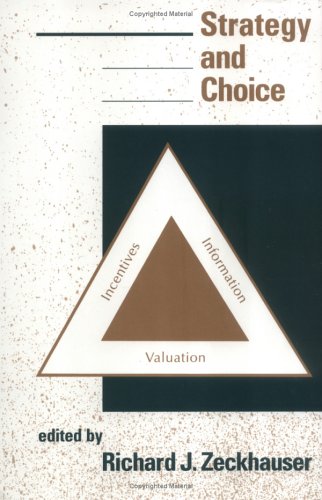
Product DescriptionThese essays by wellknown scholars present the most significant recent advances in strategic choice theory.From the coalition's desert showdown with Saddam Hussein to the dieter's duel with himself in the midnight kitchen, strategic choices determine destinies. These essays by wellknown scholars economists, psychologists, philosophers, and political scientists, inspired by master strategist Thomas Schelling present the most significant recent advances in strategic choice theory. In activities ranging from gift giving to political wheeling and dealing, men and women strive ingeniously though sometimes counterproductively to secure desired outcomes. But as this book makes clear' the fundamental questions for strategy continually reappear: What factors motivate individuals' values and actions? What principles guide effective bargaining? How can incentives and decision processes be structured to yield desirable collective outcomes? In three parts, the book addresses manyplayer, fewplayer, and oneplayer situations. The first takes up questions such as: What outcomes result when an individual's welfare depends on comparisons with the situation of others? Under what circumstances do we expect manyplayer outcomes to at least resemble participants' desired outcomes? The second asks how we can build trust, distinguish between gifts and bribes, make commitments credible, or employ third parties to improve our bargaining position. The final part of the book focuses on the struggle of the individual decision maker. How does the recollected past influence one's evaluation of the present? How can we cope with errors in decision making? When should we rely on rules and principles, as opposed to the careful weighing of alternatives prescribed by the theory of rational choice? And the most ethically challenging question how shall we value human life?ContributorsVincent P. Crawford, Avinash Dixit, Jon Elster, Robert H. Frank, Jerry R. Green, Dale Griffin, Russell Hardin, Richard J. Herrnstein, Robert Jervis, Robert Klitgaard, Howard Margolis, Barry Nalebuff, Mancur Olson, Drazen Prelec, Howard Raiffa, Amos Tversky, W. Kip Viscusi, Richard ZeckhauserReviewStrategic behavior is too interesting and important to be left to game theorists. The authors of this booksome of whom are and some of whom aren'tbring the concepts to life with the work of pointed examples that Tom Schelling made famous. they really keep your attention.Robert Solow, Institute Professor, MITAbout the AuthorRichard Zeckhauser is Frank P. Ramsey Professor of Political Economy at the John F. Kennedy School of Government, Harvard University.
⚠️ WARNING (California Proposition 65):
This product may contain chemicals known to the State of California to cause cancer, birth defects, or other reproductive harm.
For more information, please visit www.P65Warnings.ca.gov.