
Title
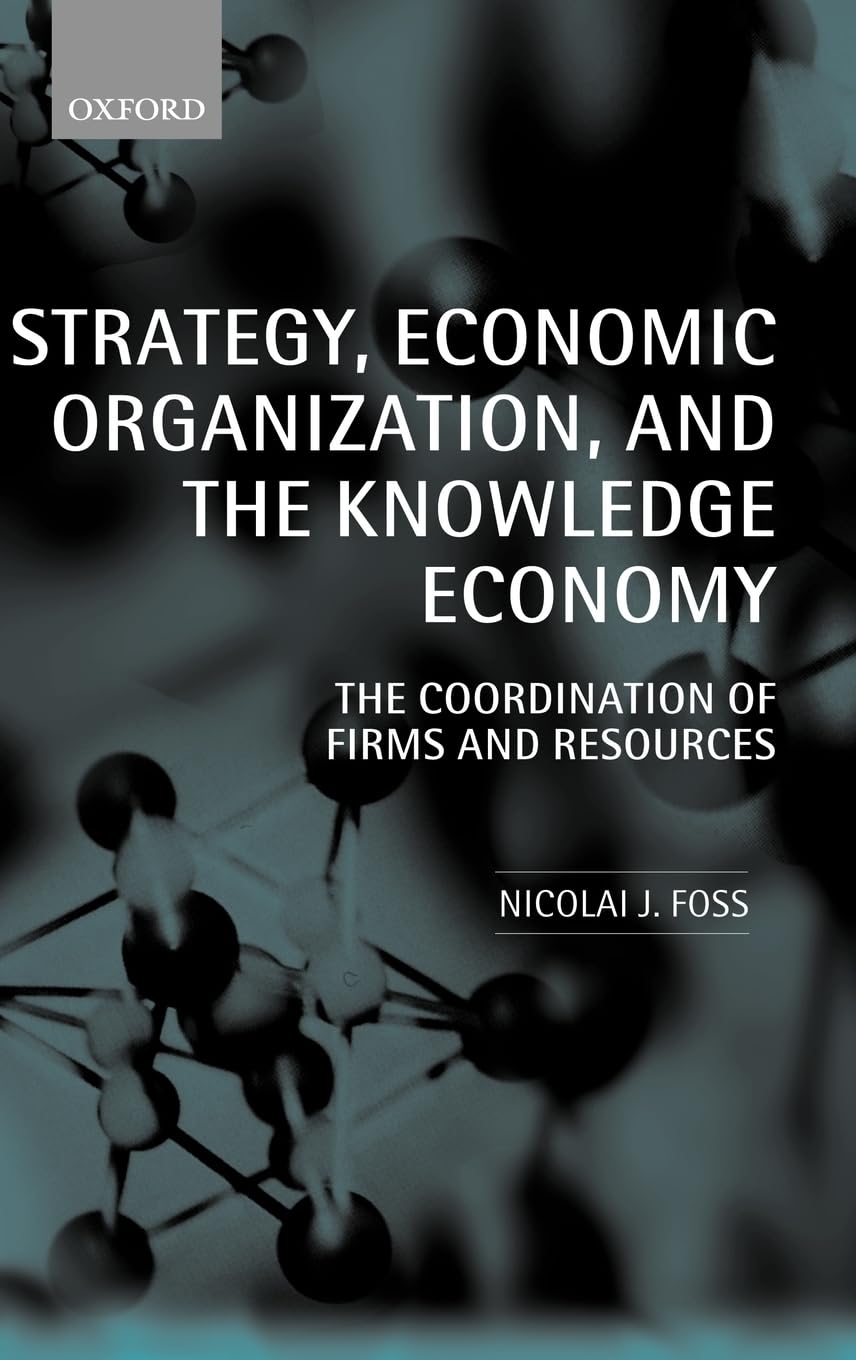
Strategy, Economic Organization, and the Knowledge Economy: The Coordination of Firms and Resources,Used
Sold by Ergodebooks, an authorized reseller.
Returns accepted within 30 days | support@ergodebooks.com
Shipping Information
- Free Standard Shipping — United States only
- Processing Time: 3–5 business days
- Estimated Delivery: 6–10 business days after dispatch
- Double-boxed, fully insured & discreetly packaged
- Tracking number sent via email once dispatched
Returns & Refund
Returns accepted within 30 days of delivery.
Damaged or Defective Item
Free return shipping + replacement or full refund
Wrong Item Received
Free return shipping + replacement or full refund
Change of Mind
Return shipping at customer's expense · 25% restocking fee applies
Payment Option

The rise of the knowledge economy has farreaching implications for the nature of economic organization as well as firm strategy. Not surprisingly, thinking in management studies as well as in economies has been profoundly affected by these changes. Thus, management thinking in particular has been increasingly characterized by a schism between those who advocate 'knowledge' or 'capabilitiesbased' approaches in the strategy and organization fields and those who adopt more economiesinfluenced approaches, notably the economics of organization. This book is a sustained attempt to overcome this schism. Its basic argument is that knowledgebased and organizational economics approaches are not substitutes but complements. In particular, organizational economics has much to contribute with respect to furthering the understanding of efficient organization and strategy in the emerging knowledge economy. This theme is taken through several theroretical as well as empirical variations. Themes such as the incentive liabilities of flat, 'knowledgebased' organizations, the role of complementary HRM practices for fostering knowledge sharing and creation, and the role of organizational instruments in the knowledge management activities of the multinational corporate are extensively treated. The book thus contains important implications for knowledge management, organizational design and international management. The book encompasses nine chapters which critically examine current thinking on strategy, and organization. The reasoning is nontechnical. While primarily aimed at a management studies audience, economists and other social scientists will also benefit from it, including Advanced Students, Academics and Researchers.
⚠️ WARNING (California Proposition 65):
This product may contain chemicals known to the State of California to cause cancer, birth defects, or other reproductive harm.
For more information, please visit www.P65Warnings.ca.gov.