
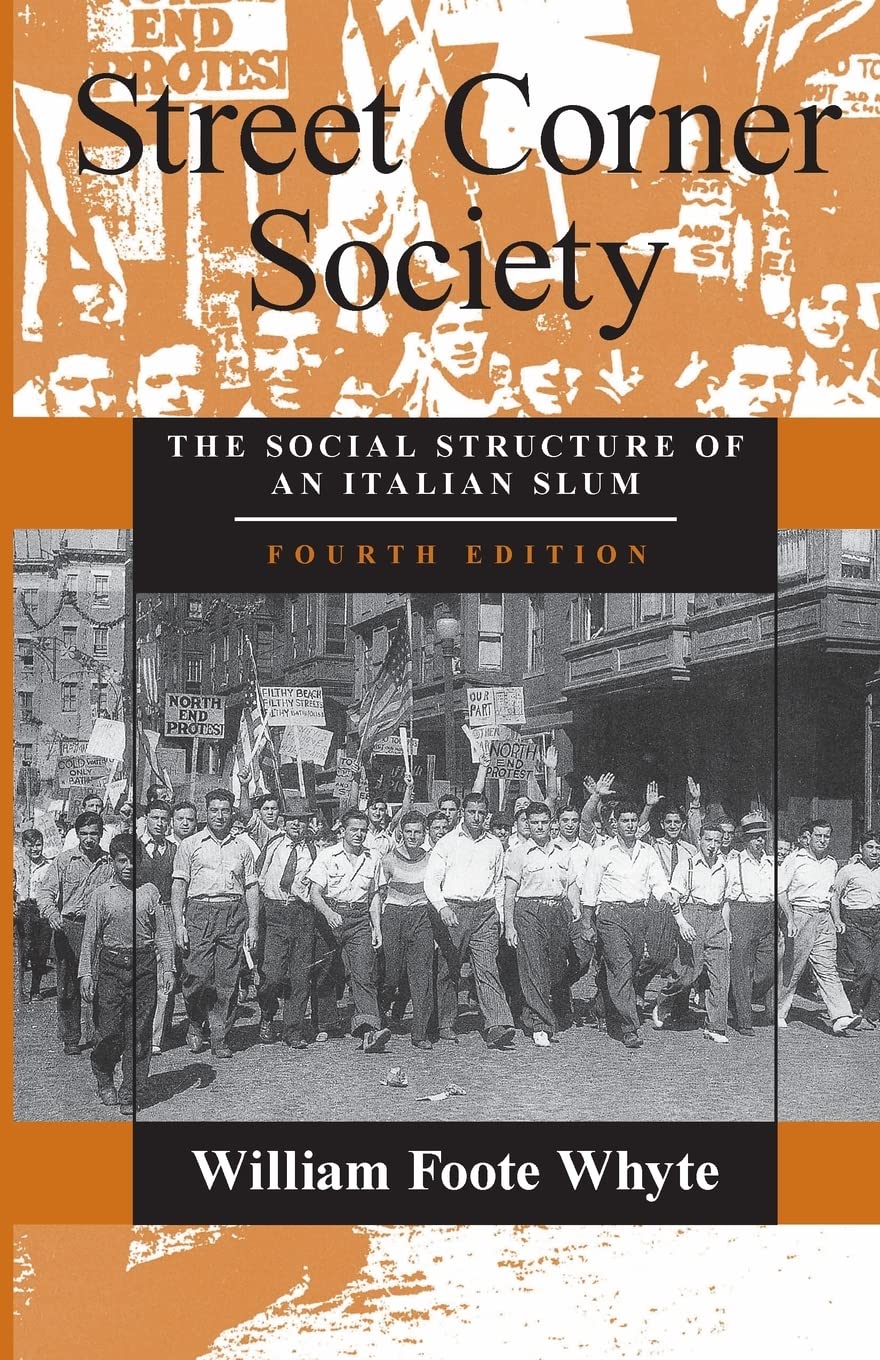
Title
Street Corner Society: The Social Structure of an Italian Slum,New
Sold by Ergodebooks, an authorized reseller.
Returns accepted within 30 days | support@ergodebooks.com
Shipping Information
- Free Standard Shipping — United States only
- Processing Time: 3–5 business days
- Estimated Delivery: 6–10 business days after dispatch
- Double-boxed, fully insured & discreetly packaged
- Tracking number sent via email once dispatched
Returns & Refund
Returns accepted within 30 days of delivery.
Damaged or Defective Item
Free return shipping + replacement or full refund
Wrong Item Received
Free return shipping + replacement or full refund
Change of Mind
Return shipping at customer's expense · 25% restocking fee applies
Payment Option

Street Corner Society is one of a handful of works that can justifiably be called classics of sociological research. William Foote Whyte's account of the Italian American slum he called 'Cornerville'Boston's North Endhas been the model for urban ethnography for fifty years.By mapping the intricate social worlds of street gangs and 'corner boys,' Whyte was among the first to demonstrate that a poor community need not be socially disorganized. His writing set a standard for vivid portrayals of real people in real situations. And his frank discussion of his methodologyparticipant observationhas served as an essential casebook in field research for generations of students and scholars.This fiftieth anniversary edition includes a new preface and revisions to the methodological appendix. In a new section on the book's legacy, Whyte responds to recent challenges to the validity, interpretation, and uses of his data. 'The Whyte Impact on the Underdog,' the moving statement by a gang leader who became the author's first research assistant, is preserved.'Street Corner Society broke new ground and set a standard for field research in American cities that remains a source of intellectual challenge.'Robert Washington, Reviews in Anthropology
⚠️ WARNING (California Proposition 65):
This product may contain chemicals known to the State of California to cause cancer, birth defects, or other reproductive harm.
For more information, please visit www.P65Warnings.ca.gov.
- Q: How many pages does 'Street Corner Society' have? A: The book has four hundred eighteen pages. This makes it a comprehensive read for those interested in urban sociology.
- Q: What is the binding type of 'Street Corner Society'? A: The book is available in paperback binding. This makes it lightweight and easy to handle for readers.
- Q: Who is the author of 'Street Corner Society'? A: The author is William Foote Whyte. He is renowned for his contributions to urban ethnography and sociological research.
- Q: What is the genre of 'Street Corner Society'? A: The genre is social sciences. It specifically explores urban sociology and the dynamics of community life.
- Q: What are the dimensions of 'Street Corner Society'? A: The dimensions are eight point four six inches in length, five point four one inches in width, and one point one two inches in height. These dimensions make it a portable book for readers.
- Q: Is 'Street Corner Society' suitable for academic research? A: Yes, it is suitable for academic research. The book's methodology and case studies are widely referenced in sociological studies.
- Q: How can I apply the insights from 'Street Corner Society'? A: You can apply the insights by understanding community interactions and social structures. This is particularly useful for students and professionals in sociology.
- Q: Is 'Street Corner Society' appropriate for beginners in sociology? A: Yes, it is appropriate for beginners. The book is written in an accessible style, making complex concepts understandable.
- Q: How should I care for my copy of 'Street Corner Society'? A: Keep it in a dry place and avoid exposure to direct sunlight. This will help preserve the book's condition over time.
- Q: What if my copy of 'Street Corner Society' arrives damaged? A: If it arrives damaged, contact the seller for a replacement or refund. Most retailers have policies in place for such issues.
- Q: Can I read 'Street Corner Society' if I have no background in sociology? A: Yes, you can read it without a background in sociology. The author's storytelling makes it engaging for all readers.
- Q: Does 'Street Corner Society' include updated content? A: Yes, the fiftieth anniversary edition includes a new preface and revisions. This offers readers updated perspectives on its findings.
- Q: Is there a focus on specific communities in 'Street Corner Society'? A: Yes, it focuses on the Italian American community in Boston's North End. This provides a detailed ethnographic study of that environment.
- Q: What methodologies does 'Street Corner Society' discuss? A: The book discusses participant observation as its primary methodology. This approach has influenced sociological research significantly.
- Q: Is 'Street Corner Society' a classic in sociological literature? A: Yes, it is considered a classic. It has set standards for urban ethnography and is widely cited in academic works.