
Title
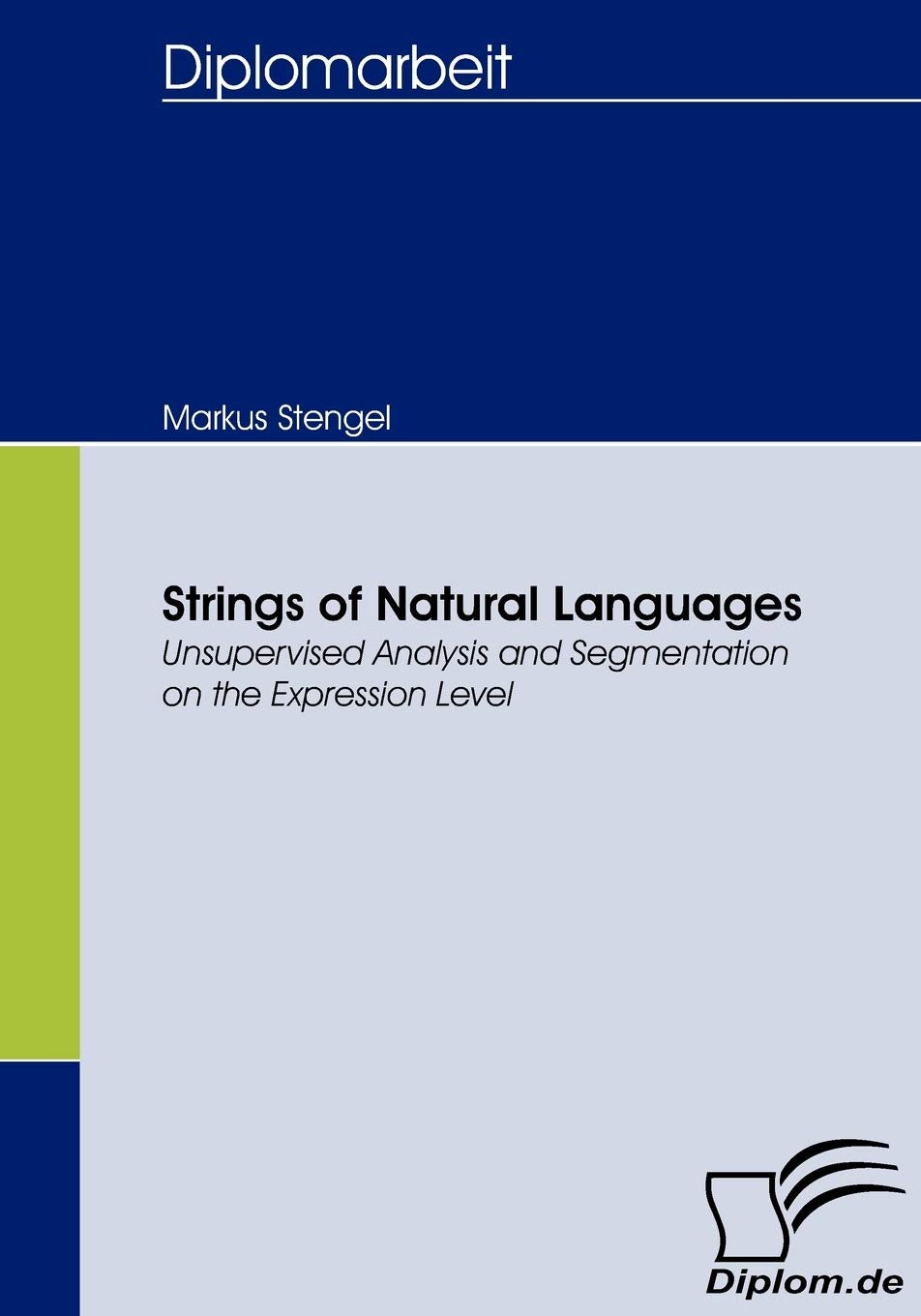
Strings of Natural Languages: Unsupervised Analysis and Segmentation on the Expression Level,Used
Sold by Ergodebooks, an authorized reseller.
Returns accepted within 30 days | support@ergodebooks.com
Shipping Information
- Free Standard Shipping — United States only
- Processing Time: 3–5 business days
- Estimated Delivery: 6–10 business days after dispatch
- Double-boxed, fully insured & discreetly packaged
- Tracking number sent via email once dispatched
Returns & Refund
Returns accepted within 30 days of delivery.
Damaged or Defective Item
Free return shipping + replacement or full refund
Wrong Item Received
Free return shipping + replacement or full refund
Change of Mind
Return shipping at customer's expense · 25% restocking fee applies
Payment Option

Product Description Learning a second language is often difficult. One major reason for this is the way we learn: We try to translate the words and concepts of the other language into those of our own language. As long as the languages are fairly similar, this works quite well. However, when the languages differ to a great degree, problems are bound to appear. For example, to someone whose first language is French, English is not difficult to learn. In fact, he can pick up any English book and at the very least recognize words and sentences. But if he is tasked with reading a Japanese text, he will be completely lost: No familiar letters, no whitespace, and only occasionally a glyph that looks similar to a punctuation mark appears. Nevertheless, anyone can learn any language. Correct pronunciation and understanding alien utterances may be hard for the individual, but as soon as the words are transcribed to some kind of script, they can be studied and given some time understood. The script thus offers itself as a reliable medium of communication. Sometimes the script can be very complex, though. For instance, the Japanese language is not much more difficult than German but the Japanese script is. If someone untrained in the language is given a Japanese book and told to create a list of its vocabulary, he will likely have to succumb to the task. Or does he not? Are there maybe ways to analyze the text, regardless of his unfamiliarity with this type of script and language? Should there not be characteristics shared by all languages which can be exploited? This thesis assumes the point of view of such a person, and shows how to segment a corpus in an unfamiliar language while employing as little previous knowledge as possible. To this end, a methodology for the analysis of unknown languages is developed. The single requirement made is that a large corpus in electronic form which underwent only a minimum of preprocessing is available. Analysis is limited strictly to the expression lev About the Author Markus Stengel, DiplomInformatik und Japanologie, Studium an der Universitt Tbingen und an der Technischen Universitt Toyohashi (Japan). Abschluss 2007 als DiplomInformatiker und Bachelor of Arts in Japanologie. Derzeit ttig in der IT eines Finanzdienstleisters.
⚠️ WARNING (California Proposition 65):
This product may contain chemicals known to the State of California to cause cancer, birth defects, or other reproductive harm.
For more information, please visit www.P65Warnings.ca.gov.