If you have any questions, you are always welcome to contact us. We'll get back to you as soon as possible, withing 24 hours on weekdays.
Customer service
All questions about your order, return and delivery must be sent to our customer service team by e-mail at yourstore@yourdomain.com
Sale & Press
If you are interested in selling our products, need more information about our brand or wish to make a collaboration, please contact us at press@yourdomain.com
Help
If you have any questions, you are always welcome to contact us. We'll get back to you as soon as possible, withing 24 hours on weekdays.
Customer service
All questions about your order, return and delivery must be sent to our customer service team by e-mail at yourstore@yourdomain.com
Sale & Press
If you are interested in selling our products, need more information about our brand or wish to make a collaboration, please contact us at press@yourdomain.com
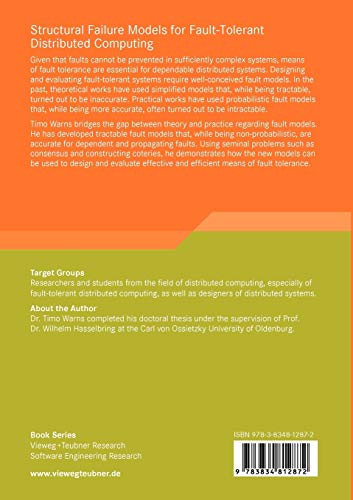
Despite means of fault prevention such as extensive testing or formal veri?cation, errors inevitably occur during system operation. To avoid subsequent system fa ures, critical distributed systems, therefore, require engineering of means for fault tolerance. Achieving fault tolerance requires some redundancy, which, unfor nately, is bound to limitations. Appropriate fault models are needed to describe which types of faults and how many faults are tolerable in a certain context. Pre ous research on distributed systems has often introduced fault models that abstract too many relevant system properties such as dependent and propagating com nent failures. In this research work, Timo Warns introduces new structural failure models that are both accurate (to cover relevant properties) and tractable (to be alyzable). These new failure models cover dependent failures (for instance, failure correlation by geographic proximity) and propagating failures (for instance, pr agation by service utilization). To evaluate the new failure models, Timo Warns shows how some seminal problems in distributed systems can be solved with proved resilience and ef?ciency, as compared to existing solutions. Particularly, the textbookstyle introduction to distributed systems and the r orous presentation of the new failure models and their evaluation may serve as an example for other software engineering research projects which is why this book is a valuable addition to both a researchers and a students library.
⚠️ WARNING (California Proposition 65):
This product may contain chemicals known to the State of California to cause cancer,
birth defects, or other reproductive harm.
For MAP (Minimum Advertised Price) violations and Intellectual Property (IP) or Trademark concerns, please contact:
support@ergodebooks.com
⚠️ California Proposition 65 Warning: Some products sold on this website may expose you to chemicals known to the State of California to cause cancer, birth defects, or other reproductive harm. For more information, visit www.P65Warnings.ca.gov.