
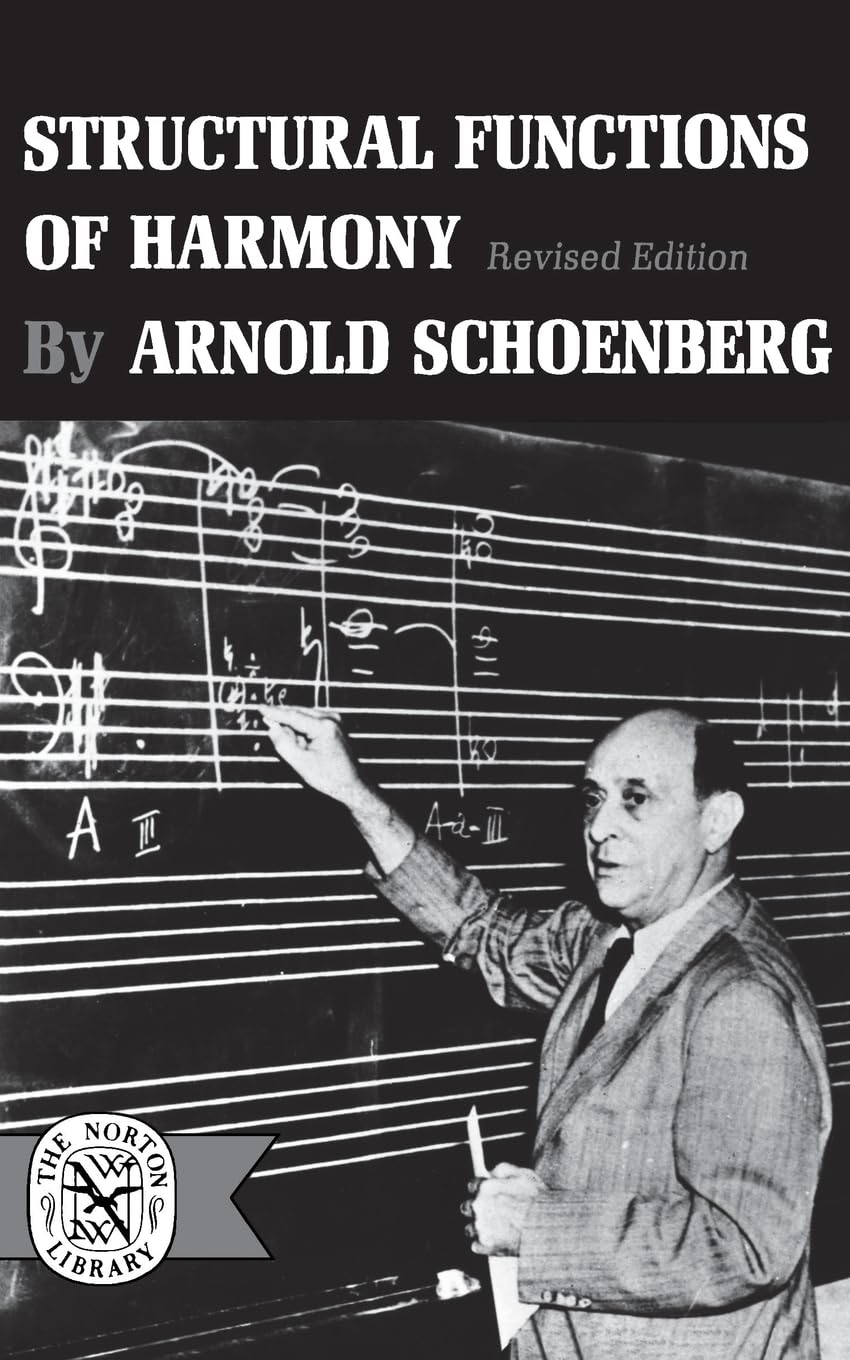
Title
Structural Functions of Harmony,New
Sold by Ergodebooks, an authorized reseller.
Returns accepted within 30 days | support@ergodebooks.com
Shipping Information
- Free Standard Shipping — United States only
- Processing Time: 3–5 business days
- Estimated Delivery: 6–10 business days after dispatch
- Double-boxed, fully insured & discreetly packaged
- Tracking number sent via email once dispatched
Returns & Refund
Returns accepted within 30 days of delivery.
Damaged or Defective Item
Free return shipping + replacement or full refund
Wrong Item Received
Free return shipping + replacement or full refund
Change of Mind
Return shipping at customer's expense · 25% restocking fee applies
Payment Option

This book is Schoenberg's last completed theoretical work and represents his final thoughts on the subject of classical and romantic harmony. The earlier chapters recapitulate in condensed form the principles laid down in his Theory of Harmony; the later chapters break entirely new ground, for they analyze the system of key relationships within the structure of whole movements and affirm the principle of 'monotonality,' showing how all modulations within a movement are merely deviations from, and not negations of, its main tonality.Schoenberg's argument is supported by music examples, which range from entire development sections of classical symphonies to analyses of the experimental harmonic progressions of Strauss, Debussy, Reger, and Schoenberg's own early music. The final chapter, 'Apollonian Evaluation of a Dionysian Epoch,' discusses the music of our time, with particular reference to the possibility of new methods of harmonic analysis.Structural Functions of Harmony is a standard work on its subject and provides an invaluable key to the development of musical structure during the last two hundred and fifty years. This new edition, with corrections, a new preface, and an index of subject headings, has been prepared under the editorial supervision of Leonard Stein.
⚠️ WARNING (California Proposition 65):
This product may contain chemicals known to the State of California to cause cancer, birth defects, or other reproductive harm.
For more information, please visit www.P65Warnings.ca.gov.
- Q: What is the main focus of 'Structural Functions of Harmony'? A: 'Structural Functions of Harmony' primarily explores Schoenberg's theories on classical and romantic harmony, emphasizing key relationships within musical movements and the concept of monotonality.
- Q: Who is the author of this book? A: The author of 'Structural Functions of Harmony' is Arnold Schoenberg, a prominent composer and theorist known for his contributions to music theory.
- Q: When was 'Structural Functions of Harmony' published? A: 'Structural Functions of Harmony' was published on June 17, 1969.
- Q: What type of binding does this edition have? A: This edition of 'Structural Functions of Harmony' is available in paperback binding.
- Q: How many pages does the book contain? A: 'Structural Functions of Harmony' contains a total of 222 pages.
- Q: Is this book suitable for beginners in music theory? A: While 'Structural Functions of Harmony' is a standard work on its subject, it may be more suitable for readers with some prior knowledge of music theory due to its advanced concepts.
- Q: What kind of musical examples are included in the book? A: The book includes a range of musical examples, from classical symphonies to analyses of works by composers like Strauss, Debussy, and Schoenberg's own early music.
- Q: Does this edition include any updates or corrections? A: Yes, this new edition of 'Structural Functions of Harmony' has been prepared with corrections, a new preface, and an index of subject headings.
- Q: What themes are discussed in the final chapter? A: The final chapter, titled 'Apollonian Evaluation of a Dionysian Epoch,' discusses contemporary music and the potential for new methods of harmonic analysis.
- Q: Is 'Structural Functions of Harmony' recommended for academic study? A: Yes, 'Structural Functions of Harmony' is considered an invaluable resource for the study of musical structure and is often recommended for academic use.