
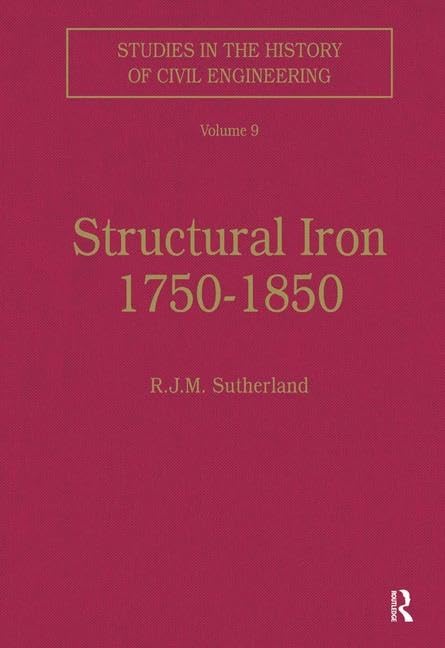
Title
Structural Iron 17501850 (Studies In The History Of Civil Engineering)
Sold by Ergodebooks, an authorized reseller.
Returns accepted within 30 days | support@ergodebooks.com
Shipping Information
- Free Standard Shipping — United States only
- Processing Time: 3–5 business days
- Estimated Delivery: 6–10 business days after dispatch
- Double-boxed, fully insured & discreetly packaged
- Tracking number sent via email once dispatched
Returns & Refund
Returns accepted within 30 days of delivery.
Damaged or Defective Item
Free return shipping + replacement or full refund
Wrong Item Received
Free return shipping + replacement or full refund
Change of Mind
Return shipping at customer's expense · 25% restocking fee applies
Payment Option

This Book Deals With The Period When Iron Became The Dominant Hightechnology Material, Increasingly Taking Over From Timber And Masonry. It Was Necessary For The Engines And Machines Of The New Industries, But Equally Vital For The Vast Civil Engineering Works Which Supported This Industrialisation. It Was These Works Mills, Warehouses, Dockyards, And Above All Bridges Which So Impressed The Public In The Early 19Th Century. The Papers Selected Here Trace The Evolving Structural Uses Of Cast And Wrought Iron In Frames And Roofs For Buildings, And Look In Particular At The Development Of Bridge Design And Construction, In America, France, And Russia, As Well As In Britain. They Cover The Processes Of Design And Testing, And At The Same Time Throw Much Light On The Attitudes And Careers Of The Engineers Themselves.
⚠️ WARNING (California Proposition 65):
This product may contain chemicals known to the State of California to cause cancer, birth defects, or other reproductive harm.
For more information, please visit www.P65Warnings.ca.gov.
- Q: What is the main focus of the book 'Structural Iron 1750–1850'? A: The book focuses on the period when iron became a dominant material in civil engineering, highlighting its use in various structures such as bridges, mills, and warehouses.
- Q: Who is the author of 'Structural Iron 1750–1850'? A: The author of the book is R.J.M. Sutherland.
- Q: What type of binding does this book have? A: The book is available in hardcover binding.
- Q: How many pages are in 'Structural Iron 1750–1850'? A: The book contains a total of 424 pages.
- Q: When was 'Structural Iron 1750–1850' published? A: The book was published on January 28, 1998.
- Q: What condition is the book 'Structural Iron 1750–1850' in? A: The book is listed as 'Used Book in Good Condition'.
- Q: What topics are covered in the book regarding bridge design? A: The book discusses the development of bridge design and construction, focusing on techniques used in America, France, Russia, and Britain.
- Q: Does this book include information about the engineers involved in civil engineering? A: Yes, the book provides insights into the attitudes and careers of the engineers during the period.
- Q: Is there any information on the design and testing processes in the book? A: Yes, the book covers the processes of design and testing related to the use of iron in civil engineering.
- Q: What historical significance does the book attribute to iron in civil engineering? A: The book illustrates how iron was essential for the industrialization period, replacing timber and masonry in major civil engineering works.