
Title
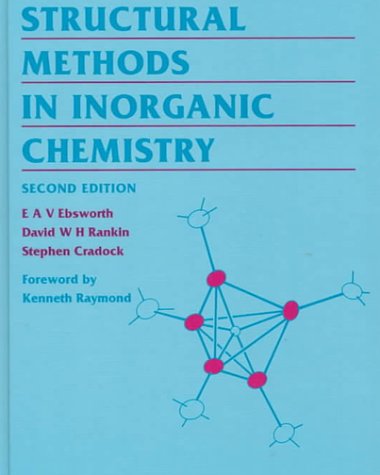
Structural Methods in Inorganic Chemistry, Second Edition,Used
Sold by Ergodebooks, an authorized reseller.
Returns accepted within 30 days | support@ergodebooks.com
Shipping Information
- Free Standard Shipping — United States only
- Processing Time: 3–5 business days
- Estimated Delivery: 6–10 business days after dispatch
- Double-boxed, fully insured & discreetly packaged
- Tracking number sent via email once dispatched
Returns & Refund
Returns accepted within 30 days of delivery.
Damaged or Defective Item
Free return shipping + replacement or full refund
Wrong Item Received
Free return shipping + replacement or full refund
Change of Mind
Return shipping at customer's expense · 25% restocking fee applies
Payment Option

Structural Methods in Inorganic Chemistry, Second Edition is the completely revised and updated version of the successful, first edition text. It is designed to help readers interpret experimental data, understand the material published in modern journals of inorganic chemistry, and make decisions about what techniques will be the most useful in solving particular structural problems. Topics addressed include time scales of physical methods, relative advantages and disadvantages of those methods, nuclear magnetic resonance spectroscopy, and rotational and vibrational spectroscopy. The book also utilizes wellchosen research examples to illustrate the use of the techniques in real research publications. Structural Methods in Inorganic Chemistry makes a strong connection between theoretical topics and the real world of practicing chemists.What's new in the second edition?The Second Edition of Structural Methods in Inorganic Chemistry has been completely revised and updated, featuring new developments in nuclear magnetic resonance and electronic spectroscopy; the addition of more recent case histories; and many new problems throughout the text. Some of the problems are numerical, others involve interpretations of data or logical analysis, while others are meant to start discussions. Answers are given to odd numbered problems, although sets of solutions and comments on the even numbered problems are available to course instructors.A series of worked examples are also included in the text to supplement the case histories. They are intended to illustrate the applications of the particular techniques to real chemical problems, and most of them are drawn from recent chemical literature.
⚠️ WARNING (California Proposition 65):
This product may contain chemicals known to the State of California to cause cancer, birth defects, or other reproductive harm.
For more information, please visit www.P65Warnings.ca.gov.