

Title
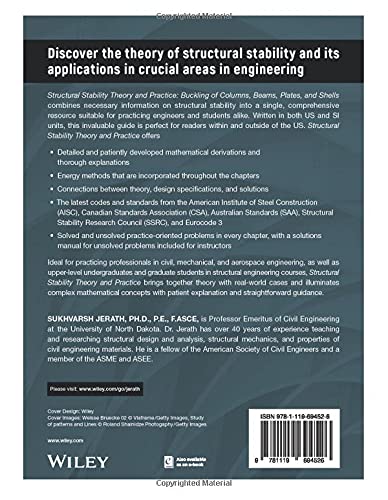
Structural Stability Theory and Practice: Buckling of Columns, Beams, Plates, and Shells,Used
Sold by Ergodebooks, an authorized reseller.
Returns accepted within 30 days | support@ergodebooks.com
Shipping Information
- Free Standard Shipping — United States only
- Processing Time: 3–5 business days
- Estimated Delivery: 6–10 business days after dispatch
- Double-boxed, fully insured & discreetly packaged
- Tracking number sent via email once dispatched
Returns & Refund
Returns accepted within 30 days of delivery.
Damaged or Defective Item
Free return shipping + replacement or full refund
Wrong Item Received
Free return shipping + replacement or full refund
Change of Mind
Return shipping at customer's expense · 25% restocking fee applies
Payment Option

Discover the theory of structural stability and its applications in crucial areas in engineeringStructural Stability Theory and Practice: Buckling of Columns, Beams, Plates, and Shells combines necessary information on structural stability into a single, comprehensive resource suitable for practicing engineers and students alike. Written in both US and SI units, this invaluable guide is perfect for readers within and outside of the US. Structural Stability Theory and Practice: Buckling of Columns, Beams, Plates, and Shell offers: Detailed and patiently developed mathematical derivations and thorough explanations Energy methods that are incorporated throughout the chapters Connections between theory, design specifications and solutions The latest codes and standards from the American Institute of Steel Construction (AISC), Canadian Standards Association (CSA), Australian Standards (SAA), Structural Stability Research Council (SSRC), and Eurocode 3 Solved and unsolved practiceoriented problems in every chapter, with a solutions manual for unsolved problems included for instructorsIdeal for practicing professionals in civil, mechanical, and aerospace engineering, as well as upperlevel undergraduates and graduate students in structural engineering courses, Structural Stability Theory and Practice: Buckling of Columns, Beams, Plates, and Shell provides readers with detailed mathematical derivations along with thorough explanations and practical examples.
⚠️ WARNING (California Proposition 65):
This product may contain chemicals known to the State of California to cause cancer, birth defects, or other reproductive harm.
For more information, please visit www.P65Warnings.ca.gov.
- Q: How many pages does this book have? A: This book has six hundred seventy-two pages. It provides extensive coverage of structural stability concepts and applications.
- Q: What are the dimensions of this book? A: The book measures seven point six inches in length, one point two inches in width, and nine point four one inches in height. These dimensions make it a manageable size for both reading and referencing.
- Q: What type of binding does this book have? A: This book features hardcover binding. This type of binding is durable and offers a professional look for library and personal collections.
- Q: What is the main focus of this book? A: This book focuses on structural stability theory and practice, specifically the buckling of columns, beams, plates, and shells. It is suited for engineering students and professionals.
- Q: Who is the author of this book? A: The author of this book is Sukhvarsh Jerath. He brings expertise in structural engineering to the material presented.
- Q: What engineering fields is this book suitable for? A: This book is suitable for civil, mechanical, and aerospace engineering fields. It serves as a valuable resource for both students and practicing professionals.
- Q: Are there practice problems included in this book? A: Yes, each chapter contains solved and unsolved practice-oriented problems. Instructors can access a solutions manual for the unsolved problems.
- Q: Does this book cover international standards? A: Yes, it includes the latest codes and standards from organizations like AISC, CSA, SAA, SSRC, and Eurocode 3. This makes it relevant for global audiences.
- Q: Is this book suitable for beginners in structural engineering? A: Yes, it is suitable for upper-level undergraduates, making it accessible for beginners in structural engineering courses.
- Q: What methods are emphasized in this book? A: The book emphasizes energy methods along with detailed mathematical derivations. This approach aids in understanding complex structural concepts.
- Q: How can I keep this book in good condition? A: To keep this book in good condition, store it upright on a shelf away from direct sunlight. Avoid exposing it to moisture to prevent damage.
- Q: Is this book safe for students? A: Yes, this book is safe for students. It provides educational content that is relevant and beneficial for their studies in engineering.
- Q: What if I receive a damaged copy of this book? A: If you receive a damaged copy, contact the seller for a return or exchange. Most sellers have customer service policies in place for such issues.
- Q: Can I use this book for self-study? A: Yes, this book is ideal for self-study. It contains comprehensive explanations and practice problems that facilitate independent learning.
- Q: Is this book updated with the latest engineering practices? A: Yes, it incorporates the latest codes and standards, ensuring that the content reflects current engineering practices.
- Q: What types of problems can I find in this book? A: You will find a variety of solved and unsolved practice-oriented problems that cover theoretical and practical aspects of structural stability.