
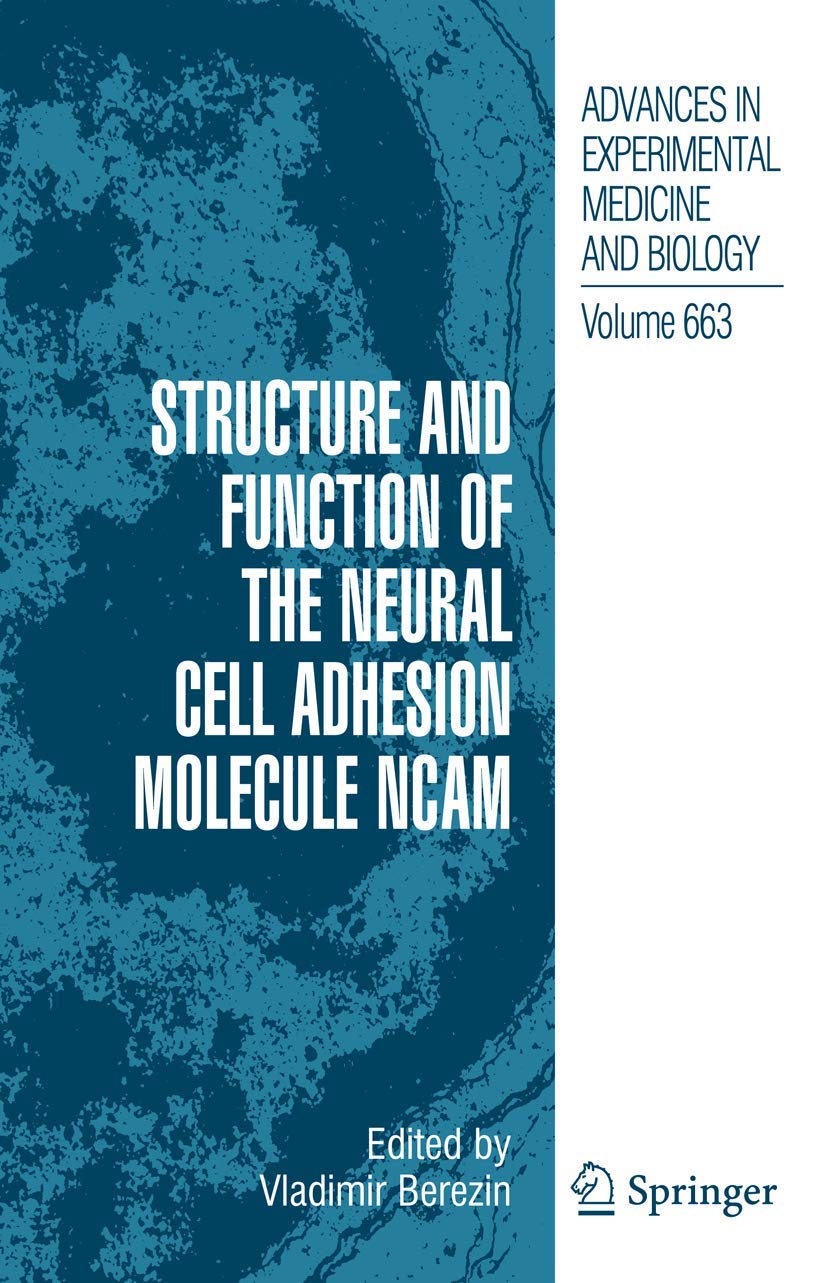
Title
Structure And Function Of The Neural Cell Adhesion Molecule Ncam (Advances In Experimental Medicine And Biology, 663)
Sold by Ergodebooks, an authorized reseller.
Returns accepted within 30 days | support@ergodebooks.com
Shipping Information
- Free Standard Shipping — United States only
- Processing Time: 3–5 business days
- Estimated Delivery: 6–10 business days after dispatch
- Double-boxed, fully insured & discreetly packaged
- Tracking number sent via email once dispatched
Returns & Refund
Returns accepted within 30 days of delivery.
Damaged or Defective Item
Free return shipping + replacement or full refund
Wrong Item Received
Free return shipping + replacement or full refund
Change of Mind
Return shipping at customer's expense · 25% restocking fee applies
Payment Option

Dr. Elisabeth Bock (Photo Keenpress) This Book Contains Review Articles That Produce A Snapshot Of Recent Developments In The Field Of The Neural Cell Adhesion Molecule Ncam. The Chapters Are Grouped Into Sections Reflecting Various Aspects Of Ncam Structure And Function. The Themes Cover The Structural Basis Of Cell Adhesion Mediated By Ncam And Ncam Interaction Partners, Ncammediated Signaling Determinants Of Ncam Function Under Physiological Conditions And In Disease, And The Therapeutic Potential Of Ncam Mimetics. Section 1, Structure And Ligands Of Ncam, Introduces The Reader To The Str Tural Basis Of Ncammediated Cell Adhesion, Discussing The Current Knowledge Of Extracellular And Intracellular Ncam Ligands And The Structural Basis Of Ncam Int Actions With The Fibroblast Growth Factor (Fgf) Receptor. Section 2, Ncam And Polysialic Acid, Focuses On Ncam Polysialylation, Discussing The Structural And Functional Aspects Of The Most Important Posttranslational Modifications Of Ncam By The Addition Of A Long Linear Homopolymer Of Sialic Acid To The Fifth Iglike Ncam Module. Section 3, Ncammediated Signal Transduction, Is Devoted To Signal V Bookid 187530_Chapid Fm1_Proof# 1 01/03/2011 Bookid 187530_Chapid Fm1_Proof# 1 01/03/2011 Vi Preface Transduction Mechanisms Associated With Ncammediated Adhesion, With A Focus On Signaling Pathways Involved In Ncammediated Neurite Outgrowth, The Role Of Growthassociated Proteins, Signaling Through Lipid Microdomains, And Signaling Crosstalk With The Epidermal Growth Factor (Egf) Receptor. Section 4, Ncam Metabolism, Focuses On Current Knowledge About Ncam Biosynthesis And The G Eration And Role Of Soluble Ncam.
⚠️ WARNING (California Proposition 65):
This product may contain chemicals known to the State of California to cause cancer, birth defects, or other reproductive harm.
For more information, please visit www.P65Warnings.ca.gov.
- Q: What is the page count of this book? A: This book contains four hundred fifty pages. It offers a comprehensive overview of the neural cell adhesion molecule NCAM.
- Q: What is the binding type of this book? A: This book is a hardcover edition. The hardcover binding provides durability and protection for the pages inside.
- Q: Who is the author of this book? A: The author of this book is Vladimir Berezin. He has expertise in the field of neuroscience and cell biology.
- Q: How is this book structured? A: This book is divided into four sections. Each section covers different aspects of NCAM, including structure, signaling, and metabolism.
- Q: Is this book suitable for beginners? A: Yes, this book is suitable for readers with a basic understanding of neuroscience. It provides foundational knowledge along with advanced topics.
- Q: What topics are covered in this book? A: This book covers NCAM structure, signaling mechanisms, polysialylation, and therapeutic potentials. It offers a detailed exploration of how NCAM functions.
- Q: How should I care for this book? A: To care for this book, keep it in a dry place and avoid direct sunlight. This helps preserve the hardcover and pages.
- Q: Can this book be used as a reference? A: Yes, this book can be used as a reference. It includes review articles that summarize recent developments in NCAM research.
- Q: What is the recommended storage for this book? A: Store this book upright on a shelf in a cool, dry environment. This prevents warping and keeps the pages in good condition.
- Q: Is there a glossary in this book? A: Yes, this book includes a glossary of terms. It helps readers understand complex terminology related to NCAM.
- Q: What is the focus of Section 1 in this book? A: Section 1 focuses on the structure and ligands of NCAM. It discusses the mechanisms of NCAM-mediated cell adhesion.
- Q: Are there illustrations in this book? A: Yes, this book contains illustrations. They help clarify complex concepts and enhance the reader's understanding of NCAM.
- Q: What is the significance of NCAM? A: NCAM plays a crucial role in neuronal development and cell adhesion. Its study is vital for understanding neurological disorders.
- Q: Does this book discuss therapeutic applications? A: Yes, it discusses the therapeutic potential of NCAM mimetics. The book explores how these may benefit various diseases.
- Q: Is there a preface in this book? A: Yes, there is a preface in this book. It provides insight into the motivations behind the research presented.
- Q: What types of readers will benefit from this book? A: Researchers, students, and professionals in neuroscience will benefit from this book. It offers valuable information for all levels.