If you have any questions, you are always welcome to contact us. We'll get back to you as soon as possible, withing 24 hours on weekdays.
Customer service
All questions about your order, return and delivery must be sent to our customer service team by e-mail at yourstore@yourdomain.com
Sale & Press
If you are interested in selling our products, need more information about our brand or wish to make a collaboration, please contact us at press@yourdomain.com
Help
If you have any questions, you are always welcome to contact us. We'll get back to you as soon as possible, withing 24 hours on weekdays.
Customer service
All questions about your order, return and delivery must be sent to our customer service team by e-mail at yourstore@yourdomain.com
Sale & Press
If you are interested in selling our products, need more information about our brand or wish to make a collaboration, please contact us at press@yourdomain.com
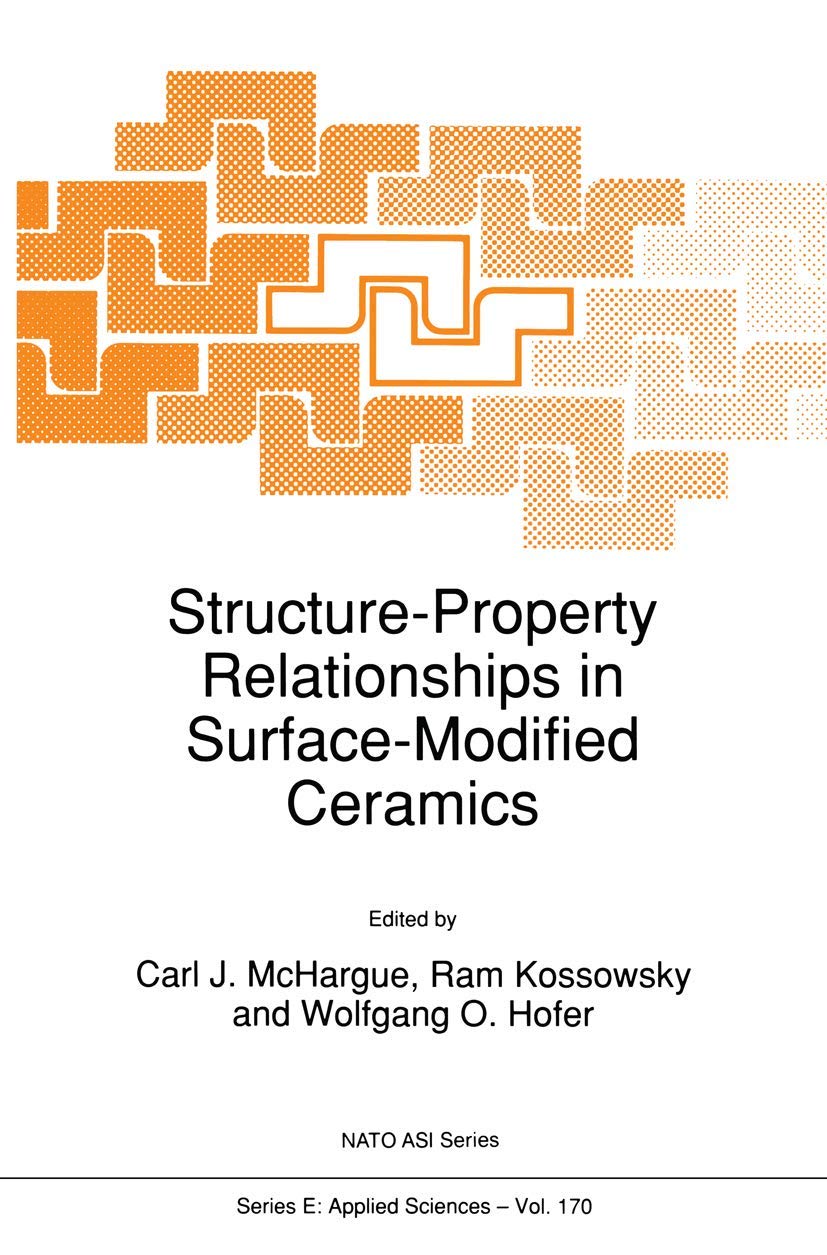
The use of ion beams for the modification of the structure and properties of the nearsurface region of ceramics began in earnest in the early 19805. Since the mechanical properties of such materials are dominated by surface flaws and the surface stress state, the use of surface modification tech niques would appear to be an obvious application. As is often the case in research and development, most of the initial studies can be characterized as cataloging the response of various ceramic materials to a range of ion beam treatments. The systematic study of material and ion beam parameters is well underway and we are now designing experiments to provide specific information about the processing parameter structureproperty rela tionships. This NATOAdvanced Study Institute was convened in order to assess our current state of knowledge in this field, to identify opportunities and needs for further research, and to identify the potential of such processes for technological application. It became apparent that this class of inorganic compounds, loosely termed ceramics, presents many challenges to the understanding of ionsolid inter actions, the relationships among ionbeam parameters, materials parameters, and the resulting structures, as well as relationships between structure and properties. In many instances, this understanding will represent a major extension of that learned from the study of metals and semiconductors.
⚠️ WARNING (California Proposition 65):
This product may contain chemicals known to the State of California to cause cancer,
birth defects, or other reproductive harm.
For MAP (Minimum Advertised Price) violations and Intellectual Property (IP) or Trademark concerns, please contact:
support@ergodebooks.com
⚠️ California Proposition 65 Warning: Some products sold on this website may expose you to chemicals known to the State of California to cause cancer, birth defects, or other reproductive harm. For more information, visit www.P65Warnings.ca.gov.