
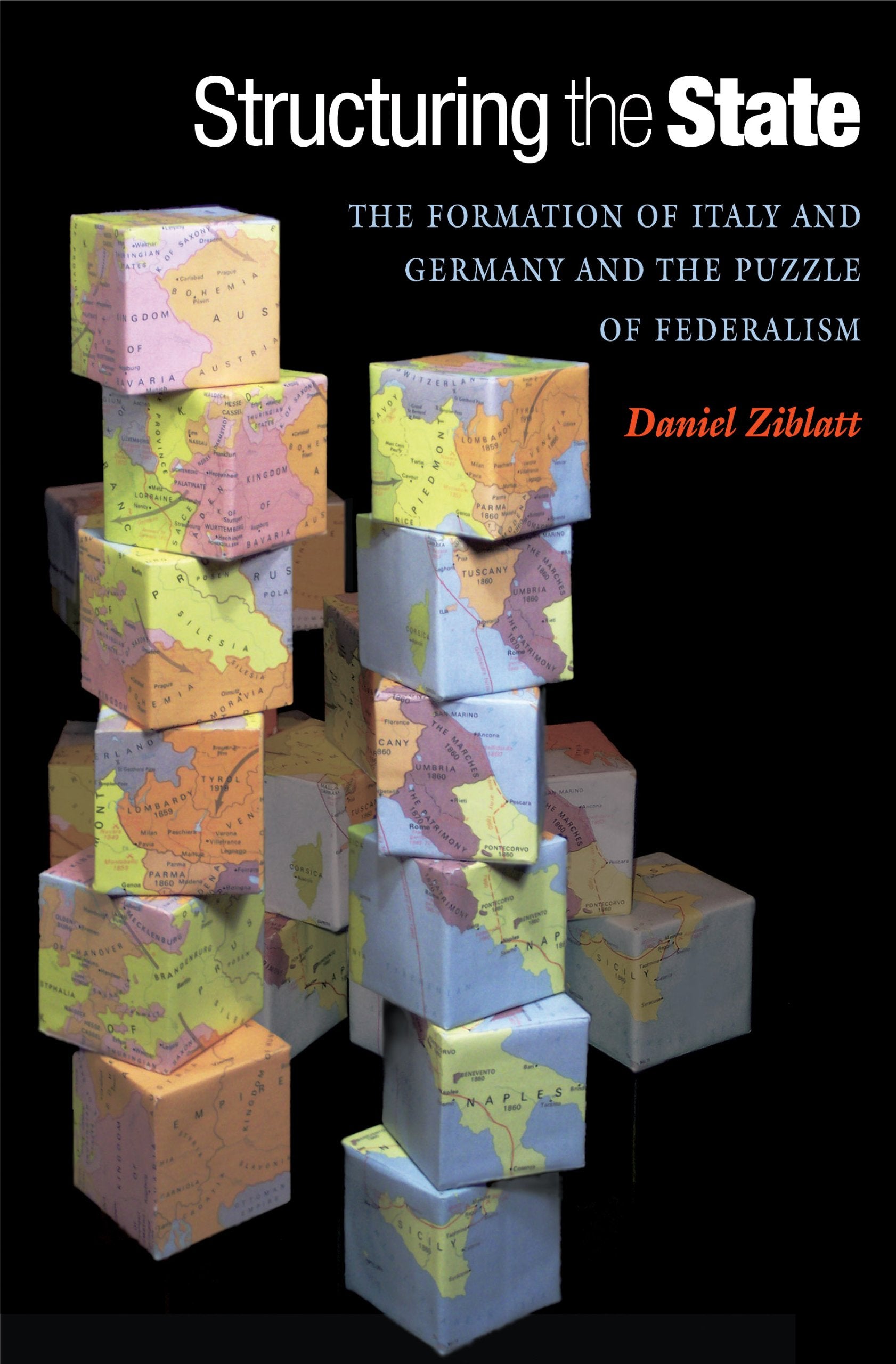
Title
Structuring the State: The Formation of Italy and Germany and the Puzzle of Federalism,New
Sold by Ergodebooks, an authorized reseller.
Returns accepted within 30 days | support@ergodebooks.com
Shipping Information
- Free Standard Shipping — United States only
- Processing Time: 3–5 business days
- Estimated Delivery: 6–10 business days after dispatch
- Double-boxed, fully insured & discreetly packaged
- Tracking number sent via email once dispatched
Returns & Refund
Returns accepted within 30 days of delivery.
Damaged or Defective Item
Free return shipping + replacement or full refund
Wrong Item Received
Free return shipping + replacement or full refund
Change of Mind
Return shipping at customer's expense · 25% restocking fee applies
Payment Option

Germany's and Italy's belated national unifications continue to loom large in contemporary debates. Often regarded as Europe's paradigmatic instances of failed modernization, the two countries form the basis of many of our most prized theories of social science. Structuring the State undertakes one of the first systematic comparisons of the two cases, putting the origins of these nationstates and the nature of European political development in new light.Daniel Ziblatt begins his analysis with a striking puzzle: Upon national unification, why was Germany formed as a federal nationstate and Italy as a unitary nationstate? He traces the diplomatic maneuverings and high political drama of national unification in nineteenthcentury Germany and Italy to refute the widely accepted notion that the two states' structure stemmed exclusively from Machiavellian farsightedness on the part of militarily powerful political leaders. Instead, he demonstrates that Germany's and Italy's 'founding fathers' were constrained by two very different preunification patterns of institutional development. In Germany, a legacy of welldeveloped subnational institutions provided the key building blocks of federalism. In Italy, these institutions' absence doomed federalism. This crucial difference in the organization of local power still shapes debates about federalism in Italy and Germany today. By exposing the source of this enduring contrast, Structuring the State offers a broader theory of federalism's origins that will interest scholars and students of comparative politics, statebuilding, international relations, and European political history.
⚠️ WARNING (California Proposition 65):
This product may contain chemicals known to the State of California to cause cancer, birth defects, or other reproductive harm.
For more information, please visit www.P65Warnings.ca.gov.