
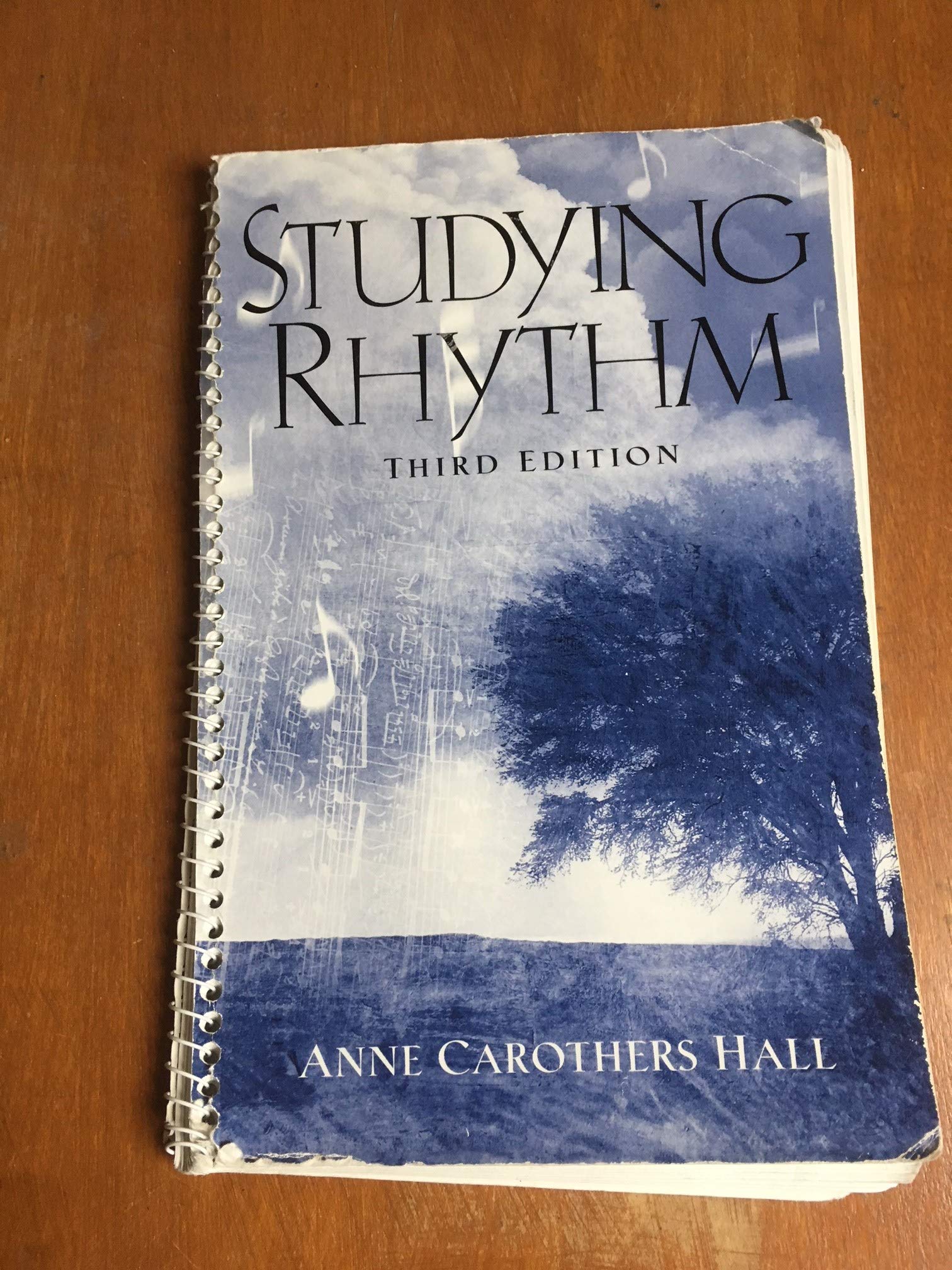
Title


Studying Rhythm (3rd Edition),New
Sold by Ergodebooks, an authorized reseller.
Returns accepted within 30 days | support@ergodebooks.com
Shipping Information
- Free Standard Shipping — United States only
- Processing Time: 3–5 business days
- Estimated Delivery: 6–10 business days after dispatch
- Double-boxed, fully insured & discreetly packaged
- Tracking number sent via email once dispatched
Returns & Refund
Returns accepted within 30 days of delivery.
Damaged or Defective Item
Free return shipping + replacement or full refund
Wrong Item Received
Free return shipping + replacement or full refund
Change of Mind
Return shipping at customer's expense · 25% restocking fee applies
Payment Option

Featuring over 300 metrical rhythmic studies in simple musical forms carefully graded, with short preliminary exercises this volume introduces readers to the basic processes and complexities of musical rhythm and helps them develop the ability to perform all kinds of rhythmic patterns accurately at sight. Suitable not only for reading, but for dictation, improvisation, and composition and for different methods the collection contains one and twopart rhythmic studies mostly 12 to 16 measures long that are intended to be sung, spoken, and tapped or clapped. The volume examines the full range of meter studies, rests and syncopation, triplets, beats, small subdivisions, changing simple and compound meter, notes in two and three beats, four against three, four notes in three beats; three notes in four beats, quintuplets and septuplets, meters with unequal beats, changing meters with unequal beats, crossrhythms and tempo modulation. For those interested in the rhythmic patterns most frequently encountered in Western art music.
⚠️ WARNING (California Proposition 65):
This product may contain chemicals known to the State of California to cause cancer, birth defects, or other reproductive harm.
For more information, please visit www.P65Warnings.ca.gov.
- Q: What is the focus of 'Studying Rhythm (3rd Edition)?' A: 'Studying Rhythm (3rd Edition)' focuses on developing the ability to perform various rhythmic patterns accurately. It includes over 300 metrical rhythmic studies and covers a wide range of topics such as meter studies, syncopation, and cross-rhythms.
- Q: Who is the author of 'Studying Rhythm (3rd Edition)?' A: The author of 'Studying Rhythm (3rd Edition)' is Hall Professor Emeritus, Anne Carothers.
- Q: How many pages does 'Studying Rhythm (3rd Edition)' have? A: 'Studying Rhythm (3rd Edition)' contains 176 pages, providing ample material for studying musical rhythm.
- Q: Is 'Studying Rhythm (3rd Edition)' suitable for beginners? A: Yes, 'Studying Rhythm (3rd Edition)' is suitable for beginners as it includes carefully graded studies and short preliminary exercises to help readers understand basic processes of musical rhythm.
- Q: What is the binding type of 'Studying Rhythm (3rd Edition)?' A: 'Studying Rhythm (3rd Edition)' is bound in a spiral format, making it easy to use for practice and study.
- Q: When was 'Studying Rhythm (3rd Edition)' published? A: 'Studying Rhythm (3rd Edition)' was published on August 28, 2004.
- Q: What methods can be used with 'Studying Rhythm (3rd Edition)?' A: 'Studying Rhythm (3rd Edition)' can be used for various methods including reading, dictation, improvisation, and composition, making it versatile for different learning approaches.
- Q: Does 'Studying Rhythm (3rd Edition)' cover advanced rhythmic concepts? A: Yes, 'Studying Rhythm (3rd Edition)' covers advanced rhythmic concepts such as changing meters, quintuplets, septuplets, and cross-rhythms, suitable for those interested in Western art music.
- Q: Are there exercises for different rhythmic patterns in this book? A: 'Studying Rhythm (3rd Edition)' includes a collection of one- and two-part rhythmic studies that can be sung, spoken, tapped, or clapped, providing diverse exercises for various rhythmic patterns.
- Q: What is the condition of 'Studying Rhythm (3rd Edition)'? A: 'Studying Rhythm (3rd Edition)' is available in new condition, ensuring a quality product for readers.