
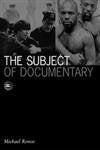
Title
Subject Of Documentary (Volume 16) (Visible Evidence),New
Sold by Ergodebooks, an authorized reseller.
Returns accepted within 30 days | support@ergodebooks.com
Shipping Information
- Free Standard Shipping — United States only
- Processing Time: 3–5 business days
- Estimated Delivery: 6–10 business days after dispatch
- Double-boxed, fully insured & discreetly packaged
- Tracking number sent via email once dispatched
Returns & Refund
Returns accepted within 30 days of delivery.
Damaged or Defective Item
Free return shipping + replacement or full refund
Wrong Item Received
Free return shipping + replacement or full refund
Change of Mind
Return shipping at customer's expense · 25% restocking fee applies
Payment Option

The Documentary, A Genre As Old As Cinema Itself, Has Traditionally Aspired To Objectivity. Whether Making Ethnographic, Propagandistic, Or Educational Films, Documentarians Have Pointed The Camera Outward, Drawing As Little Attention To Themselves As Possible. In Recent Decades, However, A New Kind Of Documentary Has Emerged In Which The Filmmaker Has Become The Subject Of The Work. Whether Chronicling Family History, Sexual Identity, Or A Personal Or Social World, This New Generation Of Nonfiction Filmmakers Has Defiantly Embraced Autobiography. In The Subject Of Documentary, Michael Renov Focuses On How Documentary Filmmaking Has Become An Important Means For Both Examining And Constructing Selfhood. By Looking At Key Figures In Documentary Filmmaking As Well As Noncanonical Video Art And Avantgarde Artists, Renov Broadens The Definition Of What Counts As Documentary, And Explores The Intersection Of The Personal And Political, Considering How Memory Can Create A Way Into Asking Troubling Questions About Identity, Oppression, And Resiliency. Offering Historical Context For The Explosion Of Personal Nonfiction Filmmaking In The 1980S And 1990S, Renov Analyzes Films In Which The Subjectivity Of The Filmmaker Is Expressly Defined In Relation To Political Struggle Or Historical Trauma, From Haskell Wexler'S Medium Cool To Jonas Mekas'S Lost, Lost, Lost. And, Looking Beyond The Traditional Documentary, Renov Contemplates Such Nontraditional Modes Of Autobiographical Practice As The Essay Film, The Video Confession, And The Personal Web Page.Unique In Its Attention To Diverse Expressions Of Personal Nonfiction Filmmaking, The Subject Of Documentary Forges A New Understanding Of The Heightened Role And Function Of Subjectivity In Contemporary Documentary Practice.Michael Renov Is Professor Of Critical Studies At The Usc School Of Cinematelevision. He Is The Editor Of Theorizing Documentary And The Coeditor Of Resolutions: Contemporary Video Practices (Minnesota, 1996) And Collecting Visible Evidence (Minnesota, 1999).
⚠️ WARNING (California Proposition 65):
This product may contain chemicals known to the State of California to cause cancer, birth defects, or other reproductive harm.
For more information, please visit www.P65Warnings.ca.gov.
- Q: How many pages does the book have? A: This book has three hundred twelve pages. It provides an in-depth exploration of the documentary genre and its evolution.
- Q: What is the binding type of this book? A: The book is paperback bound. This makes it lightweight and flexible for easy handling.
- Q: What are the dimensions of the book? A: The book measures seven point zero one inches in length, one point three inches in width, and ten inches in height. These dimensions make it a standard size for easy reading.
- Q: Who is the author of this book? A: The author is Michael Renov. He is a professor of critical studies at the USC School of Cinema-Television.
- Q: What category does this book belong to? A: This book is categorized under Performing Arts. It focuses on documentary filmmaking and its personal aspects.
- Q: Is this book suitable for academic use? A: Yes, this book is suitable for academic use. It provides critical insights into documentary filmmaking, making it valuable for students and researchers.
- Q: How can I use this book for research? A: You can use this book as a source for understanding the evolution of documentary filmmaking. It contains analyses and historical contexts relevant to the subject.
- Q: Is this book appropriate for filmmakers? A: Yes, it is appropriate for filmmakers. The book discusses various documentary practices and offers insights that can enhance their work.
- Q: Can this book be used for personal development? A: Yes, it can be used for personal development. It explores themes of identity and selfhood, which can resonate with readers on a personal level.
- Q: How should I store this book? A: Store this book in a cool, dry place to maintain its condition. Keeping it away from direct sunlight will also help preserve the cover and pages.
- Q: Is this book safe to handle for children? A: Yes, this book is safe to handle for children. However, it is recommended for older readers due to its complex themes.
- Q: What if the book arrives damaged? A: If the book arrives damaged, you should contact the seller for a return or exchange. Most sellers have policies in place for such issues.
- Q: Can I return this book if I'm not satisfied? A: Yes, you can typically return the book if you are not satisfied. Check the seller's return policy for specific details.
- Q: Is this book part of a series? A: Yes, this book is part of the Visible Evidence series. It contributes to ongoing discussions in the field of documentary studies.
- Q: Does this book contain illustrations? A: No, this book does not specifically mention illustrations. It focuses on text-based analysis of documentary filmmaking.
- Q: What is the main theme of this book? A: The main theme is the intersection of personal narrative and documentary filmmaking. It examines how filmmakers use personal experiences to convey broader social issues.