
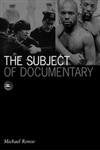
Title
Subject Of Documentary (Volume 16) (Visible Evidence),Used
Sold by Ergodebooks, an authorized reseller.
Returns accepted within 30 days | support@ergodebooks.com
Shipping Information
- Free Standard Shipping — United States only
- Processing Time: 3–5 business days
- Estimated Delivery: 6–10 business days after dispatch
- Double-boxed, fully insured & discreetly packaged
- Tracking number sent via email once dispatched
Returns & Refund
Returns accepted within 30 days of delivery.
Damaged or Defective Item
Free return shipping + replacement or full refund
Wrong Item Received
Free return shipping + replacement or full refund
Change of Mind
Return shipping at customer's expense · 25% restocking fee applies
Payment Option

The documentary, a genre as old as cinema itself, has traditionally aspired to objectivity. Whether making ethnographic, propagandistic, or educational films, documentarians have pointed the camera outward, drawing as little attention to themselves as possible. In recent decades, however, a new kind of documentary has emerged in which the filmmaker has become the subject of the work. Whether chronicling family history, sexual identity, or a personal or social world, this new generation of nonfiction filmmakers has defiantly embraced autobiography. In The Subject of Documentary, Michael Renov focuses on how documentary filmmaking has become an important means for both examining and constructing selfhood. By looking at key figures in documentary filmmaking as well as noncanonical video art and avantgarde artists, Renov broadens the definition of what counts as documentary, and explores the intersection of the personal and political, considering how memory can create a way into asking troubling questions about identity, oppression, and resiliency. Offering historical context for the explosion of personal nonfiction filmmaking in the 1980s and 1990s, Renov analyzes films in which the subjectivity of the filmmaker is expressly defined in relation to political struggle or historical trauma, from Haskell Wexler's Medium Cool to Jonas Mekas's Lost, Lost, Lost. And, looking beyond the traditional documentary, Renov contemplates such nontraditional modes of autobiographical practice as the essay film, the video confession, and the personal Web page.Unique in its attention to diverse expressions of personal nonfiction filmmaking, The Subject of Documentary forges a new understanding of the heightened role and function of subjectivity in contemporary documentary practice.Michael Renov is professor of critical studies at the USC School of CinemaTelevision. He is the editor of Theorizing Documentary and the coeditor of Resolutions: Contemporary Video Practices (Minnesota, 1996) and Collecting Visible Evidence (Minnesota, 1999).
⚠️ WARNING (California Proposition 65):
This product may contain chemicals known to the State of California to cause cancer, birth defects, or other reproductive harm.
For more information, please visit www.P65Warnings.ca.gov.
- Q: What is 'The Subject of Documentary' about? A: The Subject of Documentary explores the evolution of documentary filmmaking, focusing on how filmmakers have increasingly embraced autobiography and personal narratives in their works.
- Q: Who is the author of this book? A: The book is authored by Michael Renov, a professor of critical studies at the USC School of Cinema-Television.
- Q: What is the publication date of this book? A: The book was published on June 16, 2004.
- Q: What is the format of this book? A: This book is available in paperback format.
- Q: How many pages does 'The Subject of Documentary' have? A: The book contains 312 pages.
- Q: Is this book suitable for academic purposes? A: Yes, this book provides historical context and critical analysis, making it suitable for academic study in film and media.
- Q: What are some key themes discussed in the book? A: Key themes include the intersection of personal and political narratives, identity, memory, and the role of subjectivity in documentary filmmaking.
- Q: Is this book part of a series? A: Yes, it is part of the Visible Evidence series, which focuses on documentary studies.
- Q: What condition is this book in? A: This book is listed as 'New,' indicating it is in excellent condition.
- Q: Does the book include examples of specific films? A: Yes, the book analyzes various films, including Haskell Wexler's Medium Cool and Jonas Mekas's Lost, Lost, Lost, among others.