If you have any questions, you are always welcome to contact us. We'll get back to you as soon as possible, withing 24 hours on weekdays.
Customer service
All questions about your order, return and delivery must be sent to our customer service team by e-mail at yourstore@yourdomain.com
Sale & Press
If you are interested in selling our products, need more information about our brand or wish to make a collaboration, please contact us at press@yourdomain.com
Help
If you have any questions, you are always welcome to contact us. We'll get back to you as soon as possible, withing 24 hours on weekdays.
Customer service
All questions about your order, return and delivery must be sent to our customer service team by e-mail at yourstore@yourdomain.com
Sale & Press
If you are interested in selling our products, need more information about our brand or wish to make a collaboration, please contact us at press@yourdomain.com
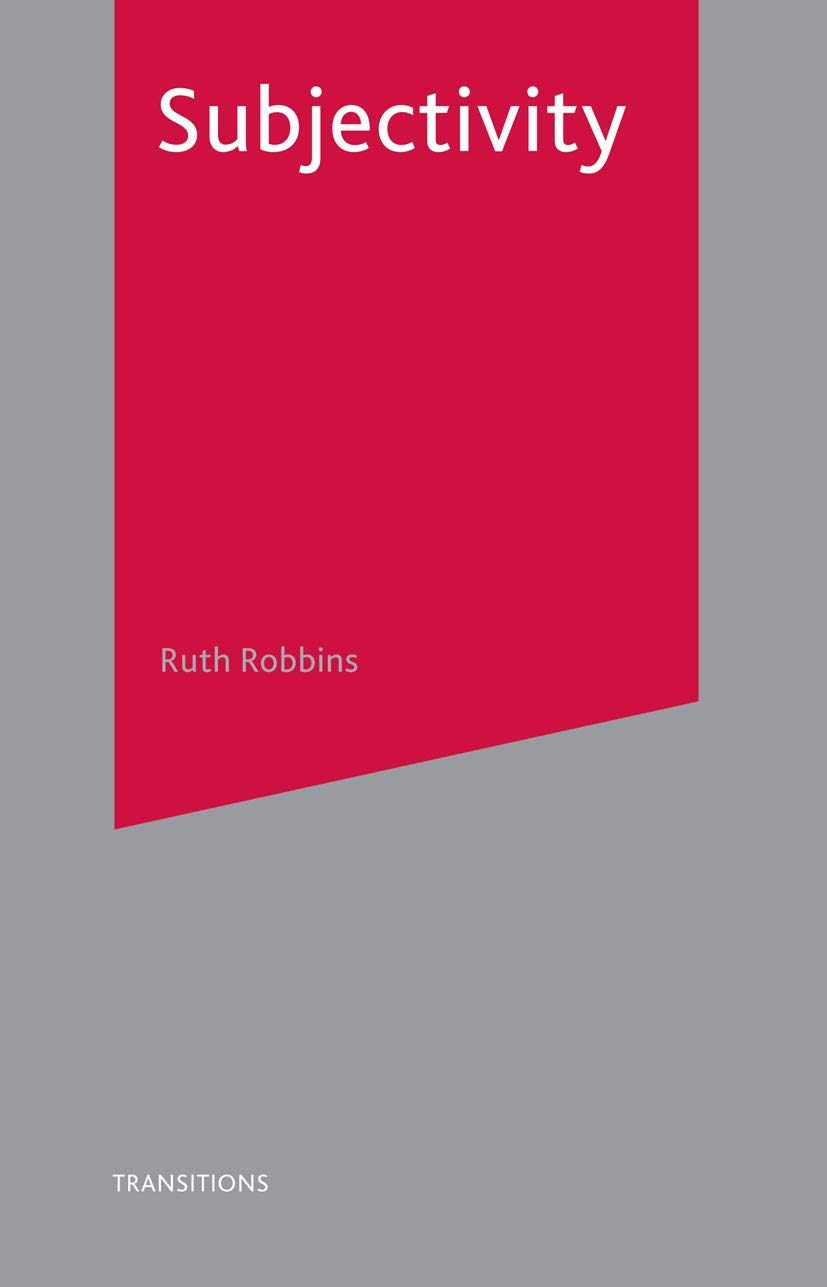
Who do you think you are? In Subjectivity, Ruth Robbins explores some of the responses to this fundamental question. In readings of a number of autobiographical texts from the last three centuries, Robbins offers an approachable account of formations of the self which demonstrates that both psychology and material conditions often in tension with one another are the building blocks of modern notions of selfhood. Key texts studied include: William Wordsworth's Prelude Thomas De Quincey's Confessions of an English Opium Eater James Joyce's A Portrait of the Artist as a Young Man Oscar Wilde's De Profundis Jung Chang's Wild SwansRobbins also argues that our subjectivity, far from being the secure possession of the individual, is potentially fragile and contingent. She shows that the versions of subjectivity authorized by the dominant culture are full of gaps and blindspots that undo any notion of universal human nature: subjectivity is culturally and historically specific we are, in part, what the culture in which we live permits us to be.Concise and easytofollow, this introduction to the concept of subjectivity, and the theories surrounding it, shows that, in spite of the insecurity of selfhood, there is still much to be gained from the textual encounter with other selves. It is essential reading for all those studying 'autobiography' or 'autobiographical writing'.
⚠️ WARNING (California Proposition 65):
This product may contain chemicals known to the State of California to cause cancer,
birth defects, or other reproductive harm.
For MAP (Minimum Advertised Price) violations and Intellectual Property (IP) or Trademark concerns, please contact:
support@ergodebooks.com
⚠️ California Proposition 65 Warning: Some products sold on this website may expose you to chemicals known to the State of California to cause cancer, birth defects, or other reproductive harm. For more information, visit www.P65Warnings.ca.gov.