
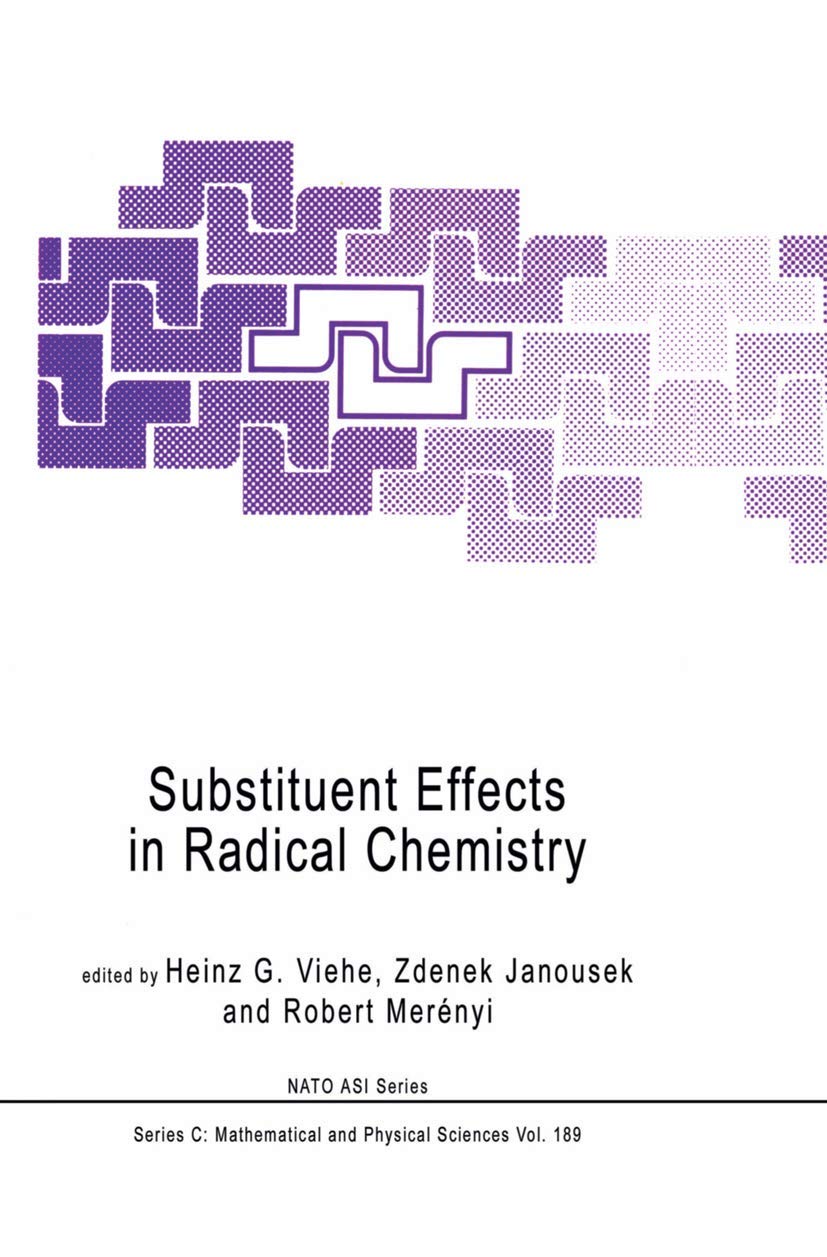
Title
Substituent Effects in Radical Chemistry (Nato Science Series C:, 189),New
Sold by Ergodebooks, an authorized reseller.
Returns accepted within 30 days | support@ergodebooks.com
Shipping Information
- Free Standard Shipping — United States only
- Processing Time: 3–5 business days
- Estimated Delivery: 6–10 business days after dispatch
- Double-boxed, fully insured & discreetly packaged
- Tracking number sent via email once dispatched
Returns & Refund
Returns accepted within 30 days of delivery.
Damaged or Defective Item
Free return shipping + replacement or full refund
Wrong Item Received
Free return shipping + replacement or full refund
Change of Mind
Return shipping at customer's expense · 25% restocking fee applies
Payment Option

Respectably old radical chemistry which plays a rna jor role in lifeprocesses, both desired (breathing, ... ) and nondesired (in flammatory diseases, ageing, ... ) has been gaining new youth in the past decade. Modern spectroscopy and other physical methods, recent advances in computational methods as well as impressive and mechanistically wellunderstood syntheses have led to a number of spectacular deve lopments in the field of radical chemistry. The impact of these achi evements will reach far beyond the field of organic chemistry, for example into biology and medicine. New facts and concepts in this rapidly expanding field deserved discussion among a number of leading experts present at the Workshop both for the information and constructive criticism. This happened during a particular brainstorming session and some of the impressions and reflections exchanged are recorded in the Epilogue. Indeed the topic chosen seems to be quintessential for the whole radical chemistry understanding and exploiting (single and multiple) substituent effects on radicals. We had the honour to organise this Workshop because some years ago, in collaboration with L. Stella, we became involved in radical stabi lising effects when both a donor and an acceptor (captor) groups are present on a Cradical. This leads to an enhanced stabilisation which we called the captodative effect and we have endeavoured the first extensi ve investigation of this effect on carbon centered radicals.
⚠️ WARNING (California Proposition 65):
This product may contain chemicals known to the State of California to cause cancer, birth defects, or other reproductive harm.
For more information, please visit www.P65Warnings.ca.gov.